Hey, Mom! The Explanation.

Here's the permanent dedicated link to my first Hey, Mom! post and the explanation of the feature it contains.

Also,

Showing posts with label outdoors and nature. Show all posts

Saturday, October 24, 2026

A Sense of Doubt blog post #4268 - TREES FOR BROKEN ATTENTION SPANS


A Sense of Doubt blog post #4268 - TREES FOR BROKEN ATTENTION SPANS

Just this share.

Thanks for tuning in.

also, but pay wall - 

Nature and Focus: How a Walk Outside Restores Your Attention

July 2, 2026


Nature and Focus: How a Walk Outside Restores Your Attention

Your brain has a focus battery, and by 2 p.m. it is usually dead. You read the same email three times. You open a tab and forget why. The fix most people reach for is more coffee, but a growing body of research says nature improves focus in a way caffeine cannot: it recharges the exact mental system that hard concentration drains.

The framework behind this is called Attention Restoration Theory. It explains why a short walk among trees can leave you sharper than an hour of pushing through fatigue at your desk.

This is not soft wellness advice. It is one of the most replicated findings in cognitive psychology.

Key Takeaways

  • Directed attention is the effortful focus you use for deep work, and it fatigues with use.
  • Attention restoration theory argues that natural settings let that system rest by pulling on a different, effortless kind of attention.
  • A landmark experiment found that a nature walk measurably improved attention and working memory, while an equivalent city walk did not.
  • You do not need a national park. A tree-lined street, a park bench, or even photos of nature can help.
  • Nature restores your attention system. A focus aid like caffeine plus L-theanine supports performance during the work block. They solve different problems.

What Directed Attention Fatigue Actually Is

Directed attention fatigue is the mental exhaustion that builds when you force your brain to concentrate on something that is not naturally interesting. It is why a long stretch of spreadsheets feels heavier than a long movie.

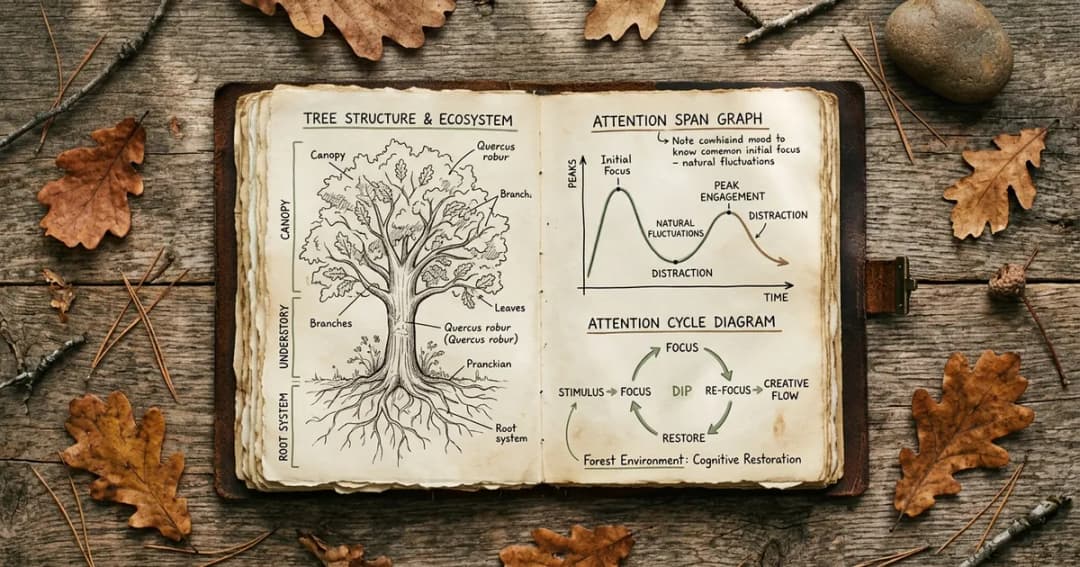
Psychologists Rachel and Stephen Kaplan built Attention Restoration Theory around two distinct kinds of attention. Attention Restoration Theory identifies two types of attention, directed (effortful, depletes) and involuntary (effortless, restores), and shows that nature environments preferentially engage involuntary attention.

Directed attention is the costly one. You burn it every time you block out distractions, resist your phone, or push through a boring task. The supply is finite, and once it runs low, your mistakes climb and your willpower drops.

Involuntary attention is the cheap one. A hawk overhead or light moving through leaves grabs your focus without any effort from you. That is the loophole nature exploits.

How Nature Improves Focus: The Science of Restoration

Nature improves focus because natural environments hold your attention gently, giving the effortful, directed-attention system time to refill. The Kaplans called this quality "soft fascination," and it is the heart of attention restoration theory.

A city street does the opposite. The urban environment, with its traffic, advertising, crowds, and constructed complexity, engages directed attention, which is why a walk through downtown can feel as draining as the work you were trying to escape.

The most cited evidence comes from Marc Berman and colleagues. In Berman, Jonides, and Kaplan (2008), Psychological Science, participants who walked in a natural setting performed better on a backward digit-span memory task than those who walked in an urban setting.

Here is the part that surprises people. Berman's team showed the effect did not even require going outside. In the same study, simply viewing pictures of nature also improved directed-attention performance, consistent with attention restoration theory.

So the question "does being outside improve concentration" has a clear answer: yes, and even a window view or a photo of a forest moves the needle.

The Four Ingredients of a Restorative Break

Not every break restores attention. Scrolling your phone on a park bench mostly trades one demand for another. Attention Restoration Theory describes four qualities that make an environment genuinely restorative.

QualityWhat it meansEveryday example
Being awayA break from your usual mental demandsLeaving your desk and the screen behind
Soft fascinationEffortless interest that does not tax focusWatching clouds, water, or wind in trees
ExtentA setting rich enough to feel immersiveA park or trail, not a single potted plant
CompatibilityA place that fits what you want to doA quiet green space for a reflective walk

Nature scores high on all four at once. That combination is why the peer-reviewed literature on PMC treats it as the classic restorative experience. A walk through a nature park or garden is perhaps the classic brief restorative experience, though longer experiences such as a vacation in nature can be even better.

Green Space Cognition: Why You Do Not Need Wilderness

Green space cognition is the study of how access to parks and trees shapes mental performance, and the practical takeaway is simple. You need a deliberate dose of nature most days, not a remote trail.

A tree-lined block on your lunch break counts. A few minutes by a window with a view of a park counts. Even nature sounds through headphones help when you are stuck inside.

The point of a nature walk for attention is not exercise. It is the soft fascination, the visual rest, the absence of demands competing for your directed focus. Walk slowly. Leave the podcast off.

How to Use Nature for Real Focus Gains

Treat restoration like a scheduled input, not an accident. A few rules make it work.

  1. Take the break before you are wrecked, not after. A short reset every 90 minutes beats one collapse at 4 p.m.
  2. Go green, not gray. A park beats a busy sidewalk. The setting matters as much as the movement.
  3. Drop the inputs. No email, no feeds. The goal is to rest directed attention, not redirect it.
  4. Keep it short and frequent. Even 10 to 20 minutes shifts attention scores, based on the experimental work above.

Nature handles recovery. Your work blocks handle output. Pairing restorative breaks with structured deep-work sessions is the closest thing to a sustainable attention system most people will find. It also explains why your best ideas tend to arrive mid-walk, when the brain's default mode network quietly takes over and connects loose threads.

Conclusion

The science here is unusually clean. Hard focus draws down a limited resource, directed attention, and natural settings refill it by engaging effortless involuntary attention instead. A short, screen-free walk in green space is not a luxury. It is maintenance for the part of your brain you rely on most.

You will not out-coffee directed attention fatigue. You can rest it, and the cheapest place to do that is outside, among trees, doing nothing in particular. Then you return to the work with a tank that is actually full.

Frequently Asked Questions

Does being outside improve concentration?

Yes. Controlled experiments show that time in natural settings improves performance on attention and working memory tasks, while equivalent time in urban environments does not produce the same gain. The leading explanation is attention restoration theory: nature engages effortless involuntary attention and lets your effortful, directed attention recover. Even brief exposure, including views or images of nature, has shown measurable effects in the research.

How long does a nature walk need to be to help focus?

Shorter than you think. The experimental work behind attention restoration theory found benefits from walks in the range of roughly 50 minutes, but later studies suggest even 10 to 20 minutes of green space can shift attention scores. Frequency matters as much as duration. A brief daily reset is more useful for sustained focus than one long walk a week.

What is directed attention fatigue?

Directed attention fatigue is the mental exhaustion that builds when you force your brain to concentrate on tasks that are not naturally engaging. It is the cognitive cost of blocking out distractions and pushing through boring work. As it accumulates, you make more errors, feel irritable, and lose self-control. Rest, sleep, and exposure to nature are the main ways to recover it.

Do I need real nature, or do photos and views work?

Real nature is the strongest dose, but it is not the only one. Research on attention restoration theory found that even viewing images of natural environments improved attention on simple cognitive tasks. A window with a view of trees, nature sounds, or a few minutes in a courtyard all help when you cannot get to a park. The effect scales with how immersive and demand-free the experience is.

Why does a walk in the city not work the same way?

City environments are full of stimuli that demand your directed attention: traffic, signage, crowds, and the need to stay alert. That keeps draining the same system you are trying to rest. Nature, by contrast, offers soft fascination that holds your attention without effort. This is the core distinction in attention restoration theory and why a green setting beats a gray one for restoration.

Can nature replace caffeine for focus?

No, because they do different jobs. Nature restores a depleted attention system during a break. Caffeine and similar focus aids support performance while you are actually working. Think of them as complementary levers rather than substitutes. The best results come from resting your attention regularly and supporting it during demanding work blocks, not from leaning on one alone.


+++++++++++++++++++++++++++++++++++++++++++++++++++++++++++++++++++++++
+++++++++++++++++++++++++++++++++++++++++++++++++++++++++++++++++++++++
+++++++++++++++++++++++++++++++++++++++++++++++++++++++++++++++++++++++

- Bloggery committed by chris tower - 2610.25 - 10:10

- Days ago: MOM = 4132 days ago & DAD = 786 days ago

- New note - On 1807.06, I ceased daily transmission of my Hey Mom feature after three years of daily conversations. I post Hey Mom blog entries on special occasions. I post the days since ("Days Ago") count on my blog each day, and now I have a second count for Days since my Dad died on August 28, 2024. I am now in the same time zone as Google! So, when I post at 10:10 a.m. PDT to coincide with the time of Mom's death, I am now actually posting late, so it's really 1:10 p.m. EDT. But I will continue to use the time stamp of 10:10 a.m. to remember the time of her death and sometimes 13:40 EDT for the time of Dad's death. The blog entry numbering in the title has changed to reflect total Sense of Doubt posts since I began the blog on 0705.04, which include Hey Mom posts, Daily Bowie posts, and Sense of Doubt posts. Hey Mom posts will still be numbered sequentially. New Hey Mom posts will use the same format as all the other Hey Mom posts; all other posts will feature this format seen here.

Friday, October 16, 2026

A Sense of Doubt blog post #4260 - Big Foot Found Dead!


A Sense of Doubt blog post #4260 - Big Foot Found Dead!

Not sure I buy this story, but it is an interesting claim and a short read.

Thanks for tuning in.


A Man Says He Found Bigfoot’s Dead Body in New York—and Has the DNA to Prove It


Darren Orf

Hearst Magazines and Yahoo may earn commission or revenue on some items through these links."

Here's what you'll learn when you read this story:

• As long as there have been legends of a Bigfoot, there have been hoaxes reporting that the elusive human relative has finally been found.

• A Bigfoot hunter says he found a dead specimen in 2024 in the Adirondack Mountains in New York State, and even confirmed it with DNA evidence after sending a sample to Cornell University.

• Now, the university says they never worked on the tests, but the Bigfoot hunter remains adamant—even threatening to sue the university for $10 million.

Cryptozoolgy—the study of legendary or folkloric creatures whose existence is highly debated—has a certain appeal to it. After all, scientists discover tens of thousands of species each year, and sometimes those species have ties to legend and folklore. The okapi, for example, was once thought to be a local legend of an "African unicorn," but in 1901, scientists discovered that this mythological creature was actually real (though more closely related to a giraffe than any sort of equine species).

Almost every human culture speaks of similar mythical creatures, whether the Loch Ness Monster, the Abominable Snowman, or the Chupacabra. Of course, the U.S. has its own fair share of legendary beings, such as the Jersey devil or the Mothman, but none are as well-known as Bigfoot. The legends of Bigfoot—or Sasquatch as derived from the native Halkomelem language—stretch back to the millennia-old pictographs drawn by the Yokuts, an indigenous tribe from present-day California. The myth entered the mainstream after the release of the famous Patterson–Gimlin film featuring the fuzzy, out-of-focus behemoth we know and love today.

The grainy, shaky film inspired countless Bigfoot-hunters and cryptid scholars since it surfaced in 1967. Almost 60 years later, we have more drama surrounding the hunt for North America's most famous hairy humanoid. Charles Stuart, who goes by "Snake the Bigfoot Hunter," purports that he found a Sasquatch corpse in the Adirondack Mountains in 2024, and he's since verified its DNA with Cornell University. But despite Stuart's assertions that we finally have answers, his discovery only inspired more questions.

Adding to the fantastical nature of the tale, Stuart theorizes that the eight-foot-tall creature died from injuries inflicted by an even larger Bigfoot. He's posted pictures of the woolly guy's furry remains, along with what he claims is a Cornell University lab report showing the specimen was more closely related to archaic human species than to Homo sapiens.

"We had blood, hair, and fecal matter, and we just submitted all and got that done through a friend of mine who worked at the Cornell Veterinarian Bio DNA Lab," Stuart told NewsNation. "The results came back…58.5 percent Neanderthal and Denisovan."

That's some pretty "woah, if true" stuff, but nearly everyone except Stuart has serious doubts. As long as there have been myths surrounding Bigfoot, there have been false claims and hoaxes claiming that humanity's long-lost cousin has finally been found. Tom Biscardi, a bigfoot researcher, claimed to have captured a Bigfoot in 2005, which turned out to be a hoax, and in 2008, another hoax claiming to have found a Bigfoot encased in ice was actually just a rubber suit. In 2012, a man dressed as Bigfoot was struck and struck and killed by a car while attempting to drum up reported sightings in the area.

Members of the Bigfoot Field Researchers Organization, a group of bigfoot hunters that Popular Mechanics previously joined in an on-the-ground expedition back in 2019, remain immensely skeptical of Stuart's claims.

"No, he doesn't actually have bigfoot remains," Matthew Moneymarker, a member of the group, said back in 2025, as reported by The New York Post. "It's just a cheesy fake dead bigfoot, perhaps a little bit better than Tom Biscardi's famous fake dead bigfoot."

Cornell University has also denied any involvement in testing this purported Bigfoot sample, to which Stuart responded by calling out the institution: "Cornell is flat out lying—I will not be silenced." Stuart is planning to sue the university for $10 million.

The "want to believe" remains strong.


+++++++++++++++++++++++++++++++++++++++++++++++++++++++++++++++++++++++
+++++++++++++++++++++++++++++++++++++++++++++++++++++++++++++++++++++++
+++++++++++++++++++++++++++++++++++++++++++++++++++++++++++++++++++++++

- Bloggery committed by chris tower - 2610.16 - 10:10

- Days ago: MOM = 4124 days ago & DAD = 778 days ago

- New note - On 1807.06, I ceased daily transmission of my Hey Mom feature after three years of daily conversations. I post Hey Mom blog entries on special occasions. I post the days since ("Days Ago") count on my blog each day, and now I have a second count for Days since my Dad died on August 28, 2024. I am now in the same time zone as Google! So, when I post at 10:10 a.m. PDT to coincide with the time of Mom's death, I am now actually posting late, so it's really 1:10 p.m. EDT. But I will continue to use the time stamp of 10:10 a.m. to remember the time of her death and sometimes 13:40 EDT for the time of Dad's death. The blog entry numbering in the title has changed to reflect total Sense of Doubt posts since I began the blog on 0705.04, which include Hey Mom posts, Daily Bowie posts, and Sense of Doubt posts. Hey Mom posts will still be numbered sequentially. New Hey Mom posts will use the same format as all the other Hey Mom posts; all other posts will feature this format seen here.

Tuesday, September 15, 2026

A Sense of Doubt blog post #4229 - Gray Whales Dying


A Sense of Doubt blog post #4229 - Gray Whales Dying

This is a good share.

This problem is serious, one of many catastrophic issues in nature and climate.

Thanks for tuning in.

https://www.yahoo.com/news/science/articles/gray-whales-washing-dead-west-110000043.html


Gray whales are washing up dead on the West Coast. The reason is alarming

Up and down the Pacific coast, dead gray whales are mysteriously washing ashore—and scientists think they know why


Ainslie Cruickshank
6 min read


The bodies kept appearing as if out of nowhere. In March a whale corpse was found floating in San Francisco Bay, seagulls perched on top like vultures at carrion. Then, in April, a whale was found dead and beached in Oregon, the arc of its carcass camouflaged against the surf. That same month, another whale, this one a juvenile, was found lifeless and lodged among woody debris in a Washington State river, miles from the ocean.

As of mid-August, 187 gray whales have been found dead this year along the West Coast, from Mexico to Alaska. Scientists have scrambled to investigate, hoping to prevent further deaths in a species that has been in decline for years—gray whales lost 35 percent of their population between 2020 and 2025.

There's been a "complete decline [and] a collapse of reproduction," says Steven Swartz, co-director and senior scientist at the Gray Whale Research in Mexico program. The whale corpses now washing up on the West Coast hold clues as to why: many of them were emaciated, so much so that one scientist described them as "a bag of bones."

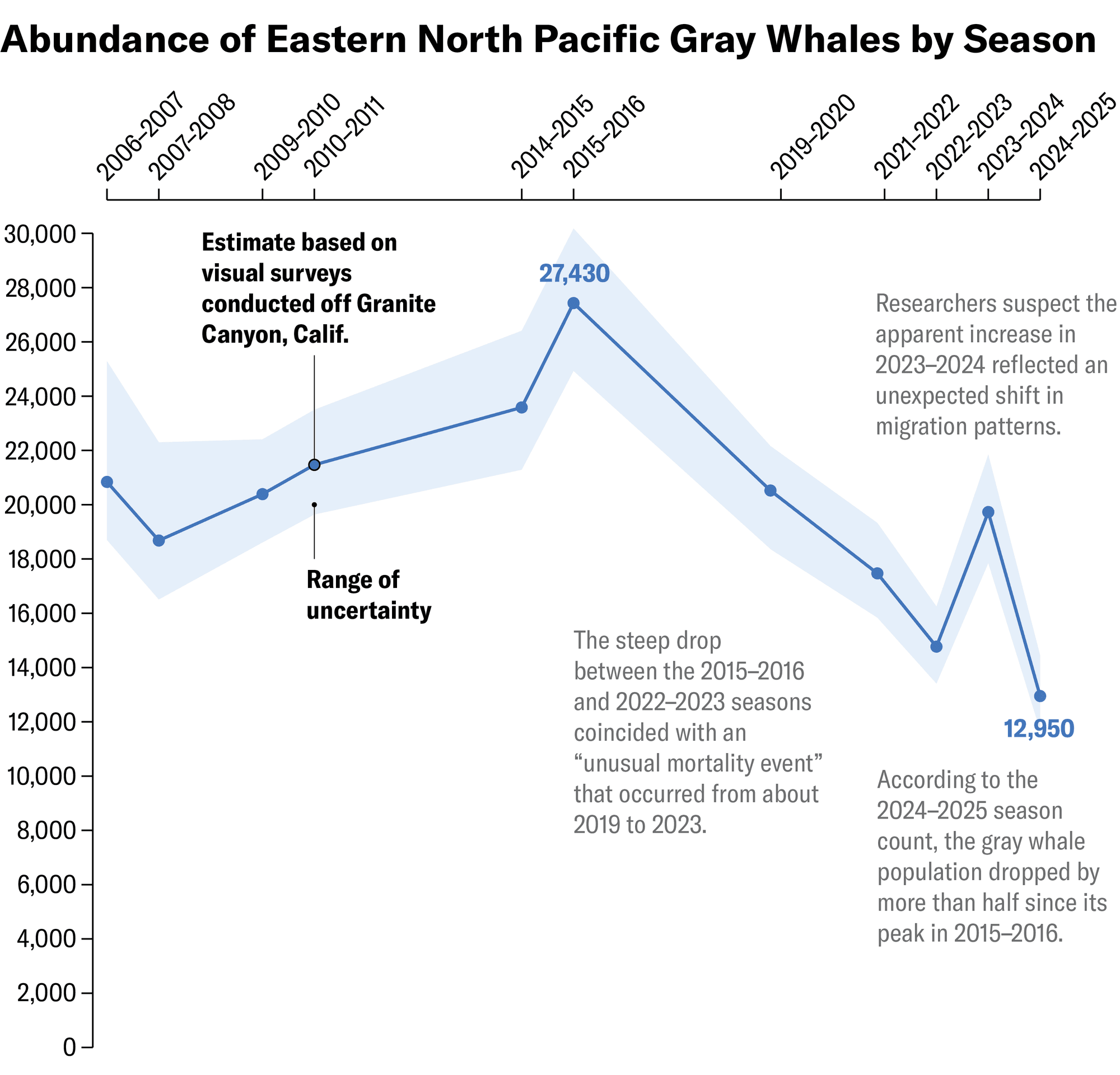
It's an incredible and horrifying twist of fate for a whale that had until recently been a major conservation success story. Decimated by whaling in the 19th century, the eastern North Pacific gray whale population had bounced back from near extinction to roughly 20,000 animals by 1994, when the species was removed from the U.S. Endangered Species List. By 2016 the whales numbered some 27,000 individuals. But as of 2025, the population had plummeted to 13,000 or so, as whale after whale washed up on shores up and down the West Coast.

Scientists, meanwhile, have been racing to explain what is happening to the whales by studying the stranded corpses for signs and clues that could illuminate why they are dying in droves.

From Rebound to Population Plummet

Gray whales are baleen whales that have mottled skin, a dorsal hump, pointed pectoral fins and eyes set low above permanently frowning mouths. They can reach 49 feet long and weigh up to 90,000 pounds, as much as six large elephants. Each year they make one of the longest known mammal migrations on Earth, a roughly 10,000-mile round trip between Mexico and the Arctic. The whales are seasonal ecosystem engineers, stirring up nutrients on the seafloor as they feed.

The mysterious strandings began in earnest in mid-December 2018. And in 2019 the National Oceanic and Atmospheric Administration (NOAA) declared an unusual mortality event, triggering an international investigation. Scientists rushed to study the stranded whales, searching for clues. They took the whales' measurements, inspected their bodies for signs of starvation or trauma, cut them open to examine their blubber and took samples from their organs. The analyses pointed to malnutrition as a common cause of death, followed by blunt force trauma consistent with being struck by boats.

In other words, the whales were either dying as a result of a lack of food or because boats had crashed into them.

The unusual mortality event officially ended in 2023 after strandings slowed—but the whales haven't stopped dying. Instead the decline has only become "more alarming," says John Calambokidis, senior research biologist and co-founder of the nonprofit Cascadia Research Collective. Though overall population numbers ticked up slightly this year, to an estimated 18,000, "the overall trend is still a decline," says Aimée Lang, a research scientist with the U.S. National Oceanic and Atmospheric Administration's Southwest Fisheries Science Center.

As scientists gather more evidence, it is becoming increasingly apparent that gray whales are starving to death. The reason why lies in the changing environment of the Arctic Ocean.

How Melting Sea Ice Is Starving Whales

Gray whales are mostly bottom-feeders, scooping up mouthfuls of sediment and invertebrates as they swim along the seafloor. They trap shrimplike amphipods and filter out the muck through baleen plates attached to their upper jaws⁠, leaving wallows and billows of mud—a nutrient feast for other organisms—in their wake. This buffet is intricately linked to the Arctic sea ice and the algae that grows beneath it.

When the algae die, they fall through the water column to the seafloor, where they feed the crustaceans that gray whales eat. But with Arctic temperatures skyrocketing, the sea ice is melting earlier and faster, disrupting the food web the whales rely on.

Line chart shows abundance of eastern North Pacific gray whales by season from 2006 to 2025.

Amanda Montañez; Source: National Oceanic and Atmospheric Administration (data)

That was the conclusion of a study published late last year in the ICES Journal of Marine Science that examined decades worth of data on the population sizes, births and deaths of gray whales and the biomass of Arctic crustaceans. It turns out that the health of the whales and the crustaceans ebbs and flows in near perfect synchrony, says study co-author Joshua Stewart, an assistant professor at Oregon State University's Marine Mammal Institute. And though gray whale populations have dipped periodically before, this time is different: "We're not seeing signs of the population quickly bouncing back like we did previously," Stewart says. Essentially, the ecosystem can no longer support as many gray whales as it once did. As a result, the whales are starving.

"The whales are just basically running out of energy as they try to migrate and dying," Swartz says. For years, he's seen more and more skinny gray whales returning to the San Ignacio Lagoon, one of their breeding areas off the Baja coast. He is also seeing far fewer calves being born. Lang, who helps count mothers and calves as they migrate north along the California coast, says that last year the team counted just 17 whale pairs. From that, they estimate 85 calves were born in 2025, well below the 1,600 or so born in 2014.

Sign of Hope

As dire as the situation is, there is still a chance that gray whales can survive this. For one, the animals could adapt to changing conditions in the Arctic by looking for food elsewhere, Lang says. They've "shown pretty amazing behavioral flexibility already," she adds.

Already there is evidence some gray whales are switching it up. A small group of gray whales called the Sounders detour from their northward migration to feed in Puget Sound, and then there is the Pacific Coast Feeding Group, which eschews the Arctic to feed between northern California and British Columbia.

There's other evidence to suggest more whales are joining those alternative routes. Gray whales have also been seen more frequently in San Francisco Bay since 2018, and scientists suspect they're searching for food there, too. But the heavy marine traffic in the Bay makes it a dangerous place for a whale: at least 18 percent of the whales that entered between 2018 and 2025 died there, according to a recent Frontiers in Marine Science study,many of which were killed by ships. A nascent system using AI and thermal cameras could help ships better spot the whales and reduce ship strikes, but it's still being tested.

These efforts also do little to address the core threat to gray whales. "The challenge with this case is that the lever we have to pull is slowing or reversing climate change," Stewart says. "It's something we know we need to do, but we haven't done it."

As the summer turns to fall and gray whales begin their return journey south, scientists will be watching closely to see how many make it back and what condition they're in when they get there.

"The big question in all our minds is just, where's the bottom?" Stewart says. "I hope they turn around soon."


+++++++++++++++++++++++++++++++++++++++++++++++++++++++++++++++++++++++
+++++++++++++++++++++++++++++++++++++++++++++++++++++++++++++++++++++++
+++++++++++++++++++++++++++++++++++++++++++++++++++++++++++++++++++++++

- Bloggery committed by chris tower - 2609.15 - 10:10

- Days ago: MOM = 4093 days ago & DAD = 747 days ago

- New note - On 1807.06, I ceased daily transmission of my Hey Mom feature after three years of daily conversations. I post Hey Mom blog entries on special occasions. I post the days since ("Days Ago") count on my blog each day, and now I have a second count for Days since my Dad died on August 28, 2024. I am now in the same time zone as Google! So, when I post at 10:10 a.m. PDT to coincide with the time of Mom's death, I am now actually posting late, so it's really 1:10 p.m. EDT. But I will continue to use the time stamp of 10:10 a.m. to remember the time of her death and sometimes 13:40 EDT for the time of Dad's death. The blog entry numbering in the title has changed to reflect total Sense of Doubt posts since I began the blog on 0705.04, which include Hey Mom posts, Daily Bowie posts, and Sense of Doubt posts. Hey Mom posts will still be numbered sequentially. New Hey Mom posts will use the same format as all the other Hey Mom posts; all other posts will feature this format seen here.