 A Sense of Doubt blog post #2347 - TRANSPARENCY IN TEACHING
I fancy myself as a very transparent teacher.
Now, that I am teaching COLLEGE SUCCESS, I was just telling my students this week about the importance of transparency, and if a teacher is not adequately transparent, then students have the right to ask for transparency and expect it to be delivered.
I had several battles with teachers over the lack of expectations, an inability to communicate WHAT THEY WANT because many of them did not know what they wanted until they saw what they DID NOT WANT.
One of the experiences that sticks with me the most is one that happened in graduate school. Upon entering the graduate program and starting course work, I had a perfect 4.0, which was always something of which I was capable but did not always achieve.
As an MFA student, many of my courses were writing workshops. Criteria for grading did not seem to be provided in these classes. Assessment seemed to be solely based on attendance and participation. If I attended, if I submitted work for workshop, if I reviewed the work submitted by others and participated well in the workshop process, I would earn an A. This precedent had been set by all my other courses.
And then there was fiction writing with Stuart Dybek. In fiction at least, though in many ways in the entire program, Stu was the golden child. He did not work a full year, he maintained a residence in Chicago and in Kalamazoo, he had a separate office off campus where he would write undisturbed, and he was heralded in the writing world as a star. He was definitely a draw for people to enter the MFA program.
Stu and I were friendly. He and I both loved all things Japanese, Baseball (though he was a White Sox fan, shudder), and our fiction sensibilities were somewhat aligned.
I missed one class, but otherwise I attended and participated. I was a frequent contributor to the discussions in workshop.
There was no expectation shared by Stu that we revise our work. There was no vocalized expectation that our be "publishable." And yet, when I received my grade, a BA (WMU's A- or B+ equivalent), I was confused, so I asked Stu if it was because I missed just one class, which is the only thing that made sense, and I was prepared to argue that this was a draconian policy. Stu told me that the expectation was that my work be publishable.
I was aghast. "Wha????"
Isn't that kind of antithetical to the whole idea of workshop? That we were expected to bring work in progress, work that we were working on, to get feedback to continue that work?
I could have rewritten and resubmitted to him if he had said that this was a thing we should do, but he did not.
And so...
I felt that there was a serious lack of transparency in his class. MFA writing workshops did not have syllabi. There was not statement of any "grading policy." Come on, we were grad students. We knew the drill. Or we thought we did.
As I was teaching at the time, I talked with many students with similar experiences: teachers who did not know what they wanted and could not explain it until they saw what they did not want and gave that effort a failing grade. MADDENING!
Later in the program, in a lit class, because I was also an MA student in literature, I rebelled against the choices in our STUDIES IN THE NOVEL class that was all examples from the 17th and 18th Century only ending the semester with two books from the 19th Century but not past 1850.
I can't even remember the name of some of these early novels, but I didn't read them. There was one week I was to read one of these relics and write an essay. I dragged my feet. I flipped around in the text, uninspired to read it. But I gleaned some content and thought about the essay I needed to write. Then a few hours before class, I sat down, flipped open the book I had not read, and made some educated decisions, cobbling together what I felt was the WORST PIECE OF SHIT I had ever written in my college career. It was surface level fluff. It was based on no real consideration of the text because I had not read the novel. It was awful. I was certain I would get laughed out of the class and the program.
The essay was returned the following week with few to no comments and a huge red grade of A.
I was stunned. How could this be? What criteria did the professor follow in making this determination. Did he even read the essay?
And so I became more ambitious. For the next essay, we were into Nathaniel Hawthorne short fiction, which were not novels in the STUDIES IN THE NOVEL class, but no matter. I had studied Hawthorne in my undergraduate college, a great little private school in the same town.
I took my undergraduate essay on Hawthorne's "The Birthmark" and all my notes from my professor's explication of Hawthorne's story and rewrote it. I spent a few weeks doing this work, laboring over passages, deeply diving into the imagery and explicating it all. With the combined might of my own long study of this story, going back a few years to my undergrad Sophomore year and my professor's great unlocking of the story's symbolism, I was sure to WOW my professor who gave me an A on such a piece of shit a few weeks earlier.
The essay was returned with whole paragraphs crossed out and a big fat C-.
I was flabbergasted. What methods did this teacher employ to make these assessments? How was I to give him what he wanted when he loved shit and hated great stuff?
TRANSPARENCY.
And so I see transparency in teaching as a two step process. The first step relies on giving students all the expectations and requirements for what they will do and how they will be assessed for what they do. As a teacher, I must be very clear here. I must explain WHY they are doing what they are doing, all of my reasoning, what SKILLS are built by the work (COURSE OUTCOMES), and then how they will be held accountable for what I have asked them to do.
Many teachers will call the last part a RUBRIC, but we did not have rubrics at my school. As a graduate student, there was little to no transparency provided by the professors. Some had no syllabus at all. Even when one shared a syllabus, it contained little to no information about the grading policies and may not have even contained a grade scale or points possible. Assignments like those literature essays were delivered verbally, out loud, in class, the week before or weeks before depending on the expectation of the size of the final product. Often the directions were as simple as "write an analysis essay on one of these Hawthorne stories in our text."
Over in my own teaching, I was taught to grade student papers in about 45-90 seconds for each. The lead instructor teaching me showed me this process. He took a student's paper off my stack, flipped through it for no more than 90 seconds and possibly UNDER 45 seconds, handed it back and said, "that's a C+."
I looked it over and saw how I could justify it was a C+, but why did HE THINK it was a C+. Did we have the same reasons for giving it a C+? There were no rubrics. There were no requirements. And the tenured professors who would occasionally come off Mount Olympus to discuss work process with us encouraged us to spend as little time grading as possible.
One such instructor never wanted to take papers home, so he would not hold classes for weeks at a time and instead meet with students in his office and spend thirty minutes or so going over their writing with them and grading them on the spot. I would overhear some of these conferences, and it seemed that the students received a great deal of good feedback, but this guy was an outlier. Literally, no one else was doing such a thing.
Fancying myself as a student-centered instructor, I started writing up instructions for my essay assignments, and detailing the requirements for which student essays would be held accountable. I was one step closer to a "rubric," but since no one had assessed my work with a rubric, EVER, (to my knowledge) or SHOWN ME a rubric, then I did not know to make one.
I tried to be clear with students: here's what I want you to do, here's why I want you to do it, here's what you get out of doing it (at least some of what they get), and here's how I will grade the work.
AND THEN, the next part is probably the most important of all: I tried to hold myself to what I said I would do and then actually do it.
If I was grading and spotted something not covered by my requirements, I could NOT grade down the student for doing the thing because I had not said I would grade down for that thing. Instead I could change the assignment for next time, and be even CLEARER about what I wanted to see and how I would grade what I saw.
Assessment should not a secretive process hidden from students.
Teachers need to be transparent and hold themselves accountable for what they have said and what they have not said.
Teachers can establish trust by being transparent in this way: Say what you want; do what you say.
When teachers go against their own policies or procedures, when teachers do not provide clear expectations and requirements, when teachers make arbitrary decisions about student work not well communicated in advance, then students should expect teachers to do better, to be even clearer next time, and to play fair.
I never cross out whole paragraphs students have written even if they are the worst dreck I have ever seen. I never expect students to write "publishable" essays but not tell them that this is what I am expecting.
Instead, I am VERY detailed about what I want (too detailed some say), and I am CONSTANTLY REVISING what I do and improving it for next time.
I still do not always grade with a rubric. It depends on the assignment.
But students always know what is required and how I arrived at the grade I have given.
And I am always willing to reconsider a grade if a student makes a strong case.
TRANSPARENCY.
It matters.
Here's some resources and a podcast from some HILARIOUS middle school teachers on being an effective teacher.
HUZZAH!!
SOME MORE RESOURCES:https://www.aacu.org/publications-research/periodicals/transparency-teaching-faculty-share-data-and-improve-studentsStudent Perceptions of Transparency in Teaching
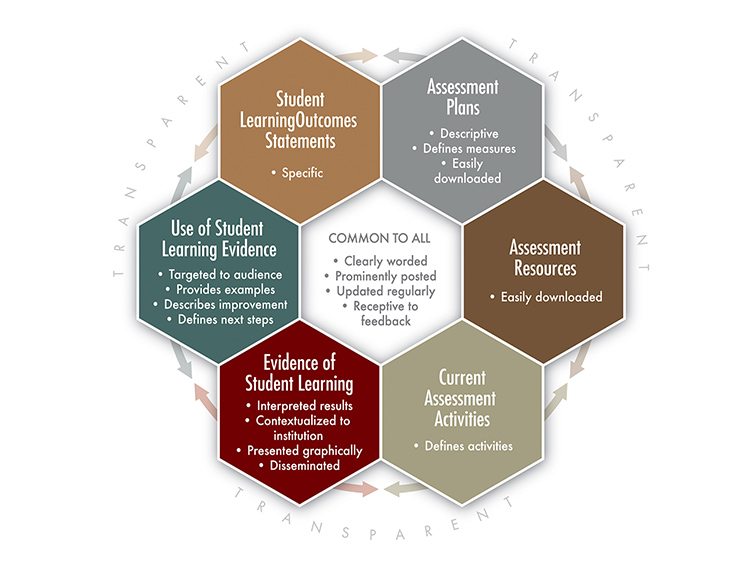 https://www.csun.edu/undergraduate-studies/faculty-development/teach-transparency
Teach with Transparency
**This page is from an old version of CSUN's Teaching Toolkit. Find an updated version on the current Teaching Toolkit on Canvas.** What Does it Mean to Teach with Transparency?
Teaching with transparency means to teach while making obvious the intellectual practices involved in completing and evaluating a learning task. The goal of transparent teaching is to promote students’ conscious understanding of how they learn. Transparent teaching methods help students understand how and why they are learning course content in particular ways.
Does it Work?
In 2014, AAC&U partnered with the Transparency in Learning and Teaching in Higher Education (TILT Higher Ed) project, founded at the University of Illinois and now housed at the University of Nevada, Las Vegas, on an initiative that significantly increases underserved college students’ success. TG Philanthropy funded the Transparency and Problem-Centered Learning project (www.aacu.org/problemcenteredlearning), with Tia McNair, Ashley Finley, and Mary-Ann Winkelmes as the coinvestigators. In its first year, the endeavor has identified a simple, replicable teaching intervention that demonstrably enhances students’ success, especially that of first-generation, low-income, and underrepresented college students in multiple ways at statistically significant levels, with a medium to large magnitude of effect. These results offer implications for how faculty can help their institutions to right the inequities in college students’ educational experiences across the country.
The results of their project suggest that faculty can contribute to increasing all students’ success, especially that of underserved students, in their first year of college (when the greatest number of students drop out) (Head and Hosteller 2015). In courses where students perceived more transparency as a result of receiving the transparently designed, problem-centered take-home assignments, they experienced significantly greater learning benefits compared with their classmates who perceived less transparency around assignments in a course. Specifically, students who received more transparency reported gains in three areas that are important predictors of students’ success: academic confidence, sense of belonging, and mastery of the skills that employers value most when hiring. These are “substantively important” and statistically significant findings that satisfy WWC standards for baseline equivalence measures of 0.05 or below, sample sizes above three hundred fifty, and effect size differences above 0.25 (US Department of Education March 2014).
What do Transparent Assignments Look Like?
- Website with example assignments:https://tilthighered.com/
- Article: A Teaching Intervention that Increases Underserved College Students' Success (Winkelmes et. al, 2016)
- Book: Magruder, E., Scott, W., Willard, M., Ruiz-Mesa, K., & Drew, S. (2019). Transparency to close opportunity gaps in the largest state system: A pilot experiment. In M. Winklemes, S. Tapp, & A. Boyle (Eds), Transparent Design in Higher Education Teaching and Leadership: A Guide to Implementing the Transparency Framework Institution-Wide to Improve Learning and Retention.
- Article: Transparency in Teaching: Faculty Share Data & Improve Students' Learning (Winkelmes, 2013)
- Article: The Power of Transparency in Your Teaching (Mulnix, 2018)

Transparency in Teaching (stuff)
By Transparency in Teaching
Three middle school teachers and their guests share what it's really like to be in a classroom today, how policies affect teaching and students, and what teachers actually think would work better. Listen in to their off the cuff, unscripted discussions, debates, and sometimes, plain silliness as they discuss today's biggest issues facing schools.
https://www.listennotes.com/podcasts/transparency-in-teaching-stuff-transparency-vQzZRLmsnIj/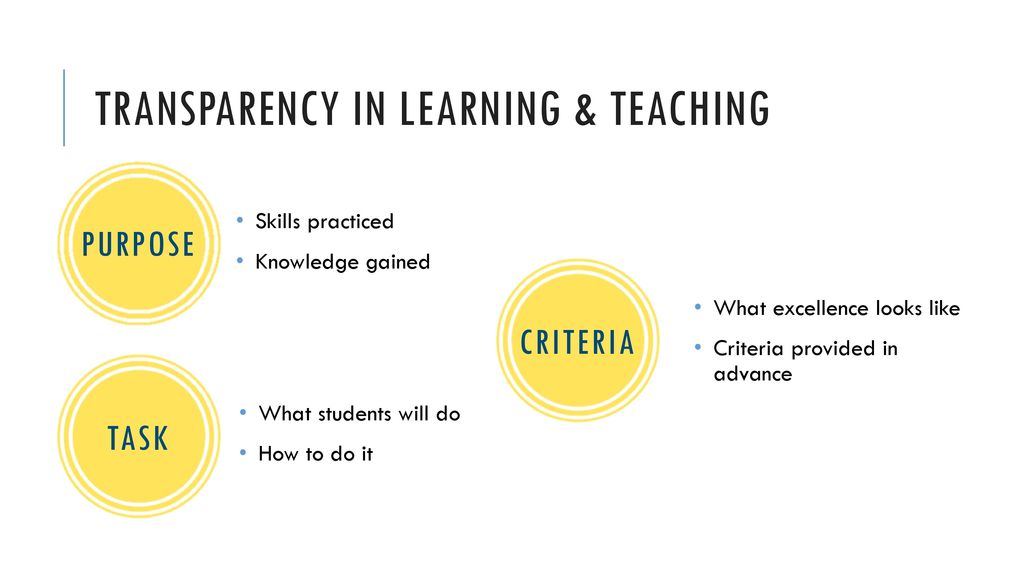 https://tilthighered.com/transparency
Transparency In Learning And Teaching Project
Transparent Methods
Transparent teaching methods help students understand how and why they are learning course content in particular ways. This list of options is adapted frequently as faculty participants identify further ways to provide explicit information to students about learning and teaching practices. Faculty participants usually employ one option from the list and students indicate the impact of this small change when they complete an online survey (taking about four to five minutes) at the end of the course. Please email wink@brandeis.edu to add your suggestions to the list.
more at the site:
https://tilthighered.com/transparency

https://canvas.northseattle.edu/courses/1734110/pages/overview-of-transparency-in-learning-and-teaching-tiltOverview of Transparency in Learning and Teaching (TILT)
“The design of assignments matters much for student learning.”
Dr. Pat Hutchings, at WSU’s capstone assignment design workshop, May 2016
The foundation of the work you will do in this workshop is based on the National Institute for Learning Outcomes Assessment (NILOA) transparency project that concluded the most promising intervention that supports learning gains for all students, especially first-generation, low-income, and under-represented students is assignment design, including making the assignment’s purpose, tasks and criteria “transparent.”
What is Transparency in Learning and Teaching (TILT)?
Transparent teaching and learning methods explicitly focus on how and why students are learning course content in particular ways.
How Does Transparency Benefit Students and Faculty?
- Promotes equitable learning opportunities for student success
- Transparent teaching/learning methods particularly benefit students who are unfamiliar with college success strategies by explicating learning/teaching processes.
- Greater benefits for underrepresented and first generation students
- Strengthens the curriculum and assessment, as students are able to do their best work.
How Can Faculty Make Assignments More Transparent?
- Using the transparent assignment template and incorporating 3 simple, but powerful, tweaks in the assignments by stating clearly the purpose, the tasks and criteria.
Scholarship of Teaching and Learning
This approach is built on considerable research in teaching and learning, including work from AAC&U, NILOA, Winkelmes, Mazur, Felder, Tanner, Light, Dweck, Fisk, Dweck, Yeager, and many others.
- Clement, M. (2016, July). Introduction to learning theories and implications for classroom design. In 2016 Joint Annual Meeting. Asas.
- Winkelmes, M. A. (2013). Transparency in Teaching: Faculty Share Data and Improve Students' Learning. Liberal Education, 99(2), n2.
- Winkelmes, M. A. (2015, February). Equity of Access and Equity of Experience in Higher Education. In The National Teaching & Learning Forum (Vol. 24, No. 2, pp. 1-4).
- Winkelmes, M. A., Bernacki, M., Butler, J., Zochowski, M., Golanics, J., & Weavil, K. H. (2016). “A Teaching Intervention that Increases Underserved College Students' Success.” Peer Review, 18(1/2), 31.
Dr. Mary Anne Winkelmes, UNLV, and TILT Higher Ed founder, has researched transparency extensively and provides materials, examples, and information.
This work, “Overview of Transparency in Learning and Teaching (TILT)” by WA SBCTC, TAD Toolkit, 2,1,1 TILT: The Equitable Assignment Challenge, is licensed under CC BY 4.0 (Links to an external site.). It is a derivative (with permission) of The Unwritten Rules of College: Transparency and Its Impact on Learning (Links to an external site.) by Mary-Ann Winkelmes used under CC BY 4.0 (Links to an external site.).

+++++++++++++++++++++++++++++++++++++++++++++++++++++++++++++++++++++++
+++++++++++++++++++++++++++++++++++++++++++++++++++++++++++++++++++++++
+++++++++++++++++++++++++++++++++++++++++++++++++++++++++++++++++++++++
- Bloggery committed by chris tower - 2107.22 - 10:10
- Days ago = 2211 days ago
- New note - On 1807.06, I ceased daily transmission of my Hey Mom feature after three years of daily conversations. I plan to continue Hey Mom posts at least twice per week but will continue to post the days since ("Days Ago") count on my blog each day. The blog entry numbering in the title has changed to reflect total Sense of Doubt posts since I began the blog on 0705.04, which include Hey Mom posts, Daily Bowie posts, and Sense of Doubt posts. Hey Mom posts will still be numbered sequentially. New Hey Mom posts will use the same format as all the other Hey Mom posts; all other posts will feature this format seen here.


