A Sense of Doubt blog post #3738 - Using Brain.Fm Daily has Changed my Brain for the BetterI recently discovered
https://www.brain.fm/.
I have subscribed for the year after trying it out for a free trial.
I have been listening for 30-60 minutes a day for a few weeks, and I feel it has changed my brain state with its "entrainment."
I feel the change. Could be all in my mind, but I am convinced by smart research and actual science.
This stuff is legit.
I will write about one of the revelations that has happened since I started using brain.fm tomorrow.
Until then, I recommend this to everyone, especially artists or people who need to induce a state of flow.
BTW, because this is NOT binaural beats, it is not
hemi-synch.
This is
Explore!
Subscribe!!
Brain.fm DID NOT pay me to write this post; they do not even know that I am writing this post.
Thanks for tuning in.
How is Brain.fm music made?
Made with science,
tested with science.
We use neuroscience to inform our music-making, but also use science to test the resulting music. These are two different roles of science at Brain.fm, setting us apart from any other music service.
The Brain.fm White Paper
Peak productivity on demand
Brain.fm’s focus music is made to help you work better, by blending into the background so you can focus distraction-free... all while stimulating the brain with gentle rhythmic pulses in the music that support sustained attention.
Other music is made to grab your attention, making it hard to think and work, even if you don’t realize it. Brain.fm’s functional music is designed from the bottom up to affect your brain and optimize your performance.
FOCUS WITH SCIENCE
Real science with
extraordinary results
Scientists at Brain.fm work with academic institutions to observe the effects of our technology on the brain using fMRI, EEG, and behavioral studies. We always include placebo groups in our tests to ensure our tech is what makes the difference.
See our science
Why does Brain.fm increase focus?
Your brainwaves operate at different speeds (Hz) that scientists generally break down into 4 categories that are associated with different mental states.
- Delta (0.5-4 Hz) - Deep sleep
- Theta (4-8 Hz) - Light sleep and deep relaxation
- Alpha (8-12 Hz) - Relaxed wakefulness, creativity, and meditation
- Beta (12-30 Hz) - Active thinking, problem-solving, and focus
Brain.fm identifies the optimal Hz range for a given mental state and translates it into volume modulations within certain areas of our music. This encourages your brain to increase the power level of brainwaves that are equal to or similar to the patterns we've embedded in the music.
This process not only enhances brainwave activity but also synchronizes your brainwaves throughout your brain, making it easier for different parts of your brain to work together more seamlessly.
It may sound wild, but we've conducted quality research, published multiple papers, and received a grant from the National Science Foundation to continue our work.
In short—brain.fm is a safe, evidence-based way to hack your brain and take control of your mental state on demand using sound.
Is this the same as binaural beats?
Brain.fm is not binaural beats. There are some similarities, but it’s important to remember that binaural beats were first discovered in 1839, popularized in the 1970’s and haven’t really changed since.
In a way, you could think of Brain.fm as binaural beats 2.0. We took the concept behind binaural beats and applied an updated understanding of neuroscience and auditory processing to create a more effective and powerful solution.
Some core differences:
- Binaural beats primarily impacts the lower brain which is not where thinking or creativity occurs.
- Brain.fm impacts the prefrontal cortex which is where all your thinking and creativity comes from
- Binaural beats requires both ears to be free of hearing damage and high quality headphones to be on.
- Brain.fm works with one or two ears, does not require headphones, and is not dependent on your ability to hear certain frequencies.
Most importantly, Brain.fm uses many methods to make our music work, unlike binaural beats which is just one technique!
How large are your scientific studies?
We’ve conducted research and testing with hundreds of participants. We always include placebo groups to make sure it’s not just our music that increases focus, but the technology embedded within it.
You can read our papers, supporting research, and more at www.brain.fm/science
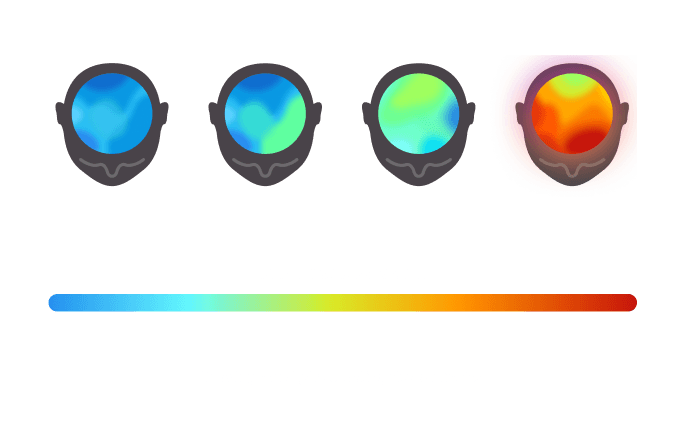
From Left to Right: Resting, Pink Noise, Average Music. Brain.fm
with phase locking values of 4000 (far left of spectrum) to 13,000 (far right).
Electrical activity in the brain: EEG studies
Electroencephalography measures fluctuations in electrical current at the scalp, showing rhythmic brain activity (‘brainwaves’) and how this kind of activity shifts in response to Brain.fm music.
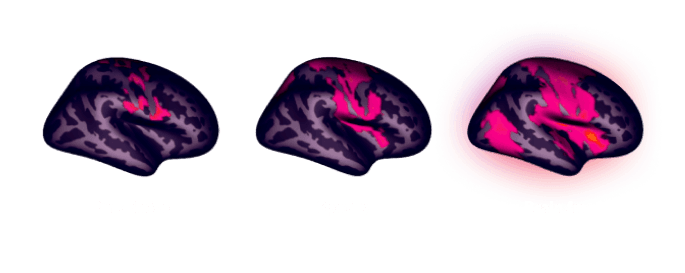
From left: Pink Noise, Spotify, Brain.fm
Blood flow in the brain: FMRI studies
Functional magnetic resonance imaging measures blood flow in the brain, showing which brain regions and functional networks are more active in response to Brain.fm versus other music.
Brain.fm is not ‘binaural beats’!
Binaural beats produce weak neural synchrony while modulation directly in each stereo channel (used by Brain.fm) has much stronger effects on brain activity. Importantly, Brain.fm uses many methods to make our music work, unlike binaural beats which is just one technique!
Music without distractions
Most music in the world is designed to grab your attention, which leads to distraction. Instead, our process ensures that attention-grabbing elements are subdued or removed, allowing the music to sit comfortably in the background.
+++++++++++++++++++++++++++++++++++++++++++++++++++++++++++++++++++++++
+++++++++++++++++++++++++++++++++++++++++++++++++++++++++++++++++++++++
+++++++++++++++++++++++++++++++++++++++++++++++++++++++++++++++++++++++
- Bloggery committed by chris tower - 2505.13 - 10:10
- Days ago: MOM = 3603 days ago & DAD = 257 days ago
- New note - On 1807.06, I ceased daily transmission of my Hey Mom feature after three years of daily conversations. I post Hey Mom blog entries on special occasions. I post the days since ("Days Ago") count on my blog each day, and now I have a second count for Days since my Dad died on August 28, 2024. I am now in the same time zone as Google! So, when I post at 10:10 a.m. PDT to coincide with the time of Mom's death, I am now actually posting late, so it's really 1:10 p.m. EDT. But I will continue to use the time stamp of 10:10 a.m. to remember the time of her death and sometimes 13:40 EDT for the time of Dad's death. The blog entry numbering in the title has changed to reflect total Sense of Doubt posts since I began the blog on 0705.04, which include Hey Mom posts, Daily Bowie posts, and Sense of Doubt posts. Hey Mom posts will still be numbered sequentially. New Hey Mom posts will use the same format as all the other Hey Mom posts; all other posts will feature this format seen here.




No comments:
Post a Comment