
As someone studying to be a Clinical Mental Health Counselor, I have been thinking about some of the issues that I may encounter outside of the varied mental health problems, personality disorders, and so on.
Let me preface my remarks with some caveats and confessions.

.jpg)
My dogs remind me all the time about being kind and having empathy, especially Ellory, who looks a lot like this dog above (left).
Ellory is such an earnest, sweet, genuine soul that she is EXTREMELY sensitive, and so she reminds me all the time of why it's important to focus on positive emotions and not negative emotions or energy.
As I confessed, I am not immune and above this kind of thing. I have done some awful things to other people. I have acted with extreme selfishness. I have hurt people. And just writing about it all like this is setting myself up to sound self-righteous and narcissistic. I know. I like to think that I am analytical, that I work to improve, that I try to avoid hurting people. I do all right. I think I have been better in the last five years.
But is it an either/or?
I believe in forgiveness, and I hate absolutes. I hate "never" statements.
I am sure some things are. Child sexual abuse (really any abuse, but that's a really bad one) comes to mind.
One thing I have been discussing with my therapist is the difference between thoughts, especially negative thoughts, and feelings.
He made a good point about how we place moral judgment on our feelings or the feelings of others.
Negative thoughts are different. We need to learn to recognize negative thought patterns and change our thinking to more healthy and better regulated thoughts.
I recently was very focused on a situation and fearing a negative outcome. And then I flipped the switch and focused on that situation having a positive outcome. The situation is not resolved yet, so it may still not turn out favorably. But dwelling on a negative outcome only amps up my stress, anxiety, and fear. Focusing on a positive outcome reduced my stress, anxiety, and fear. Though I am being realistic in my rational mind about all possible outcomes, some of which are not how I want the situation to resolve, I keep my focus on the positive. As negative thoughts rise up, I recognize them, understand where they are coming from, and turn my focus back to the positive.
That said, there's forgiveness and understanding, and then there's allowing ourselves to be abused over and over by an untrustworthy person. It's okay to cut them loose. That's self-preservation. Though even in doing so, I try to practice forgiveness. I do not like harboring grudges. I do not really believe in HATE.
I would recommend that clients examine their relationships and the harm done to them. An abuser that they can cut from their life entirely is necessary, surely, but other relationships and the breaches of trust require different actions, whatever with which the client feels comfortable. A spouse/partner or family member relationship may be more resilient and worthy of forgiveness and continuation than a friend, a co-worker, distant family member, or neighbor.
And though forgiven, and grudges dismissed, anger processed, one need not remain friends with someone who is toxic and abusive nor work with them in an employment setting (if possible) nor interact with them if they live nearby.
I look forward to talking with people about trust issues, which will help my own trust issues as well as theirs.
Here's two articles I found that I liked on the issue of repairing trust, if repairing trust is what one wishes to do. In some cases, it's not necessary.
Thanks for tuning in.

4 Ways Leaders Can Repair Broken Trust in the Workplace
Broken trust is one of the most devastating realities a leader can face, yet it’s an issue that inevitably crops up in any workplace. If you find yourself in the unenviable position of needing to repair damaged trust after something has gone awry, there are ways to get your team back on track and open up the channels of communication throughout your organization.
Let’s dive in to explore how leaders can diagnose and resolve broken trust among their teams for better productivity and morale. From clearly outlining expectations to implementing better decision-making protocols, learn what measures you should take when trying to restore faith between co-workers and management alike.
First of all, recognizing that trust is broken is precisely where the magic happens. We all make mistakes and will inevitably cause a breakdown of trust at some point. However, it’s what we do with our mistakes that really matters. Most of us feel pain and shame when we hurt others, especially people who report to us. It’s important to recognize and lean into that raw pain to find growth and connection waiting for us: We can rebuild trust through pain, and that helps elevate us as leaders. The pain of broken trust often serves as a catalyst for growth, regeneration and transformation.
1. Repair Starts With You
With great leadership comes great responsibility. Leaders make a conscious choice to lead, and therefore have a responsibility to do so. One of the most critical job duties as a leader is to focus on daily trust-increasing activities, especially when consciously repairing the damage from broken trust. You, the leader, carry the sole responsibility for your actions and must begin the trust-rebuilding by offering a heartfelt apology. Leaders cannot expect to be trusted if they don’t start with the intention to trust — it’s a two-way street.
2. Apologize and Acknowledge
Simply saying “I’m sorry” isn’t enough to repair trust once it’s broken — but it’s the best place to start. Always begin with a sincere and authentic apology, then acknowledge the part you played in the situation. Accept and recognize your wrongdoing and explain how the issue came to be. Then name the steps that you are going to take to ensure that it won’t happen again. Once you’ve taken responsibility, you can then start to rebuild trust.
“How do you want me to be with you right now?”
This simple question will quickly tumble down the walls of insecurity and hurt. Simple, yet so incredibly powerful, it allows all parties to express their needs, which are likely different from your own. And it shows that you’re willing to be flexible and accommodating to regain trust. This question also level-sets expectations and prevents misunderstandings. Discussing feelings at work can be challenging, especially in organizations where employees and leaders don’t often talk about personal issues, but it can absolutely be critical at times.
4. Trust Takes Time
Trust is the cornerstone of all relationships and is the essential ingredient that allows people to work together effectively and efficiently. When trust is lacking, people are reluctant to communicate and share ideas, stifling creativity and collaboration. Tending to trust regularly requires commitment and time.
Some ideas are committing to regular one-on-one check-ins with your direct reports, and making sure they are holding regular check-ins with their direct reports, too. Team building exercises are fun and essential moments to put work aside and spend some time getting to know people on a personal level. Research shows that it’s much easier to trust people we know personally, so it’s important to take the time to develop interpersonal relationships on your teams. And finally, I empower you to make a company-wide declaration to commit to open and honest communication, as this is the very best way to actively build and sustain trust in the workplace.
Leaders face an immense challenge in rebuilding trust with their employees once it has been broken. It can be hard to know where to start when trying to mend the trust that has been lost, but there are steps organizations, and the leaders within them, can take to regain confidence in the workplace environment.
There’s no quick fix to regaining trust, but by following the trust formula outlined above, you’ll be on the path toward repair. Remember: It starts with you, always apologize and acknowledge, meet people where they are and know that trust takes time. No matter your level of experience or area of expertise, you can restore trust on your team and improve performance as a result.

When Trust is Broken: What it Means and How to Repair it
Trust and Trust Repair
Trust is fundamental in any relationship. We can feel when we are trusted and understand when we have lost trust; yet, we often have difficulty describing exactly what it is. Researchers most frequently define trust as the willingness of a person to be vulnerable to another based on the confident expectations that they will act in beneficial ways (Mayer et al., 1995). In simple terms, trust means believing that you can rely on someone to help you. Unfortunately, trust is fragile. One misstep can harm a relationship beyond repair if not properly addressed. Therefore, it’s important to understand what it means to break trust and how to properly repair it.
When trust is breached, the damage can be extensive. The repercussions may extend beyond cooperation on a professional level, leading to a fundamental distrust of one’s values and intentions. The range of reactions may be best understood through the nature of the violation. There are two types of trust violations: competence and integrity. Competence violations occur when someone fails to meet expectations involving technical and interpersonal skills required for successful performance (McAllister, 1995). This can generally be seen as a mistake, such as accidentally giving someone the wrong information. On the other hand, integrity violations occur when someone acts in an unethical manner or breaks a promise (McAllister, 1995). Integrity violations themselves are intentional, whether the impact on others is intentional. For example, someone may decide to lie about a deadline to ensure it gets done on time. While they may think they are doing something good, the person they lied to may feel betrayed when they find out. Integrity violations are seen as more severe and are more difficult to repair, as people may attribute the violation to one’s identity, rather than the situation at hand. Understanding how the violation is perceived (i.e., as a competence or integrity violation) is vital to repairing trust, as different strategies must be used, and different aspects must be addressed.
Before moving on to the strategies to rebuild trust, it should be noted that not all trust can be repaired and repaired trust may never be the same as pristine trust. Whether or not you achieve forgiveness, the important thing is that you are moving forward with authenticity and sincerity.
Trust Repair Tactics
There are several tactics to trust repair which can broadly fit into two categories: substantive and non-substantive. Substantive trust repair strategies include concrete actions with tangible elements that are meant to restore balance by addressing the negative social exchange itself (Dirks, 2011). Below are summaries of the two most common substantive tactics.
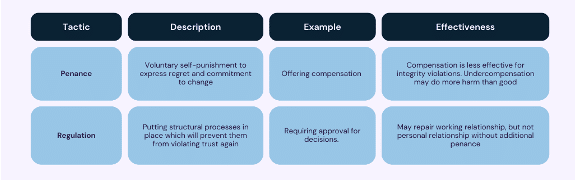
While these tactics are generally effective, they may be more relevant to forgiveness than reconciliation, meaning that an individual may be willing to continue to work with the other, but the personal relationship will not be restored (DiFonzo et al., 2020). Neither tactic truly addresses the harm done to the trusting relationship, but rather attempts to “even the score”.
Non-substantive repair strategies describe tactics for trust repair which have purely verbal components and are meant to re-cast negative perceptions (Dirks, 2011). Below are summaries of common non-substantive repair strategies.
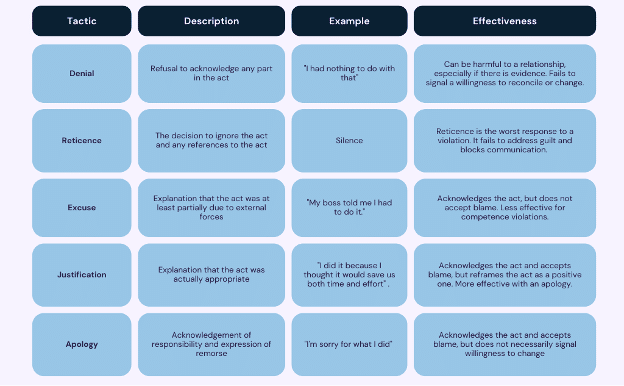
Because all these strategies are strictly verbal, they require one’s word to be taken at face value. If this is the first time you’ve broken their trust in a longstanding relationship, this may be a possibility. However, if you’ve broken their trust before or if you haven’t known each other for very long, this may not be enough to show that the violation of trust does not reflect your true intentions. Does this then mean that there is no way to repair trust? Fortunately, it doesn’t. As you may have guessed, it’s possible to combine tactics to express a genuine desire to rebuild both the working and personal relationships. This combination of tactics is seen in the substantive apology.
The Substantive Apology
An apology can be more than just saying “I’m sorry”. When done right, it can instill confidence and inspire reconciliation. The most important aspect of repairing a trusting relationship is being sincere (Lewicki & Bunker, 1996), as it is essential for building and sustaining lasting relationships. If you are unwilling to truly reconcile, you should not use this strategy. Instead, you should be transparent and communicate your intentions, using substantive strategies to negotiate an effective way to continue to work together. If you are genuine in your desire to mend fences, then learning how to apologize effectively will be invaluable.
Researchers have extensively studied the science of the apology, coming to several general conclusions:
- Apologies should be given as soon as possible after the transgression. A prompt apology conveys concern about the impact (Kähkönen et al., 2021).
- Apologies are more effective for competence than integrity violations (Kim et al., 2004; Lewicki et al., 2016). Further, as perceived intentionality increases, restorative actions are less effective for forgiveness (Martinez-Diez et al., 2021).
- Apologies may be seen as insincere if there are frequent transgressions (Lewicki & Brinsfield, 2017), if the apology is not detailed (Shapiro et al., 1994), or if they do not perceive the transgressor as remorseful (Tomlinson et al., 2004).
Additionally, Lewicki et al. (2016) has gone so far as to identify the ingredients to an effective apology:
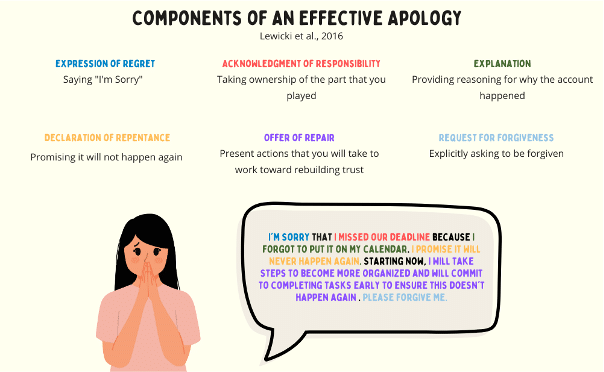
While the components have an additive effect on forgiveness (i.e., more components = more effective; Lewicki & Brinsfield, 2017), not all components are needed for every situation, and not all of them are equally useful. The most critical components for an effective apology are acknowledgment of responsibility, explanation, and offer of repair (Lewicki and Polin, 2012), as they signal a commitment to making things right. Whether you follow the exact formula or not, it is paramount that you follow through with your words and make doing so a priority. Promises only go so far and failure to commit to reconciliation can quickly deteriorate the relationship more than if you had never apologized at all.
Ultimately, even if you do everything you can to rebuild trust, it’s up to the other person to forgive you. If they decide not to accept your apology, you must respect their decision. However, this does not stop you from following through on your actions to repair the relationship, where possible. Even if they choose not to continue working with you, you should use the experience as a learning opportunity and apply what you have learned to future relationships.
Author

References
DiFonzo, N., Alongi, A., & Wiele, P. (2020). Apology, restitution, and forgiveness after psychological contract breach. Journal of business ethics, 161(1), 53-69.
Dirks, K. T., Kim, P. H., Ferrin, D. L., & Cooper, C. D. (2011). Understanding the effects of substantive responses on trust following a transgression. Organizational Behavior and Human Decision Processes, 114(2), 87-103. doi:http://dx.doi.org.portal.lib.fit.edu/10.1016/j.obhdp.2010.10.003
Kähkönen, T., Blomqvist, K., Gillespie, N., & Vanhala, M. (2021). Employee trust repair: A systematic review of 20 years of empirical research and future research directions. Journal of Business Research, 130, 98-109. doi:http://dx.doi.org.portal.lib.fit.edu/10.1016/j.jbusres.2021.03.019
Kim, P. H., Ferrin, D. L., Cooper, C. D., & Dirks, K. T. (2004). Removing the shadow of suspicion: The effects of apology versus denial for repairing competence- versus integrity-based trust violations. Journal of Applied Psychology, 89(1), 104-118. doi:http://dx.doi.org.portal.lib.fit.edu/10.1037/0021-9010.89.1.104
Lewicki, R. J., & Brinsfield, C. (2017). Trust repair. Annual Review of Organizational Psychology and Organizational Behavior, 4, 287-313. doi:http://dx.doi.org.portal.lib.fit.edu/10.1146/annurev-orgpsych-032516-113147
Lewicki, R. J., & Bunker, B. B. (1996). Developing and maintaining trust in work relationships. Trust in organizations: Frontiers of theory and research, 114, 139.
Lewicki, R. J., & Polin, B. (2012). In Kramer R. M., Pittinsky T. L. (Eds.), The art of the apology: The structure and effectiveness of apologies in trust repair. New York, NY: Oxford University Press.
Lewicki, R. J., Polin, B., & Lount, R. B., Jr. (2016). An exploration of the structure of effective apologies. Negotiation and Conflict Management Research, 9(2), 177-196. doi:http://dx.doi.org.portal.lib.fit.edu/10.1111/ncmr.12073
Martinez-Diaz, P., Caperos, J. M., Prieto-Ursúa, M., Gismero-González, E., Cagigal, V., & Carrasco, M. J. (2021). Victim’s perspective of forgiveness seeking behaviors after transgressions. Frontiers in psychology, 12, 1161.
Mayer, R. C., Davis, J. H., & Schoorman, F. D. (1995). An integrative model of organizational trust. The Academy of Management Review, 20(3), 709-734. doi:http://dx.doi.org.portal.lib.fit.edu/10.2307/258792
McAllister, D. J. 1995. Affect- and cognition-based trust as foundations for interpersonal cooperation in organizations. Academy of Management Journal, 38. 24-59.
Shapiro, D. L., Buttner, E. H., & Barry, B. (1994). Explanations: What factors enhance their perceived adequacy? Organizational Behavior and Human Decision Processes, 58(3), 346-368. doi:https://doi-org.portal.lib.fit.edu/10.1006/obhd.1994.1041
Tomlinson, E. C., Dineen, B. R., & Lewicki, R. J. (2004). The road to reconciliation: Antecedents of victim willingness to reconcile following a broken promise. Journal of Management, 30(2), 165-187. doi:http://dx.doi.org.portal.lib.fit.edu/10.1016/j.jm.2003.01.003
+++++++++++++++++++++++++++++++++++++++++++++++++++++++++++++++++++++++
+++++++++++++++++++++++++++++++++++++++++++++++++++++++++++++++++++++++
+++++++++++++++++++++++++++++++++++++++++++++++++++++++++++++++++++++++
- New note - On 1807.06, I ceased daily transmission of my Hey Mom feature after three years of daily conversations. I post Hey Mom blog entries on special occasions. I post the days since ("Days Ago") count on my blog each day, and now I have a second count for Days since my Dad died on August 28, 2024. I am now in the same time zone as Google! So, when I post at 10:10 a.m. PDT to coincide with the time of Mom's death, I am now actually posting late, so it's really 1:10 p.m. EDT. But I will continue to use the time stamp of 10:10 a.m. to remember the time of her death and sometimes 13:40 EDT for the time of Dad's death. The blog entry numbering in the title has changed to reflect total Sense of Doubt posts since I began the blog on 0705.04, which include Hey Mom posts, Daily Bowie posts, and Sense of Doubt posts. Hey Mom posts will still be numbered sequentially. New Hey Mom posts will use the same format as all the other Hey Mom posts; all other posts will feature this format seen here.


No comments:
Post a Comment