
A Sense of Doubt blog post #3749 - Birthright Citizenship Nonsense Arguments
Just a quick share today because what really needs to be said. On this thing, the Constitution is VERY clear.
To End Birthright Citizenship, Trump Is Rewriting Civil War History
The case hinges on an 1868 amendment that has always covered ex-slaves, confederates, and migrants.
When the Trump administration asks the Supreme Court on Thursday to allow it to deny birthright citizenship to the children of undocumented immigrants and visa holders, its legal theory will rest on a reinterpretation of a critical phrase of the Constitution. But when you plug their preferred meaning back into the historical context in which the Constitution’s Citizenship Clause was enacted, the results are nonsensical. In other words, the crux of the government’s argument simply makes no sense.
“It is made up.”
The first sentence of the 14th Amendment, passed by Congress a year after the Civil War, is the Citizenship Clause: “All persons born or naturalized in the United States, and subject to the jurisdiction thereof, are citizens of the United States.” When President Donald Trump signed an executive order on the first day of his administration that would deny birthright citizenship to the children of undocumented immigrants and visa holders, he premised it on the idea that undocumented immigrants and visa holders are not “subject to the jurisdiction” of the United States. This is the phrase the government is asking the courts to reinterpret into a fictional absurdity.
It has long been a fact that “subject to the jurisdiction” of the United States means bound by its laws. That is the plain meaning of the words. But the Trump administration and its supporters in the legal academy allege it has a different meaning. They argue that “subject to the jurisdiction” actually implies a compact of “allegiance” for “protection” between the individual and the government. As the government put it in one brief: a “reciprocal relationship of allegiance and protection that would bring them within the political jurisdiction of the United States.”
But there is no reason to think that this was the drafters’ intention. “It is made up for the purposes of trying to reconcile the executive order with long standing practice and the language of the Constitution,” Cristina Rodríguez, a Yale Law professor, says of the allegiance-for-protection frame the government is trying to get the Supreme Court to accept. “There is no evidence or use of the word allegiance anywhere in the debates over the 14th Amendment.”
When originally mulling the language of the clause, 19th-century senators debated whether the language would grant citizenship to the children of Chinese workers in California or even Gypsies, whom senators warned do not follow the law. The answer from Sen. Lyman Trumbull was “undoutedly.” Because these groups were obviously included, and the Supreme Court upheld this understanding of the clause in United States v. Wong Kim Ark in 1898, the Trump administration is left to argue that allegiance and protection hinge in part on the length of time the parents are in the United States—temporary visitors such as visa holders, they argue, lack allegiance and protection while those here permanently acquire them. It’s a tricky line-drawing question that seems as difficult to apply today as it did when the amendment passed.
The government further argues that undocumented immigrants cannot owe allegiance because they violated United States law in entering the country. “That defiance is inconsistent with establishing the requisite ‘allegiance’ to the United States necessary to be completely subject to its political jurisdiction,” a government brief argues. But that’s not an actual rule. It’s more a general vibe the administration is trying to inculcate; or, as it put it a few paragraphs later, the “general equitable principle that no wrongdoer should ‘profit by his own wrong.’”
But this general principle doesn’t bear any relation to the history of the Amendment. Indeed, importing the allegiance-for-protection principle into the context of the 1860s just doesn’t work. “You can’t make sense of a lot of the people who would have gotten citizenship through an allegiance theory” at the time, says Rodríguez.
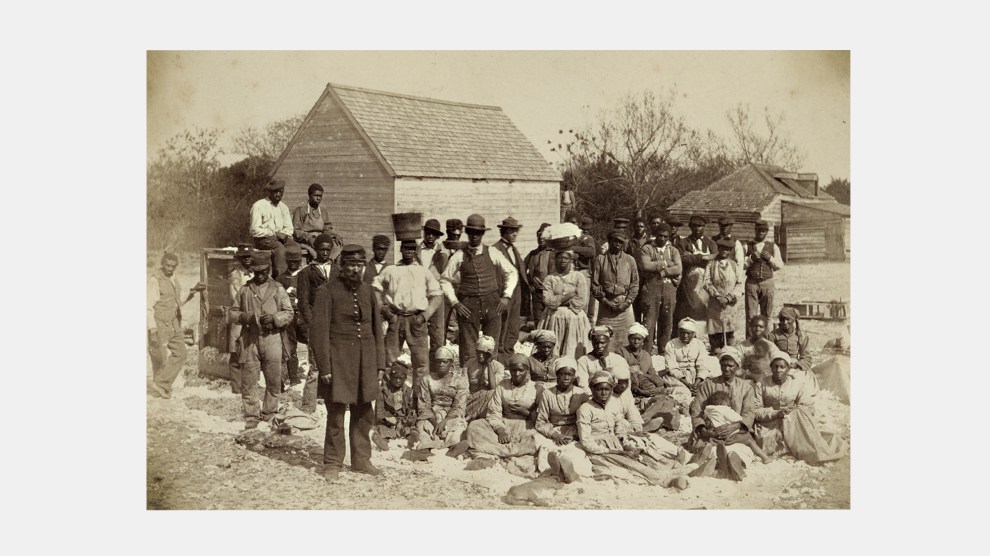
Take the formerly enslaved Black population. In 1857, the Supreme Court ruled in Dred Scott v. Sanford that Black people could never be citizens. First and foremost, the post-war Citizenship Clause was aimed at reversing that ruling. But could it have really been argued, as Trump and his legal backers contend, that the formerly enslaved fit the allegiance-for-protection mold that would make them full members of the United States’ “political jurisdiction”? They had neither consented to their presence in the country, pledged any sort of allegiance, nor had they received the protection of its laws—quite the opposite, in fact.
In March, law professors Randy Barnett and Ilan Wurman sought to shore up the Trump administration’s allegiance-for-protection theory with a New York Times op-ed. The piece drew a flurry of critiques, alleging their work was shoddy and illogical. “If being subject to US jurisdiction requires a compact trading allegiance for protection, former slaves obviously didn’t qualify,” George Mason law professor Ilya Somin wrote in Reason, in response to the op-ed. “Thus, the Barnett-Wurman theory would defeat the central purpose of the Citizenship Clause.”
Like the Trump administration’s own briefs, Barnett and Wurman relied heavily on sources that predated the 14th Amendment. This includes the following description of the English common law: “it is neither the climate nor the soil—that makes a natural-born subject, ‘but their being born within the allegiance and under the protection of the king.’”
If true, this interpretation of the Citizenship Clause, and the allegiance-for-protection framework more broadly, might have disqualified everyone born in the Confederate states during the Civil War. It was the position of the United States and the Congress that drafted the 14th Amendment that secession was illegal and therefore the states never officially left. But that was still an open question in 1866, when the amendment was drafted, leaving it unclear if the children of confederates could definitely be said to have been born on US soil.
If treason did not disqualify a traitor’s children, neither could the infraction of crossing a border.
Even if these children were born on US soil, their confederate parents were clearly not offering voluntary allegiance to the United States—they were fighting a bloody war to exit. Nor were they receiving the government’s protection, as the Union army was fighting its soldiers and destroying its towns. Certainly, children born after secession and before the end of the war were not “born within the allegiance and under the protection” of the government in Washington.
Yet no one in 1866 raised the specter that these young Southerners were not citizens, nor that the Citizenship Clause would not apply to them. As law professors Vikram Amar and Jason Mazzone recently noted, no one ever doubted it. Instead, they point out that in 1867, Sen. John Bingham successfully argued to his colleagues that even the former rebels remained “‘subject to’ U.S. ‘jurisdiction’ and thus were covered and protected by the Citizenship Clause of the Fourteenth Amendment that was in the process of being enacted.”
Clearly, this was not the kind of jurisdiction based on “allegiance” and “protection” that Barnett, Wurman, and the Trump administration are describing. In fact, in May 1865, President Andrew Johnson issued one of several blanket amnesty proclamations to broad swaths of confederates, extending an olive branch to any now willing to pledge loyalty to the United States and the Constitution. “The presumption of the amnesty proclamation is everyone committed treason,” says University of Virginia legal historian Cynthia Nicoletti, a crime of loyalty. Again, this does not seem to square with the idea of “allegiance-for-protection” as the prerequisite for citizenship.
Surely, if the crime of treason did not disqualify the traitor’s children from citizenship, then neither could the far less serious infraction of crossing the border without authorization in search of a better life.
The Trump administration’s arguments against birthright citizenship for all are ahistorical, and make no sense when considered in the context of the Civil War and its aftermath. It’s a bold argument it is asking the Supreme Court to accept—and we’ll soon find out where the justices stand.
+++++++++++++++++++++++++++++++++++++++++++++++++++++++++++++++++++++++
+++++++++++++++++++++++++++++++++++++++++++++++++++++++++++++++++++++++


No comments:
Post a Comment