Hey, Mom! The Explanation.

Here's the permanent dedicated link to my first Hey, Mom! post and the explanation of the feature it contains.

Also,

Showing posts with label grammar. Show all posts

Saturday, June 27, 2026

A Sense of Doubt blog post #4149 - SoD Reprint from 2016 - GRAMMAR POLICE: THINGS THAT SUCK #3 - The sign at Burger King


A Sense of Doubt blog post #4149 - SoD Reprint from 2016 - GRAMMAR POLICE: THINGS THAT SUCK #3 - The sign at Burger King


Today's reprint: one of my favorites.


LOW POWER MODE: I sometimes put the blog in what I call LOW POWER MODE. If you see this note, the blog is operating like a sleeping computer, maintaining static memory, but making no new computations. If I am in low power mode, it's because I do not have time to do much that's inventive, original, or even substantive on the blog. This means I am posting straight shares, limited content posts, reprints, often something qualifying for the THAT ONE THING category and other easy to make posts to keep me daily. That's the deal. Thanks for reading.

BLOG VACATION #1 - 2026 - Taking a blog vacation for a couple of weeks, until at least June 26th, 2026. Mostly reprints. A few simple shares (not that simple shares are out of the norm) and THAT ONE THING. Need time for other things.


Link to the original post I am reprinting below:

Sunday, June 12, 2016


Hey, Mom! Talking to My Mother #341 - GRAMMAR POLICE: THINGS THAT SUCK #3 - The sign at Burger King

Hi Mom, I like to take pictures of signs out in the world and question their accuracy and meaning.

I did two of these posts in the early days of the blog. Here's the links to those posts:

THINGS THAT SUCK #1: "Receipt Desired?"

THINGS THAT SUCK #2: "Please Prepay in Advance."


And so now, after a long hiatus, I have found another sign that really makes no sense. The picture above (and left) shows a sign on the fast food window at my local Burger King.

Now, look at it closely. You know what they want to communicate. People always want extra sauces. Burger King does not intend to give away extra sauce for free. So Burger King has a policy to levy a charge for sauce not normally included with the order. If an order of chicken nuggets comes with one container of sauce for dipping, and a customer wants three extra packets, then he/she will have to pay extra for those packets.

But this idea of paying extra for those three (or however many) packets is not really communicated by that sign. The sign reads: "There will be an additional charge for sauces that are not included with the item ordered."

Think about the wording of that message.

Aren't all the sauces in their box of sauces under the counter not included with my order? So, by following the sign's logic, shouldn't every customer be levied an additional charge for all the sauces in the building that have been included with the order? Actually, all the sauce packets owned by the corporation, would potentially be included in the concept of "sauces that are not included with the item ordered." Truly, all the sauce on the planet might be considered part of that group of "sauces not included," but it seems fair in this case to restrict the set to sauces owned and housed by this particular Burger King franchise as charging for sauces outside the building seems a bit unfair.

Then what about the passive voice of "there will be an additional charge" as if the charge just happens, and it is quite out of their control?

"OH, no, there's that charge for sauce again," random Burger King employee observes as the POS system rings up another sauce charge. "It just keeps happening. We can't do anything about it. After all, 'there will be an additional charge.' It will be. What can we do about what is determined "to be" by its very definition?"

No, that's just normal passive voice for the bad news in the business world. It would be much more negative , hostile, and off-putting to have a sign that reads: "We must charge you a fee of .25 cents for each additional sauce packet you request." This language would be more direct and clear, but it's too aggressive for the customer service world. People might be offended.

Possibly this phrasing would be better: "An additional .25 cents will be charged for each sauce packet requested beyond those included with the menu item." Or even, ".25 cents will be charged for each extra sauce packet requested." Because isn't it assumed that "extra" and/or "additional" implies a number beyond what is normally included?

Then what about the wording of "the order"? Not "your order." THE order. This implies the one single order. Not "this order." Instead it's "the order." It's an abstract and general case. But does it apply to "your order"? We don't know. We don't know what "the order" is because "the order" may not be "this current order, your order."

Also, the language of "the item ordered" reads in that passive voice mode, leaving YOU, the customer, out of the equation. But that's the non-personing of the customer service industry that is supposed to be dealing with persons, especially the rubber-stamped, homogeneity of the fast food industry.


"An additional .25 cents will be charged for each sauce packet requested beyond those included with the menu item."

This message seems to be a huge improvement over the one stuck to the Burger King fast food window. Is it longer? The one in the picture is 16 words. My rewrite is 19 words, but it includes the additional information of the cost per sauce packet, which is essential information if you're a customer planning to spend extra money on some sauce. And would an extra three words be a burden for clarity? The sign is already pretty large. The phrase would fit with maybe only a slight increase in sign size.

Obviously, the writers Burger King hired should take one of my classes. :-)

Reflect and connect.
Have someone give you a kiss, and tell you that I love you.
Talk to you tomorrow, Mom.
- Days ago = 343 days ago
- Bloggery committed by chris tower - 1606.12 - 10:10
NOTE on time: When I post late, I had been posting at 7:10 a.m. because Google is on Pacific Time, and so this is really 10:10 EDT. However, it still shows up on the blog in Pacific time. So, I am going to start posting at 10:10 a.m. Pacific time, intending this to be 10:10 Eastern time. I know this only matters to me, and to you, Mom. But I am not going back and changing all the 7:10 a.m. times. But I will run this note for a while. Mom, you know that I am posting at 10:10 a.m. often because this is the time of your death.
PS: I think I am going to tag John Scalzi when I post this as I think he will find it amusing. We shall see.
+++++++++++++++++++++++++++++++++++++++++++++++++++++++++++++++++++++++
+++++++++++++++++++++++++++++++++++++++++++++++++++++++++++++++++++++++
+++++++++++++++++++++++++++++++++++++++++++++++++++++++++++++++++++++++

- Bloggery committed by chris tower - 2606.27 - 10:10

- Days ago: MOM = 4013 days ago & DAD = 667 days ago

- New note - On 1807.06, I ceased daily transmission of my Hey Mom feature after three years of daily conversations. I post Hey Mom blog entries on special occasions. I post the days since ("Days Ago") count on my blog each day, and now I have a second count for Days since my Dad died on August 28, 2024. I am now in the same time zone as Google! So, when I post at 10:10 a.m. PDT to coincide with the time of Mom's death, I am now actually posting late, so it's really 1:10 p.m. EDT. But I will continue to use the time stamp of 10:10 a.m. to remember the time of her death and sometimes 13:40 EDT for the time of Dad's death. The blog entry numbering in the title has changed to reflect total Sense of Doubt posts since I began the blog on 0705.04, which include Hey Mom posts, Daily Bowie posts, and Sense of Doubt posts. Hey Mom posts will still be numbered sequentially. New Hey Mom posts will use the same format as all the other Hey Mom posts; all other posts will feature this format seen here.

Thursday, April 17, 2025

A Sense of Doubt blog post #3712 - SoD Reprint of #284 The Dread Semicolon


A Sense of Doubt blog post #3712 - SoD Reprint of #284 The Dread Semicolon


Back to reprint mode, so I can work on other original blog posts.

You know with 3711 posts, I have a lot I can reprint.

Thanks for tuning in.

The link to the original post I am reprinting below:

Saturday, April 16, 2016


LOW POWER MODE: I sometimes put the blog in what I call LOW POWER MODE. If you see this note, the blog is operating like a sleeping computer, maintaining static memory, but making no new computations. If I am in low power mode, it's because I do not have time to do much that's inventive, original, or even substantive on the blog. This means I am posting straight shares, limited content posts, reprints, often something qualifying for the THAT ONE THING category and other easy to make posts to keep me daily. That's the deal. Thanks for reading.


Hey, Mom! Talking to My Mother #284 - The Dread Semicolon

Hi Mom, I am behind again, and so today and tomorrow I am staying with some show and tell, sharing cartoons or comics with you (and any readers who join us) because that's both fun and easy and I need to catch up and I don't have much time to do it and I am fine with this run-on sentence and do not plan to punctuate it but if I wanted to punctuate it, I could use SEMI-COLONS.

We spent a lot of time revising and editing your college papers, especially your English class papers, when you returned to college, Mom. I miss those days. I apologize for ever being exasperated with how many changes we had to make and how many times we had to print those papers. They had to be perfect. I get it. I have that gene, also. Thanks a lot.

For my readers, because Mom knows, I already apologized to her for that exasperation. I am just doing to again because it's relevant. But I apologized at the time and I apologized later during all those years when she lived after the Meningitis.

Just thinking about those years of working with you, Mom, fills me with love and a deep sadness. I would like to go back to that time. Not because I left things unsaid, but because I miss you so much and that was a good time. Before you had the meningitis and I paid you back in Spades for all the years you took care of me by helping Dad take care of you, those times when you were in college were times when I could help you and show my gratitude for what a great mom you were, you are. That meant a lot to me, means a lot to me.

Anyway, now I am crying, when I was supposed to be laughing!! So on to the cartoons.

As you know, in my adventures in teaching English, I see a lot of semi-colon use, and very little of it is correct. I swear that this is the MOST often misused punctuation in the English language, which is silly, because it really only has one use. Any other uses are very rare, and the main use is somewhat common. This cartoon explains that well. And now I have a good place on my blog to send students. Ha!! Ulterior motive!

FROM THE OATMEAL: THE SEMI-COLON

All HAIL THE OATMEAL. Since I am sharing the work from THE OATMEAL with credit, go there, donate, buy stuff, enjoy it. THE OATMEAL is one of the best cartoon sites on the Internet.


Reflect and connect.
Have someone give you a kiss, and tell you that I love you.
Talk to you tomorrow, Mom.
- Days ago = 286 days ago
- Bloggery committed by chris tower - 1604.16 - 10:10

+++++++++++++++++++++++++++++++++++++++++++++++++++++++++++++++++++++++
+++++++++++++++++++++++++++++++++++++++++++++++++++++++++++++++++++++++
+++++++++++++++++++++++++++++++++++++++++++++++++++++++++++++++++++++++

- Bloggery committed by chris tower - 2504.17 - 10:10

- Days ago: MOM = 3577 days ago & DAD = 232 days ago

- New note - On 1807.06, I ceased daily transmission of my Hey Mom feature after three years of daily conversations. I post Hey Mom blog entries on special occasions. I post the days since ("Days Ago") count on my blog each day, and now I have a second count for Days since my Dad died on August 28, 2024. I am now in the same time zone as Google! So, when I post at 10:10 a.m. PDT to coincide with the time of Mom's death, I am now actually posting late, so it's really 1:10 p.m. EDT. But I will continue to use the time stamp of 10:10 a.m. to remember the time of her death and sometimes 13:40 EDT for the time of Dad's death. The blog entry numbering in the title has changed to reflect total Sense of Doubt posts since I began the blog on 0705.04, which include Hey Mom posts, Daily Bowie posts, and Sense of Doubt posts. Hey Mom posts will still be numbered sequentially. New Hey Mom posts will use the same format as all the other Hey Mom posts; all other posts will feature this format seen here.

Tuesday, August 13, 2024

A Sense of Doubt blog post #3465 - Harris-Walz and Grammar Nerds


A Sense of Doubt blog post #3465 - Harris-Walz and Grammar Nerds


I love that I just learned that there's an Apostrophe Protection Society.

Love this!

Thanks for tuning in.

Time for the COUNTDOWN!!!

https://www.270towin.com/2024-countdown-clock/

083 DAYS TO THE ELECTION


https://www.nytimes.com/2024/08/10/us/harris-walz-apostrophe-possessive.html


Is It Harris’ or Harris’s? Add a Walz, and It’s Even Trickier.

With Vice President Kamala Harris and Gov. Tim Walz running on the same ticket, grammar geeks are in overdrive.


When Vice President Kamala Harris chose Gov. Tim Walz of Minnesota as her running mate, she put to rest weeks of speculation over the future of the Democratic ticket. But the battle over apostrophes was just getting started.

Where were voters (and journalists) supposed to place the possessive squiggle?

It all felt a bit, as some social media users described, like apostrophe hell: Would it be Ms. Harris’s and Mr. Walz’s or Ms. Harris’ and Mr. Walz’s? The Harrises and the Walzes? The Harrises’ family home and the Walzes’ family dog? It was enough to see double, made worse by the fact that stylebooks, large news organizations and grammar geeks were all split or contradicted one another.

“Anyone who tells you there are universal rules to how to add an apostrophe ending in S is either wrong or lying,” Jeffrey Barg, a grammar columnist, said. “You can’t be wrong as long as you’re consistent.”

The Associated Press Stylebook, widely considered to be the gold standard among news organizations, is clear on its rule for the possessive of singular proper names ending in S — only an apostrophe is needed (Harris’), though there are always exceptions. The New York Times, The Washington Post and The Wall Street Journal all do the opposite, opting for ’s to mark a singular possessive and a simple apostrophe for plural possessive (Harrises’ and Walzes’).

Merriam-Webster, the oldest dictionary publisher in America, splits the difference: For names ending in an S or Z sound, you can add ’s or just an apostrophe, though the dictionary says ’s is the more common choice.

“People want to know what the rules are because they want to do this correctly,” said Mr. Barg, who was raised on The A.P. Stylebook. But at the same time, “you can’t impose language from the top down — it’s a bottom-up thing,” he said. “I think it’s going to be a learning experience for us as a country.”

According to Merriam-Webster, the apostrophe first appeared in the early 16th century and was originally used to indicate that something had been taken out of a word. Couple the evolution of the punctuation mark with the difficulty of the English language, which draws deeply from German and French, and problems are bound to arise. The core of the stumble falls when we go to write something that does not match how we talk.

“This is the kind of thing you get when you have three languages in a trench coat,” said Nicole Holliday, an acting associate professor of linguistics at the University of California, Berkeley.

People can easily pronounce the plural or possessive of Harris or Walz, both of which contain epenthetic schwas, Ms. Holliday said. When a word ends in an S or Z sound, we insert a schwa — the “uh”-like sound that can be represented by any vowel in the English alphabet — to break up a block of consonants.

Put two epenthetic schwas on a ticket and the so-called apostrophe hell breaks loose. She surmised that the online debate might be fueled by Democrats wanting to one-up each other in their grammar geekdom.

JD Vance, the Republican vice-presidential nominee, is in the same grammar situation with the possessive of his name, “but because we spell it with an E, nobody thinks that’s weird,” she said.

Ms. Holliday had historically used The A.P. style in her research of Ms. Harris’s linguistic choices. But she is starting to come around to using ’s on all presidential and vice-presidential candidates — Harris’s, Walz’s, Trump’s, Vance’s.

“I love an elegant solution,” she said.

Ellen Jovin, the author of “Rebel With a Clause,” said that A.P. style “causes strain on the system,” in part because in a way it splits the ticket — it’s Harris’ but Walz’s. “That’s going to freak people out,” she said.

“I feel it’s one of the more emotional hot-button grammar issues out there,” she continued. “English speakers often don’t like to see S’s jammed up against each other, which I don’t really relate to.”

But at the end of the day, withholding an extra S after Harris “just doesn’t fit what people say,” she said.

Bob McCalden, who leads the Apostrophe Protection Society in the United Kingdom, agreed.

“The challenge I would put to anyone that said, no, the possessive of Harris is just with an apostrophe, is how do you say that?” he said. By using only an apostrophe and not including an extra S, the name doesn’t flow properly, he said.

The questions of apostrophe placement regarding Harris and Walz are far from the most debated use of the punctuation mark, Mr. McCalden said. (That would be using orange’s instead of oranges.) But the discourse comes at a pivotal time for apostrophes: Thursday, Aug. 15, is International Apostrophe Day.


Just putting these down here for funsies...


+++++++++++++++++++++++++++++++++++++++++++++++++++++++++++++++++++++++
+++++++++++++++++++++++++++++++++++++++++++++++++++++++++++++++++++++++
+++++++++++++++++++++++++++++++++++++++++++++++++++++++++++++++++++++++

- Bloggery committed by chris tower - 2408.13 - 10:10

- Days ago = 3329 days ago

- New note - On 1807.06, I ceased daily transmission of my Hey Mom feature after three years of daily conversations. I plan to continue Hey Mom posts at least twice per week but will continue to post the days since ("Days Ago") count on my blog each day. The blog entry numbering in the title has changed to reflect total Sense of Doubt posts since I began the blog on 0705.04, which include Hey Mom posts, Daily Bowie posts, and Sense of Doubt posts. Hey Mom posts will still be numbered sequentially. New Hey Mom posts will use the same format as all the other Hey Mom posts; all other posts will feature this format seen here.

Saturday, August 10, 2024

A Sense of Doubt blog post #3462 - Boomer (and Gen X) Ellipses... Are you talking TO ME?


A Sense of Doubt blog post #3462 - Boomer (and Gen X) Ellipses... Are you talking TO ME?

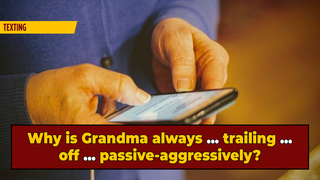
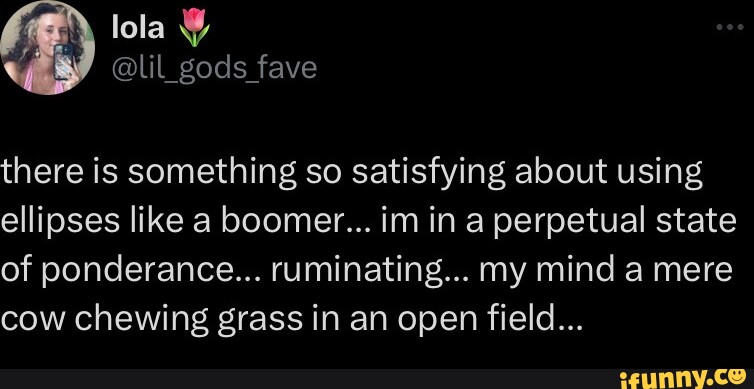
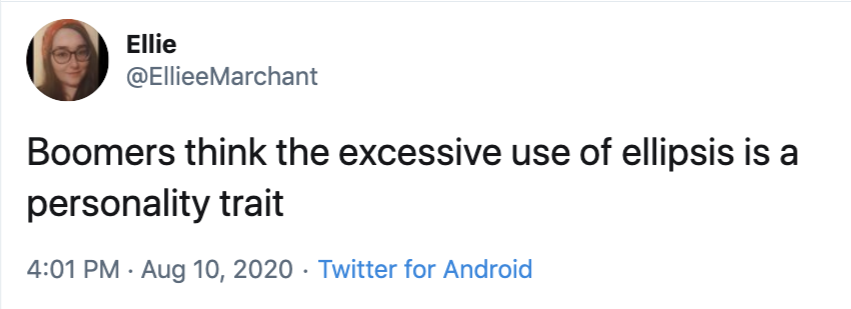
Apparently both Baby Boomers and Gen X are accused by younger generations of using ellipses in confusing ways.


Lumping Boomer and Gen Xer behavior together on this issue does not prove the point I plan to make in an upcoming post that the standard age range for Boomers is wrong and that I 100% identify with Gen X and not with Boomers.

Yet here, Boomers and Gen Xers are aligned...

:-)
LOL.


You can Google "Gen X (or Baby Boomer) ellipses meme" and get all kinds of good stuff.

There's TONS. I can't share it all, but this is the gist that I have shared here.

It resonated with me because I do it, too.

I also have old computer files with two spaces after a period that I have not converted yet.

Thanks for tuning in.


Ellipsis signifies their voice trailing off. It's inviting you to give a response or alternatives. It's an awkward, exaggerated pause for dramatic effect. It's used sarcastically. It symbolizes disappointment. It means exactly what they say, with no sarcasm. It's there just for fun.


from
https://www.reddit.com/r/GenX/comments/108t56v/so_umm_theres_that/


Maybe it's because we sort of came-of-age with stupid technology that transitioned from verbal to text? It's soooooo hard to me, still, to get the right "feel" in text. I don't know...the little dots just help man.


Not to sound like an old codger, but why do younger generations call everything passive aggressive? I was told last week that the thumbs up emoji is now borderline hate speech. Of course I replied "...whatever."


More defense

https://www.quora.com/Why-do-boomers-and-seniors-use-ellipses-in-place-of-every-piece-of-punctuation-on-Facebook-posts-Is-this-some-sort-of-outdated-grammar-construction

The use of ellipses (...) in place of other punctuation marks, such as periods, commas, or question marks, is a common phenomenon on social media platforms like Facebook, and it is not limited to just boomers and seniors. While it may not be exclusive to any particular generation, it can sometimes be more prevalent among older users who may not be as familiar with the conventions of online communication.

There are a few reasons why some people might use ellipses excessively in their online posts:

  1. Informality: Social media platforms are often more casual and conversational in nature, and some users may use ellipses as a way to convey a sense of informality or a more relaxed tone in their writing.
  2. Pause or Emphasis: Ellipses can be used to indicate a pause in speech or writing, or to create a sense of suspense or emphasis. Some users may use them as a stylistic choice to add a certain rhythm or flow to their posts.
  3. Uncertainty or Hesitation: In some cases, people may use ellipses as a way to convey uncertainty, hesitation, or a trailing off of thought. It can be a way to signal that there is more to say or that the thought is not fully formed.
  4. Lack of Familiarity with Punctuation: Some users, particularly those who are not as familiar with standard punctuation conventions or who may be typing on mobile devices, might use ellipses as a catch-all for various types of punctuation.

While the use of ellipses in place of other punctuation marks may not adhere to traditional grammar rules, it is important to recognize that language use is constantly evolving, especially in digital communication. Different people have different writing styles, and what may seem like incorrect or excessive use of ellipses to some may be seen as a valid form of expression by others.

In conclusion, the use of ellipses in place of other punctuation marks on social media is not necessarily an outdated grammar construction. It is more of a stylistic choice that some users make for various reasons, including informality, emphasis, uncertainty, or simply out of habit.


I've asked this myself more than once (older millennial), and have spent quite a bit of time talking to my elders, strangers and friends and family. Interpreting what I've gathered, it seems to stem from the technology divide. Younger folks, who have grown up with instant communication, autocorrect and emojis are used to rapid fire thought, delivered in lieu of face-to-face speech. It's fast, imprecise, and generally pretty forgiving…provided you know the lingo. If you didn't grow up with texting, predictive Google searches, memes and the like, electronic communication tends to fall in a void somewhere between writing a handwritten note and a term paper. It isn't formal, per say. But it isn't viewed as being as free and easy as younger people treat it. The ellipses (…) are intended to imply thoughtful pauses or to simulate the natural gaps that happen all the time in spoken conversation as speakers collect their thoughts and formulate a response. Young people see…this…(naturally) as words unspoken or subtextual cues (e.g. being passive aggressive). But elder folk use ellipses to give a visual cadence to what they are treating as conversational writing. As far as I can tell, it’s analogous to unspoken “ums," “hmms," and “huhs.”


The Ellipsis is Widening the Gap Between Millennials and Boomers. Here’s Why

Published Jun 28, 2021

https://www.purewow.com/tech/why-do-boomers-use-ellipses

Imagine you’re playing charades. You draw a card that prompts you to act out a phone conversation. What shape does your hand take? If you’re over the age of 15, you’ll probably extend your thumb and pinky fingers to create the surfer’s gesture and raise the symbol up to your ear. If you’re a young teen or kid who grew up surrounded by smart devices (rather than flip phones or handsets), you might curl your hand like you’re holding a brick or simply stretch your palm out flat before beginning your mimed chat. You’re probably also wondering, “What the hell is charades?”

The viral phone challenge stunned TikTok last year, with Millennial and Gen X parents watching in disbelief as their kids clutched pretend iPhones. But it’s not the first time the app has exposed these generational splits. Users have poked fun at Baby Boomers and their penchant for decorative signs encouraging us to “Live, Laugh, Love.” They’ve also cast Millennial women as “cheugy” for sporting side parts and clapping along to the Friends theme song.

And now, the people of TikTok have taken aim at older adults for a particular grammatical choice: Their puzzling useand overuseof the ellipsis.

“I emailed a professor to schedule a meeting to go over some classes and he replied with ‘Sounds good…we can meet then.’ I thought he hated me,” TikTok user @heyanoushka lamented in a viral video last month. “I will spend 10 minutes trying to interpret the tone of this ellipsis,” TikToker @megalybrak captioned a montage of e-mails from their manager. So what’s the deal with the ellipsis and why is it causing so much intergenerational confusion? We chatted with Gretchen McCulloch, Internet Linguist and author of Because Internet: Understanding the New Rules of Language, to learn more about the beloved Boomer punctuation and how the three dots are widening the age gap online. 


The ellipsis has pre-internet roots

Turns out, people were sprinkling their phrases with ellipses long before texts and Facebook comments existedA look back at casual written communication of the past—old postcards, recipe books and informal notes—clued McCulloch into the intended use of the punctuation. “When we think about informal pre-internet writing, space was at a premium. If you’re sending someone a postcard, but you only have a small box to write in, you won’t speak in full sentences,” she points out. To save real estate on the page, the writer would string together thoughts using ellipses and dashes, rather than penning longer, formal sentences with periods. You wouldn’t want someone to read your brownies recipe only to discover you didn’t have space to include bake time or cooling instructions, right?  

But we no longer have to worry about running out of room on the recipe card. “It seems to be that using a dot-dot-dot imports an offline norm into an internet space,” McCulloch notes. The internet gives our words room to breathe. With the vast digital expanse at our disposal, we’re free to use as many line breaks as we’d like in e-mails or fire off 20 texts in a group chat. Run out of characters in a tweet? Simply pick up where you left off with a new tweet reply (or five). And as for that recipe? Write an entire essay about your childhood before getting to the instructions for the perfect double-chocolate brownie.

Why does it feel so foreign to younger people?

So why do the dots cause so much drama compared to the innocuous dash or comma? To the younger crowd—whose first words to their crush probably went down on Instant Messenger—the ellipsis has taken on an entirely different meaning. “For people who primarily use line breaks as a way of separating their thoughts, the dot-dot-dot is then available for another meaning, and that other meaning is something left unsaid,” McCulloch tells us. To Millennials, the three dots are a punctuational bridge to nowhere, signaling hesitation, trailing off or—at worst—passive aggression. “I can’t wait to see your presentation…” suggests a continuation the writer is thinking, but won’t actually come forward with, like, “…because it’s sure to be a disaster.”

Clearly, letting your reader fill in the blanks does more harm than good. “If you’re constantly assuming your boss is sending you messages with something left unsaid, you’re going to think, ‘Is my boss mad at me?,’ whereas your boss is just trying to be informal and relaxed,” says McCulloch. The ellipsis? Relaxed? We know, it’s hard to believe.

To older adults, digital communication doesn’t carry all the nuance

Although it’s unfathomable to younger generations, McCulloch says that most older adults aren’t sending digital messages with tone in mind. “People who use the ellipsis like that are not even aware that social media writing is capable of conveying passive aggressiveness and they’re definitely not being passive aggressive,” she explains. While Millennials are hyperconscious of how their digital communication is perceived (see: ensuring our emails have the correct exclamation-point-to-period ratio), this isn’t always the case for Baby Boomers, whose messaging skews more direct.  

McCulloch tells us older adults think using an ellipsis is simply the correct form when it comes to informal speech. “The imagined audience for older people is not the actual people they’re writing to. Their imagined audience is still their memory of their grade-school English teacher,” she notes. For quick exchanges, you wanted your writing to sound like you were speaking. According to the “invisible grammarian” McCulloch says Boomers still have in mind, the proper way to bring together informal thoughts is with an ellipsis. “The dot-dot-dot is trying to be casual,” she stresses.


When in doubt, overcommunicate

As someone of either generation, how can we be more mindful of these communication quirks? Start by being open and accepting of all styles of online communication. McCulloch tells us to approach these punctuation differences like we're chatting with someone who has a different accent. “It’s not like one of them has to be right and the other has to be wrong. You don’t have to have one right answer, but it is really useful for people to be aware that this is a thing that a whole section of people do on a regular basis, so you know which kind of accent you’re communicating with in terms of digital punctuation style,” she explains. 

And if you’re not clear on what someone’s really getting at in their text or Slack message, ask! “Have these overt meta conversations,” suggests McCulloch. “You can say, 'When you said this, were you mad at me?'" It’s better to have an honest chat than assume your father-in-law or co-worker secretly hates you. And if someone actually is frustrated with you, it’s their responsibility to convey their feelings through a direct conversation; not via a few dots in an e-mail.

This isn’t the first mix-up and it won’t be the last

The cool thing about colloquial language? It’s always changing. McCulloch reminds us of a time when internet newcomers typed in all caps. Remember calling your parents to explain that their text messages make it seem like they’re yelling at everyone? (Remember calling someone about anything, period?) McCulloch says it spurred larger cultural conversations, with explainer videos and memes surrounding the caps lock phenomenon. “Now, no one has to do that anymore because people do know that all caps is shouting,” she says. 

More change across our keyboards is inevitable. Younger generations will usher in new forms of digital language, and we’ll all try to keep up. “We don’t want to get too hung up thinking we’ve discovered the right way to do things because we’re just going to get proven wrong again,” says McCulloch. So just wait. Before you know it, Generation Alpha (aka the iPad kids) will be eager to make fun of your “main character aesthetic” and that cat sweater you’re wearing ironically.


+++++++++++++++++++++++++++++++++++++++++++++++++++++++++++++++++++++++
+++++++++++++++++++++++++++++++++++++++++++++++++++++++++++++++++++++++
+++++++++++++++++++++++++++++++++++++++++++++++++++++++++++++++++++++++

- Bloggery committed by chris tower - 2408.10 - 10:10

- Days ago = 3326 days ago

- New note - On 1807.06, I ceased daily transmission of my Hey Mom feature after three years of daily conversations. I plan to continue Hey Mom posts at least twice per week but will continue to post the days since ("Days Ago") count on my blog each day. The blog entry numbering in the title has changed to reflect total Sense of Doubt posts since I began the blog on 0705.04, which include Hey Mom posts, Daily Bowie posts, and Sense of Doubt posts. Hey Mom posts will still be numbered sequentially. New Hey Mom posts will use the same format as all the other Hey Mom posts; all other posts will feature this format seen here.