Though the current project started as a series of posts charting my grief journey after the death of my mother, I am no longer actively grieving. Now, the blog charts a conversation in living, mainly whatever I want it to be. This is an activity that goes well with the theme of this blog (updated 2018). The Sense of Doubt blog is dedicated to my motto: EMBRACE UNCERTAINTY. I promote questioning everything because just when I think I know something is concrete, I find out that it’s not.
Hey, Mom! The Explanation.
Here's the permanent dedicated link to my first Hey, Mom! post and the explanation of the feature it contains.
The Doomsday Clock - which shows how symbolically close the world is to nuclear Armageddon - is to remain at 90 seconds to midnight.
Scientists have listed reasons for keeping its hands the closest they have ever been to "Doomsday" - but stopped short of nudging it further forward.
The threat of a new nuclear arms race, the Ukraine war and climate change concerns were all factors, they said.
The clock is set annually by the Bulletin of the Atomic Scientists.
Since 2007, members have considered the impact of new man-made risks such as AI and climate change, as well as the greatest threat - nuclear war.
In its 2024 announcement on Tuesday, the Bulletin said that China, Russia and the US were all spending huge sums to "expand or modernise their nuclear arsenals" - which added to the "ever-present danger of nuclear war through mistake or miscalculation".
The war in Ukraine had also created an "ever-present risk of nuclear escalation", it said.
A lack of action on climate change and risks linked to "misusing" emerging biological technologies and Artificial Intelligence (AI) tools were also cited.
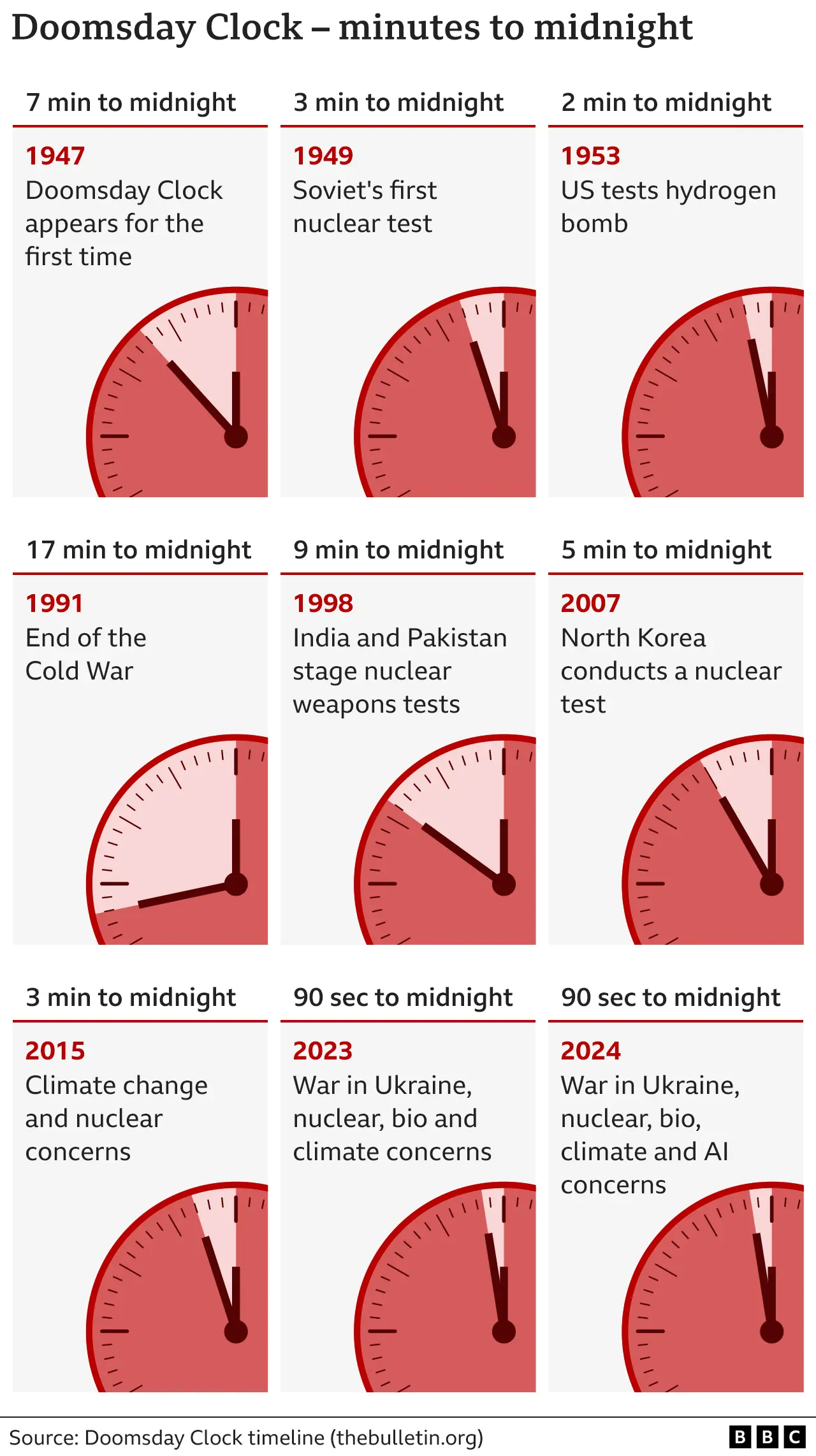
The Doomsday Clock was created in 1947 by J Robert Oppenheimer and fellow US scientists who had developed the atomic bomb.
They had seen its devastating effects two years earlier, at the end of World War Two, on the Japanese cities of Hiroshima and Nagasaki. They wanted to warn the public and put pressure on world leaders to make sure nuclear weapons were never used again.
The hands of the clock have moved 25 times. In 1947, they started at seven minutes to midnight. At the end of the Cold War, in 1991, they had fallen back to 17 minutes to midnight.
Bulletin president Rachel Bronson told the BBC that "every major country, including the UK, is investing in their nuclear arsenal as if nuclear weapons are usable for a very long time. This is a very dangerous time… leaders are not acting responsibly."
Pavel Podvig, a Russian nuclear weapons expert who has been involved in setting the Doomsday Clock for many years, says he was shocked when President Putin put Russia's nuclear forces on alert after the invasion of Ukraine.
The world reacted with horror to the Russian leader's threat but it seems he had made a deliberate calculation.
"This is exactly what nuclear weapons are there for - to make certain you have a certain freedom of action," Podvig says. "The Russian President believed that by making these statements he could deter the West from intervening in Ukraine which was a correct calculation - this is how deterrence works."

Despite decades of arms control agreements there are still about 13,000 nuclear warheads globally, 90% of them Russian and American. Six other countries are declared nuclear powers: the UK, France, China, India, Pakistan and North Korea. Israel is widely believed to have these weapons, but has never confirmed it. Most modern nuclear weapons are many times more powerful than those that destroyed Hiroshima and Nagasaki.
In 2021, the UK increased the cap on its warheads from 225 to 260, potentially 35 more warheads, and the country's nuclear force is on high alert. Since the war in Ukraine began, there has been rhetoric from senior Russian figures suggesting Moscow's nuclear weapons could be used against the UK.
The UK's nuclear deterrent is housed in the west of Scotland at the Faslane base, home to four Vanguard submarines that carry Trident missiles armed with nuclear warheads.

HMS Vigilant, one of the UK's Vanguard submarines, stationed at Faslane
Feargal Dalton, a former Lt Cdr who served on board submarine HMS Victorious, is one of a handful of people who have actually fired a Trident missile: a test missile with a dummy warhead.
"There's always one [submarine] somewhere out there, at 15 minutes notice to fire," Dalton says. "As we speak there is a nuclear deterrent out there. The Vladimir Putins of the world know it's out there, it's credible and we could use it if needs be."
Ever since the atomic bomb was created there has been opposition to these weapons. In the 1980s, the women of the Greenham Common peace camp fought to get all US nuclear missiles removed from UK soil - the last warheads left in 2008.
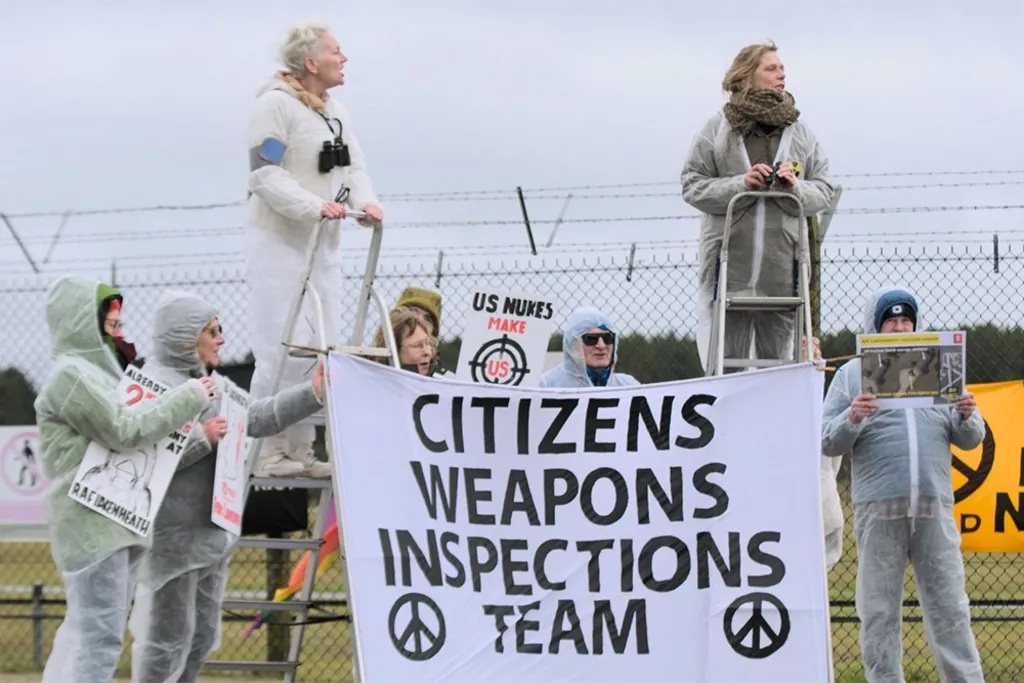
CND protesters at RAF Lakenheath in Suffolk
However, at RAF Lakenheath in Suffolk the Campaign for Nuclear Disarmament (CND) is now protesting against the possibility of US weapons returning.
Pentagon documents - first reported by the Federation of American Scientists - suggest US "special" weapons will be stationed at the base. US fighter planes that are capable of dropping such weapons arrived at Lakenheath in 2021 and there are now plans by the United States Air Force to build dormitories for troops to serve in a potential nuclear mission on this site.
"We know that we have got public opinion on our side," Sophie Bolt from CND explains - as her small group chant slogans over the perimeter fence of the base. "Nearly 60% of the population do not want to have nuclear bombs sited in Britain.
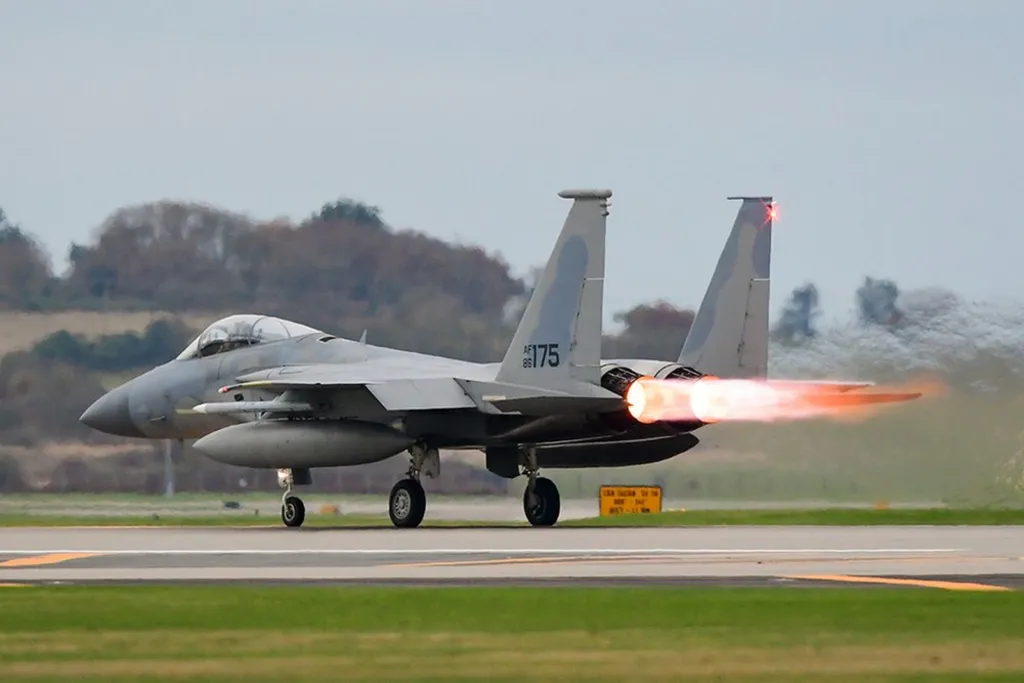
RAF Lakenheath is home to the US Air Force's 48th Fighter Wing
"We've got nothing to do with this base, it is totally under US control," Alan Wright, another protestor says. "If we get Trump in [the White House] next time and he may press the button because he's got a bigger button than Putin - then we are a target."
However, Donald Trump has previously said he would end the war in Ukraine within 24 hours of being elected, although he hasn't explained how. Some analysts believe it is likely that US support for Ukraine could be diminished.
In the past decade, fears of a nuclear war have also been ramped up by Kim Jong-Un, leader of North Korea, the latest nation to join the nuclear club. He has boasted of testing nuclear-capable missiles that could reach the United States.
Former Bulletin of Atomic Scientists member and Doomsday Clock adviser, Sig Hecker, has visited North Korea's nuclear facilities seven times as part of a scientific research programme and estimates it could have 50 to 60 nuclear warheads by now.
"Nuclear weapons, nuclear terrorism, nuclear proliferation - it's all going in the wrong direction," he says.
- Bloggery committed by chris tower - 2402,27 - 10:10
- Days ago = 3161 days ago
- New note - On 1807.06, I ceased daily transmission of my Hey Mom feature after three years of daily conversations. I plan to continue Hey Mom posts at least twice per week but will continue to post the days since ("Days Ago") count on my blog each day. The blog entry numbering in the title has changed to reflect total Sense of Doubt posts since I began the blog on 0705.04, which include Hey Mom posts, Daily Bowie posts, and Sense of Doubt posts. Hey Mom posts will still be numbered sequentially. New Hey Mom posts will use the same format as all the other Hey Mom posts; all other posts will feature this format seen here.
When I was 24, I watched a small white car through the 4X scope attached to my M240B machine gun. The weapon rested on the wall of a rooftop on the outskirts of the city of Tal Afar, Iraq. The street down which the car drove was otherwise empty, the United States Army having previously informed the citizens of Tal Afar to evacuate their city or find themselves caught between military-strength deadliness and the people toward whom that deadliness was meant to be applied.
Though the day was hot and hazy, and I had been awake for all but a few of the preceding 48 hours, it was unmistakably clear that from a window of the small white car the occupant of the passenger seat had unfurled a white flag of truce. This was plain even without the aid of magnification provided by my scope. Through the scope, I saw a man in the passenger seat and a woman driving. They were old, and though I can’t say with any certainty how old, their age registered immediately as an important characteristic. Old people rarely try to kill American soldiers. I believe this to be both historically true and true in that place and at that time. Old couples waving white flags of truce from windows of small white cars are exceedingly unthreatening, even in a place like Tal Afar in September 2004, where many of the young men were very dangerous, including and perhaps especially us.
Someone said, “What ya got, Powers?” And I said: “Nothing. Just an old couple trying to get out.” There were perhaps a dozen people on that rooftop, some of whom I knew about as well as you can know a person, others whom I had only met a couple of days earlier. I think someone got on the radio but I can’t say that for sure. I do know that none of the people on that rooftop were afraid of the old man and the old woman in the small white car. Some distance away from us, perhaps on another rooftop, another group of soldiers had been watching the same white car, though I did not know that yet.
I don’t remember how much time passed between my saying, “It’s nothing,” and someone in that other group of soldiers opening fire, but it was likely less than 10 seconds. And I don’t know why they did it. But I know that .50-caliber machine-gun rounds tore into the small white car and tore into the old man and the old woman until the small white car stopped moving and the old man and the old woman were both dead. So it goes. They have been dying in my mind every day for the last 14 years. I suspect they will do so until I’ve exhausted my own days on this earth. This is my moment trapped in amber.
I am now 38. I live in a rented house in Pittsboro, N.C., with my wife, my two daughters and my dog. I try to be kind. I try not to hurt people. And though I have just told you all the things I know with certainty about that day in September in Tal Afar, Iraq, when I was 24, I’m still not sure what it means. I don’t know if my being there in that place and at that time makes me a bad person, but on most days I think it means I do not get to claim to be a good one.
There is an eminently useful thought experiment with which I suspect you are familiar. It goes something like, “What would an alien think of ____?” The blank is typically filled in with something like sex, or our destructive relationship to the natural world, or money. War is sometimes used to fill that blank, too. The point of the thought experiment is to invent a kind of critical distance between a particular aspect of human behavior and ourselves, the ones behaving un-self-consciously like humans.
This thought experiment is useful precisely because it forces a perspective so separate, or alien, that with a little luck we gain some insight into why we are the way we are or why we do the things we do, like procreate, or poison our habitat, or hoard digital proxies for paper proxies for bits of rare but not all that rare metals, or watch old people get machine-gunned to death, or firebomb medium-size German cities. I’ve often thought that “Slaughterhouse-Five” is a variation on this kind of thought experiment; it has few if any equals in creating the kind of distance that can offer insight into the mass insanity of modern warfare.
But it is so much more than a uniquely useful thought experiment on war. It is equally remarkable in the innovative way its structure is married to, and made necessary by, the story itself. Just before his capture by the Germans during the war, our hero, Billy Pilgrim, becomes “unstuck in time.” Later in the narrative we learn that this is a consequence of Billy’s subsequent abduction by Tralfamadorians, aliens who happen to be unbound by the normal limitations of time and space. Through this ingenuous device Kurt Vonnegut shows the past as an irresistible force, particularly in the case of those who have trauma at the center of their experience.
The war intrudes on Billy’s later life in a way that will be immediately familiar to those who have fought in one. His past arrives without invitation, bouncing between the war, his childhood and his unremarkable later life as an optometrist, which is itself punctuated by visits to mental and veterans hospitals. As the narrative progresses we begin to understand that for a man who has witnessed the horrors that Billy has, the Tralfamadorians’ belief that the past, present and future are merely the primitive notions of Earthlings starts to sound like a comforting explanation for the intrusive nature of traumatic experience.
This all may sound very strange to you. It is, beautifully strange. But let me be more direct about what I really think this book is. “Slaughterhouse-Five” is wisdom literature. It is a book of awe and humbling clarity. Its lessons are so simple that by adulthood most of us have forgotten or taken them for granted only to be stunned upon being reacquainted with their fundamental gravity.
Through the little green eyes of Billy Pilgrim’s Tralfamadorian captors, we see ourselves as mere human beings, mortal animals utterly stripped of our pretensions. Our crimes become both monumental and quotidian. Our grief and our destiny both inevitable. This may sound cynical or nihilistic, but I would argue that this book is among the most humane works of art ever created. It is concerned with and dedicated to the alleviation and prevention of human suffering in the face of its inevitability, and I can think of no braver moral position to take than that one. I’ve relied on it as a touchstone in my life. You can have Job. I’ll throw in my lot with Billy Pilgrim.
In the singularly brilliant introductory chapter, Vonnegut tells us in his own voice how he came to write this book. It was born from his experiences as a young Army private taken prisoner in World War II, witness to both the brutality of the German war machine and the catastrophic Allied firebombing of Dresden. Near the end of the chapter he writes the following: “I have told my sons that they are not under any circumstances to take part in massacres, and that the news of massacres of enemies is not to fill them with satisfaction or glee. I have also told them not to work for companies which make massacre machinery, and to express contempt for people who think we need machinery like that.”
This is merely one example of Vonnegut’s unmatched moral clarity. He, more than any other writer I can think of, could cut through cant and sophistry and dissembling to expose our collective self-deceptions for what they are. His sentences are accusations that let you keep your dignity. And for those of us who recognize ourselves in those accusations, that generosity is a rare gift. Few among us will ever write something so plainly and undeniably true that its honesty feels provocative even 50 years after it first appears in print, but Vonnegut did when he wrote “Slaughterhouse-Five.” I, for one, am grateful it exists.
Kevin Powers is the author of two novels, “The Yellow Birds,” a National Book Award finalist, and “A Shout in the Ruins,” as well as a poetry collection, “Letter Composed During a Lull in the Fighting.”
This essay is adapted from the introduction to a new, 50th-anniversary edition of “Slaughterhouse-Five,” by Kurt Vonnegut, published this month by Modern Library.
A version of this article appears in print on March 24, 2019, Page 13 of the Sunday Book Review with the headline: ‘Slaughterhouse-Five’ at 50. Order Reprints | Today’s Paper | Subscribe
- Bloggery committed by chris tower - 2301.04 - 10:10
- Days ago = 2742 days ago
- New note - On 1807.06, I ceased daily transmission of my Hey Mom feature after three years of daily conversations. I plan to continue Hey Mom posts at least twice per week but will continue to post the days since ("Days Ago") count on my blog each day. The blog entry numbering in the title has changed to reflect total Sense of Doubt posts since I began the blog on 0705.04, which include Hey Mom posts, Daily Bowie posts, and Sense of Doubt posts. Hey Mom posts will still be numbered sequentially. New Hey Mom posts will use the same format as all the other Hey Mom posts; all other posts will feature this format seen here.
A Sense of Doubt blog post #2610 - Pink Floyd's First Single in 28 Years: FOR UKRAINE: Musical Monday for 2204.11
Just a share today because this is awesome.
Thanks for tuning in today.
ENJOY.
Blog Vacation Two 2022 - Vacation II Post #47
I took a "Blog Vacation" in 2021 from August 31st to October 14th. I did not stop posting daily; I just put the blog in a low power rotation and mostly kept it off social media. Like that vacation, for this second blog vacation now in 2022, I am alternating between reprints, shares with little to no commentary, and THAT ONE THING, which is an image from the folder with a few thoughts scribbled along with it. I am alternating these three modes as long as the vacation lasts (not sure how long), pre-publishing the posts, and not always pushing them to social media.
'Hey Hey Rise Up', released in support of the people of Ukraine, sees David Gilmour and Nick Mason joined by long time Pink Floyd bass player Guy Pratt and Nitin Sawhney on keyboards, all accompanying an extraordinary vocal by Andriy Khlyvnyuk of Ukrainian band Boombox. All proceeds go to Ukrainian Humanitarian Relief.
This is the first new original music that they have recorded together as a band since 1994’s The Division Bell.
The track uses Andriy’s vocals taken from his Instagram post of him in Kyiv’s Sofiyskaya Square singing ‘The Red Viburnum In The Meadow’, a rousing Ukrainian protest song written during the first world war. The title of the Pink Floyd track is taken from the last line of the song which translates as ‘Hey, hey, rise up and rejoice’. The song’s opening choral parts are by Ukrainian VERYOVKA Folk Song and Dance Ensemble.
Gilmour, who has a Ukrainian daughter-in-law and grandchildren says: “We, like so many, have been feeling the fury and the frustration of this vile act of an independent, peaceful democratic country being invaded and having its people murdered by one of the world's major powers”.
Gilmour explains how he came to know Andriy and his band Boombox. “In 2015, I played a show at Koko in London in support of the Belarus Free Theatre, whose members have been imprisoned. Pussy Riot and the Ukrainian band, Boombox, were also on the bill. They were supposed to do their own set, but their singer Andriy had visa problems, so the rest of the band backed me for my set - we played Wish You Were Here for Andriy that night. Recently I read that Andriy had left his American tour with Boombox, had gone back to Ukraine, and joined up with the Territorial Defense. Then I saw this incredible video on Instagram, where he stands in a square in Kyiv with this beautiful gold-domed church and sings in the silence of a city with no traffic or background noise because of the war. It was a powerful moment that made me want to put it to music.”
While writing the music for the track, David managed to speak with Andriy from his hospital bed in Kyiv where he was recovering from a mortar shrapnel injury. “I played him a little bit of the song down the phone line and he gave me his blessing. We both hope to do something together in person in the future.”
Speaking about the track Gilmour says, “I hope it will receive wide support and publicity. We want to raise funds for humanitarian charities, and raise morale. We want express our support for Ukraine and in that way, show that most of the world thinks that it is totally wrong for a superpower to invade the independent democratic country that Ukraine has become.”
The video for ‘Hey Hey Rise Up’ was filmed by acclaimed director Mat Whitecross and shot on the same day as the track was recorded. David Gilmour “We recorded the track and video in our barn where we did all our Von Trapped Family live streams during lockdown. It's the same room that we did the 'Barn Jams' with Rick Wright back in 2007. Janina Pedan made the set in a day and we had Andriy singing on the screen while we played, so the four of us had a vocalist, albeit not one who was physically present with us.”
The artwork for the track features a painting of the national flower of Ukraine, the sunflower, by the Cuban artist, Yosan Leon. The cover of the single is a direct reference to the woman who was seen around the world giving sunflower seeds to Russian soldiers and telling them to carry them in their pockets so that when they die, sunflowers will grow.
“I rang Nick up and said: ‘listen, I want to do this thing for Ukraine. I’d be really happy if you played on it and I’d also be really happy if you’d agree to us putting it out as Pink Floyd.’ And he was absolutely on for that.
In 2015, David Gilmour was scheduled to play a concert in London with the Ukrainian band BoomBox. As he explained in a recent statement, the band’s lead singer Andriy Khlyvnyuk had trouble with his visa, leaving the rest of the Boombox to back Gilmour on a version of “Wish You Were Here.” That song’s sentiments took on an entirely different kind of urgency last month after Russia invaded Ukraine.
“Recently I read that Andriy had left his American tour with BoomBox, had gone back to Ukraine, and joined up with the Territorial Defense,” said Gilmour. “Then I saw this incredible video on Instagram, where he stands in a square in Kyiv with this beautiful gold-domed church and sings in the silence of a city with no traffic or background noise because of the war. It was a powerful moment that made me want to put it to music.”
The song Khlyvnyuk sings is “Oh, the Red Viburnum in the Meadow,” a “1914 protest song,” The Guardian reports, “written in honor of the Sich Riflemen who fought both in the first world war and the Ukrainian war of independence.” Gilmour decided to go further and use the “big platform” of Pink Floyd to release a single by the band – their first original song in 28 years. He called drummer Nick Mason and they recorded the track in Gilmour’s barn with bassist Guy Pratt and keyboardist Nitin Sawhney.
Released as “Hey, Hey, Rise Up” – with Khlyvnyuk’s approval (Gilmour says it took some doing to track him down) – the track’s proceeds will be donated to the Ukraine Humanitarian Relief Fund. It’s probably safe to say that this is not a Pink Floyd reunion. Gilmour insisted the band was done when keyboardist Richard Wright died in 2008. “This is the end,” he told the BBC, and there’s little reason to think he’s gearing up for a tour or a new Pink Floyd album now.
Instead, “Hey, Hey, Rise Up” is part of a larger protest by Gilmour, who writes of his Ukrainian daughter-in-law Janina, his grandchildren, and his “extended Ukrainian family” as a very personal connection to the news of the invasion. But he also wants to give young Ukrainians like Khlyvnyuk – who had no idea the world was watching – a larger voice and give voice to the shock and horror felt the world over as civilian deaths and atrocities mount. As he wrote in his statement:
We, like so many, have been feeling the fury and the frustration of this vile act of an independent, peaceful democratic country being invaded and having its people murdered by one of the world’s major powers… We want to express our support for Ukraine and in that way, show that most of the world thinks that it is totally wrong for a superpower to invade the independent democratic country that Ukraine has become.
Gilmour has pulled all his solo records and Pink Floyd’s catalogue post-1987 from streaming services in Russia. As for speculation that Roger Waters blocked the removal of earlier Pink Floyd material, or controversies over Waters’ statements to Russia Today and other outlets – “Let’s just say I was disappointed and let’s move on,” says Gilmour.
He’s more interested in talking about the war and Khlyvnyuk’s experiences. “He said he had the most hellish day you could imagine,” when Gilmour spoke to him and sent him the song — a day spent “picking up bodies of Ukrainians, Ukrainian children, helping with the clearing up. You know, our little problems become pathetic and tiny,” he says, “in the context of what you see him doing.”
See the English translation of the song just below:
In the meadow a red viburnum has bent down low Our glorious Ukraine has been troubled so And we’ll take that red viburnum and we will raise it up And we, our glorious Ukraine shall, hey—hey, rise up—and rejoice! And we’ll take that red viburnum and we will raise it up And we, our glorious Ukraine shall, hey—hey, rise up and rejoice!
- Bloggery committed by chris tower - 2204.11 - 10:10
- Days ago = 2474 days ago
- New note - On 1807.06, I ceased daily transmission of my Hey Mom feature after three years of daily conversations. I plan to continue Hey Mom posts at least twice per week but will continue to post the days since ("Days Ago") count on my blog each day. The blog entry numbering in the title has changed to reflect total Sense of Doubt posts since I began the blog on 0705.04, which include Hey Mom posts, Daily Bowie posts, and Sense of Doubt posts. Hey Mom posts will still be numbered sequentially. New Hey Mom posts will use the same format as all the other Hey Mom posts; all other posts will feature this format seen here.
A Sense of Doubt blog post #2570 - WAR IS HELL - THAT ONE THING
In the 1970s ('73-'75 specifically), Marvel published a comic called War is Hell.
It seems timely to remind the world of this epithet -- "War is Hell" -- at this time given what is happening in Ukraine.
Hello.
This is THAT ONE THING.
And just to be how I am, I added a few more covers.
Check out the racist imagery on #12.
Blog Vacation Two 2022 - Vacation II Post #07
I took a "Blog Vacation" in 2021 from August 31st to October 14th. I did not stop posting daily; I just put the blog in a low power rotation and mostly kept it off social media. Like that vacation, for this second blog vacation now in 2022, I am alternating between reprints, shares with little to no commentary, and THAT ONE THING, which is an image from the folder with a few thoughts scribbled along with it. I am alternating these three modes as long as the vacation lasts (not sure how long), pre-publishing the posts, and not always pushing them to social media.
- Bloggery committed by chris tower - 2203.02 - 10:10
- Days ago = 2484 days ago
- New note - On 1807.06, I ceased daily transmission of my Hey Mom feature after three years of daily conversations. I plan to continue Hey Mom posts at least twice per week but will continue to post the days since ("Days Ago") count on my blog each day. The blog entry numbering in the title has changed to reflect total Sense of Doubt posts since I began the blog on 0705.04, which include Hey Mom posts, Daily Bowie posts, and Sense of Doubt posts. Hey Mom posts will still be numbered sequentially. New Hey Mom posts will use the same format as all the other Hey Mom posts; all other posts will feature this format seen here.