Though the current project started as a series of posts charting my grief journey after the death of my mother, I am no longer actively grieving. Now, the blog charts a conversation in living, mainly whatever I want it to be. This is an activity that goes well with the theme of this blog (updated 2018). The Sense of Doubt blog is dedicated to my motto: EMBRACE UNCERTAINTY. I promote questioning everything because just when I think I know something is concrete, I find out that it’s not.
Hey, Mom! The Explanation.
Here's the permanent dedicated link to my first Hey, Mom! post and the explanation of the feature it contains.
A Sense of Doubt blog post #4222 - STAR TREK DAY - 60th Anniversary of the Best Show Ever!
I love STAR TREK.
No surprise for people who know me.
I actually do not rate it as the best TV show ever. That's the latest Battlestar Galactia as well as Chernobyl, Buffy the Vampire Slayer, and Lost. Others might say Breaking Bad or Six Under, but I have not watched those series in their entirety.
Long before Star Wars came out, there was Star Trek.
I was kind of young for the original broadcasts. I saw most if not all of it in re-runs in the after school two hours of Bugs Bunny, Gilligan's Island, and then Star Trek.
Though there was a lot of Brady Bunch and Partridge Family mixed in there, too.
Star Trek has been a great love that has carried through my whole life.
I bonded with college friends watching the original series.
I bonded with post-college friends and collabortaed on a novel with the original cast (never published).
I found a Star Trek fan group in my new home out west here, and though I do not attend often enough, I am glad that they exist.
On September 8, 1966, Star Trek: The Original Series made its television debut, introducing audiences to Gene Roddenberry’s vision of a future built around exploration, optimism and discovery. Six decades later, that vision has grown into one of entertainment’s most enduring franchises, spanning 11 television series, 14 films and more than 900 episodes.
For John Van Citters, VP of Brand Development for Star Trek, the franchise’s longevity comes back to what has been at its core from the beginning. “What really separates Star Trek and has given it enduring appeal across generations is that it’s a brand of values,” he says. “Gene Roddenberry’s original construct has shown itself time and again to be malleable across different shows and characters to remain relevant to new generations of viewers.”
This year, the franchise’s annual Star Trek Day on September 8 takes on added significance as Star Trek marks its 60th anniversary. Paramount is commemorating the milestone with screenings, fan experiences, television specials, theatrical events and partnerships stretching from Hollywood to London and all the way to the International Space Station.
“Star Trek Day is an opportunity to make more noise about Star Trek. To remind people that it’s not just a great show and great storytelling, but it’s a part of our larger world and culture,” Van Citters says. “I think Star Trek Day gives us the opportunity to celebrate a rare piece of popular culture and remind people that in a world that can seem harsh, there is always room for the optimism that Star Trek represents.”
A Global Salute to 60 Years
At the center of the September 8 festivities is one of Star Trek’s most recognizable gestures: the Vulcan Salute. Fans around the world are invited to participate in a global digital Vulcan Salute celebrating connection, community and optimism. The initiative will culminate at London’s Science Museum, where fans will gather for an official Guinness World Records™ attempt for the Most People Performing the Vulcan Salute Simultaneously as part of the museum’s free, adults-only Star Trek Lates event.
Across London, King’s Cross St Pancras and South Kensington Underground stations will feature Star Trek-themed takeovers from September 7-8 as part of a four-destination fan trail, while Samsung’s King’s Cross flagship store will host screenings and activations in partnership with Paramount+.
In Los Angeles, fans can celebrate “under the stars” at the Autry Museum on September 8 with a free outdoor screening of Star Trek: The Original Series episode “The Man Trap” and an advance screening of Star Trek: Strange New Worlds episode “Orders of Magnitude,” in addition to talent appearances, food trucks and giveaways. Hollywood will also honor Star Trek creator Gene Roddenberry with the restoration of his “Star” plaque on Hollywood Boulevard, which was first introduced in 1985.
In Germany, Movie Park Germany will mark Star Trek Day with live entertainment, cosplay, special guests, fan activities and participation in the global Vulcan Salute attempt.
Star Trek Goes to Space — For Real
For a franchise that has spent 60 years imagining humanity among the stars, one of the anniversary’s most fitting tributes will happen in orbit. European Space Agency astronaut Sophie Adenot will wear the Captain’s Delta badge from Star Trek: Strange New Worlds aboard the International Space Station, with special content from orbit premiering across Star Trek social channels September 8.
The Final Frontier Returns to the Big Screen
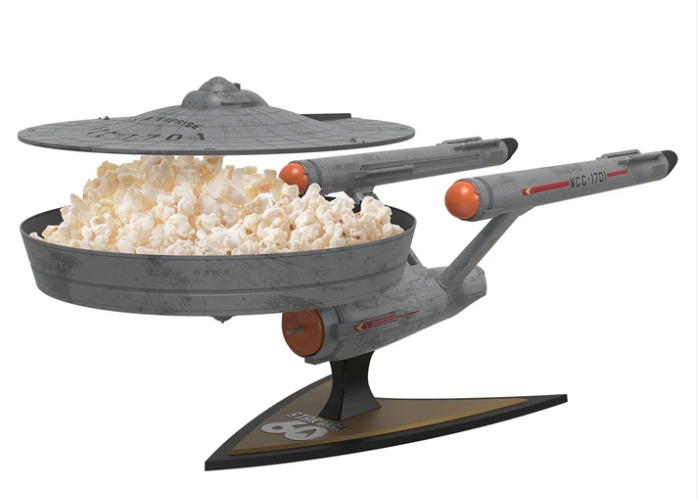
Additionally, from September 4-8, more than 750 theaters across the U.S. will present restored 4K screenings of classic Star Trek films paired with episodes of Star Trek: The Original Series making their theatrical debut. Participating theaters will also offer limited-edition Enterprise popcorn vessels and commemorative drink cups while supplies last.
Limited-edition Enterprise popcorn vessel
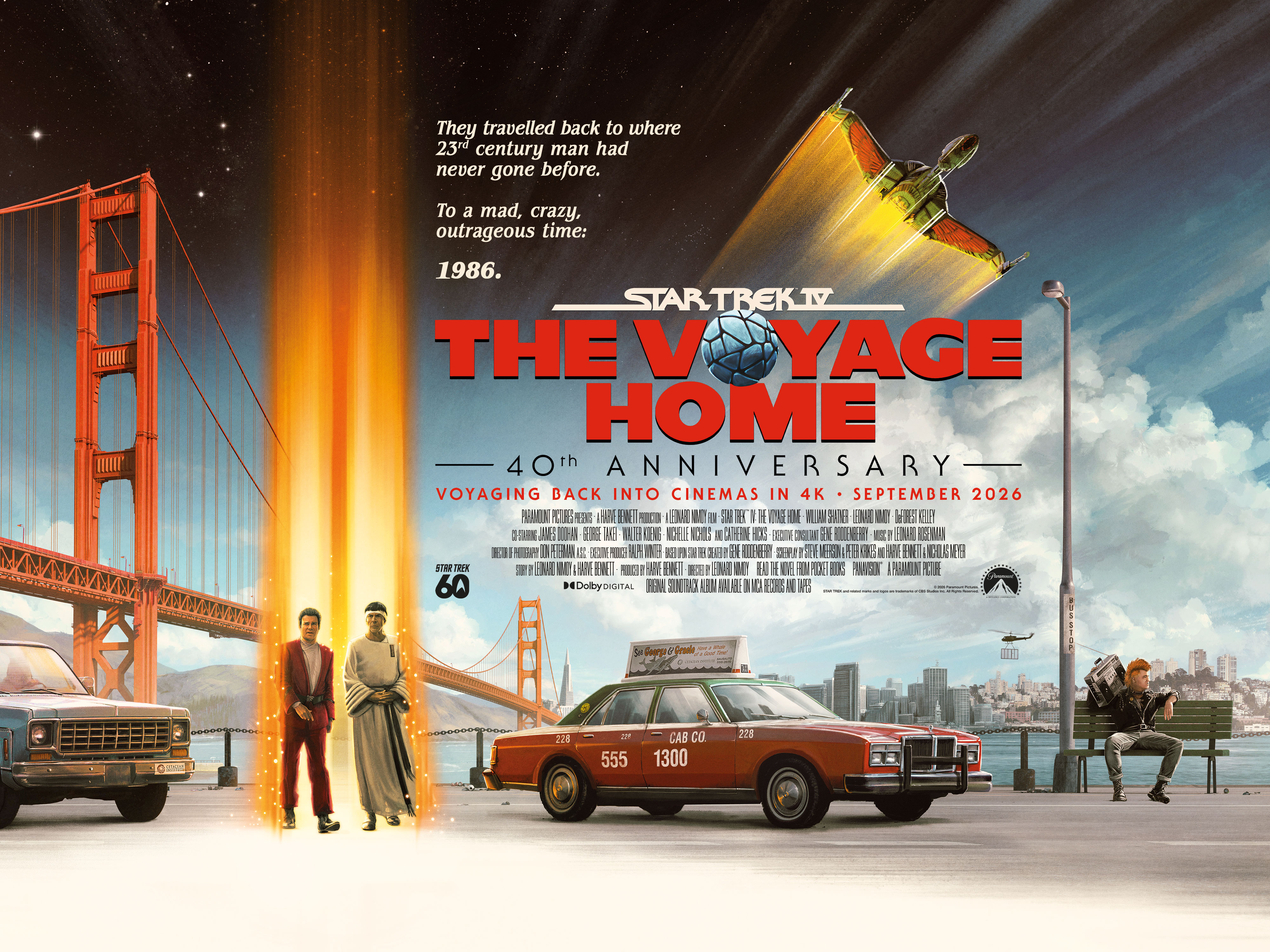
In the UK and Republic of Ireland, Star Trek’s largest market outside the U.S., Paramount is celebrating another milestone: the 40th anniversary of Star Trek IV: The Voyage Home. A theatrical re-release will mark the first time the digital 4K version has been widely available in cinemas across the market and will feature all-new artwork from acclaimed artist and frequent Paramount collaborator Matt Ferguson (Transformers One, The Running Man). Released in 1986, The Voyage Home became the most commercially successful of the classic Star Trek films, earning $110 million at the domestic box office.
Star Trek IV: The Voyage Home commemorative artwork by Matt Ferguson
Products and Partnerships Celebrate 60 Years
The 60th anniversary is also extending beyond the screen through partnerships and products that tap into Star Trek’s legacy of exploration, imagination and fandom.
Star Trek is partnering with DarkSky International to encourage fans to explore, protect and appreciate night skies and natural landscapes for future generations. The franchise is also teaming with the National Park Foundation on digital content encouraging fans to discover national parks and places that inspire exploration.
Fans can bring the anniversary home through a lineup of new products and collaborations. The LEGO Group and Paramount Products & Experiences are releasing the 1,701-piece LEGO Icons Star Trek: U.S.S. Enterprise NCC-1701 Bridge set, recreating the original series bridge and transporter room with eight Starfleet minifigures.
LEGO Icons Star Trek: U.S.S. Enterprise NCC-1701 Bridge set
Additional collaborations include Magic: The Gathering x Star Trek, launching November 13; DK Publishing’s Star Trek Timelines, arriving November 17; commemorative 60th anniversary coins from The Royal Mint and Agoro; and the first officially realized Original Saurian Brandy, inspired by the iconic bottle first seen in “The Man Trap” in 1966.
Paramount Brands Join the Celebration
The anniversary will also reach across Paramount’s brands and platforms. The celebration begins on September 7 with an Entertainment Tonight: ET Vault Unlocked special featuring archival interviews with Gene Roddenberry and cast members from across the franchise, along with behind-the-scenes footage.
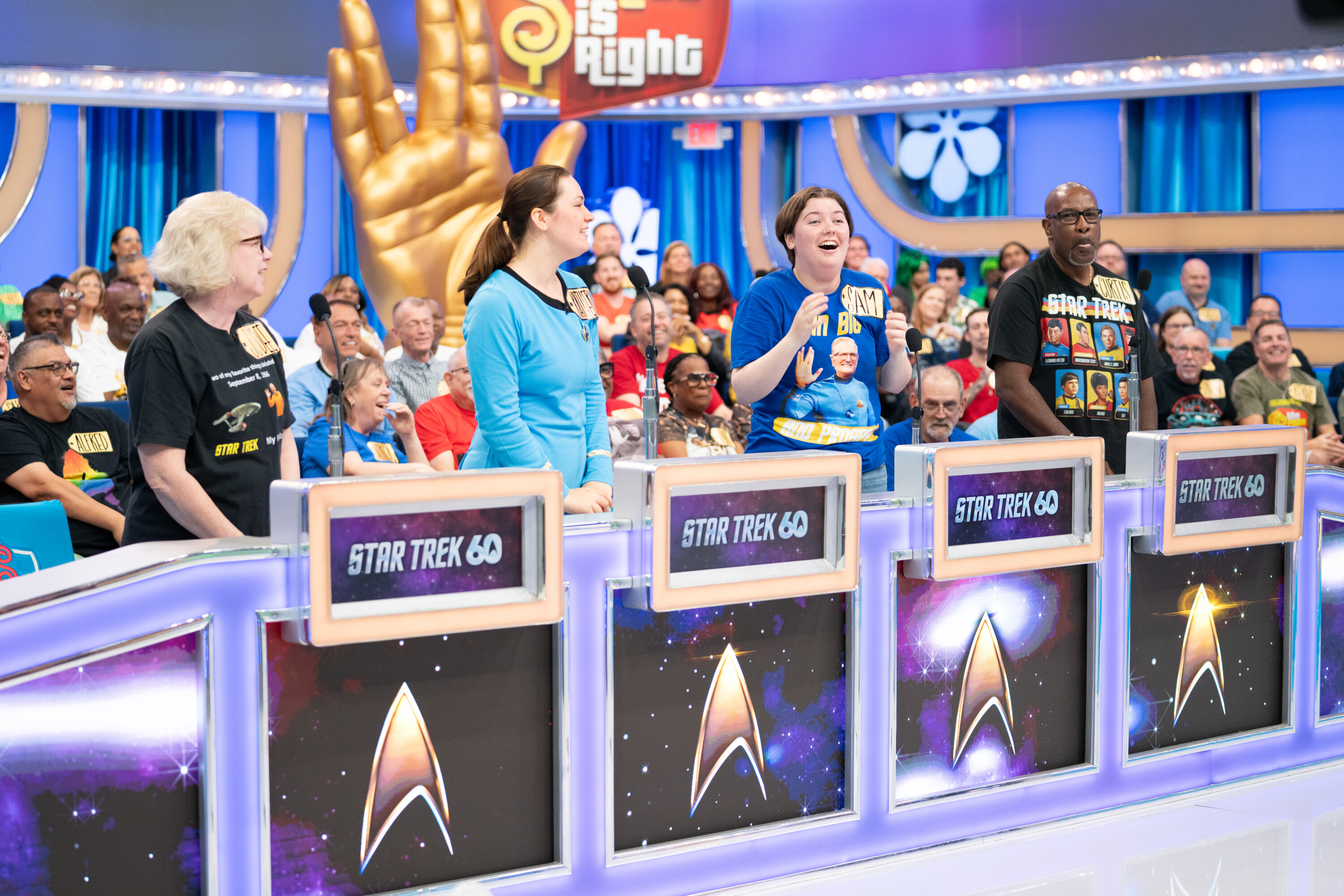
On September 8, The Price Is Right and Let’s Make a Deal will celebrate Star Trek with themed episodes airing on CBS and streaming on Paramount+. Star Trek: Strange New Worlds stars Rebecca Romijn and Ethan Peck will join Drew Carey on The Price Is Right, where an audience of superfans will compete for Star Trek-inspired prizes. On Let’s Make a Deal, “Captain” Wayne Brady, “Commander” Jonathan Mangum and “First Officer” Tiffany Coyne will welcome Star Trek fans competing for vacations, franchise memorabilia and more.
Superfans compete on The Price Is Right for Star Trek-inspired prizes
Also on September 8, season two of Star Trek: Scouts launches on YouTube, and Nick at Nite will present a four-hour marathon of memorable Star Trek-themed episodes of The Big Bang Theory.
Celebrating the Past and Looking Ahead
The 60th anniversary comes as the Star Trek universe continues to evolve. Star Trek: Strange New Worlds will conclude its fourth season on September 24 on Paramount+, before returning for its fifth and final season in 2027. At New York Comic Con on October 10, the Star Trek Universe panel will preview Star Trek: Starfleet Academy, dive into its second season and welcome surprise guests to celebrate the anniversary.
Star Trek will also receive the Franchise of the Year Award at the 2026 Broadcasting + Cable Hall of Fame ceremony on September 29 in recognition of six decades of storytelling and cultural influence.
What began with one television series in 1966 has grown into a global universe spanning television, film, animation, games, publishing and experiences. Six decades later, Star Trek continues to look toward what might come next.
For Van Citters, that sense of possibility is exactly what makes the franchise’s future so compelling. “The universe is limitless,” he said. “What excites me the most about Star Trek is what we haven’t seen yet.”
For full details of all Star Trek 60th events, activations and partnerships, visit StarTrek.com.
- Bloggery committed by chris tower - 2609.08 - 10:10
- Days ago: MOM = 4086 days ago & DAD = 740 days ago
- New note - On 1807.06, I ceased daily transmission of my Hey Mom feature after three years of daily conversations. I post Hey Mom blog entries on special occasions. I post the days since ("Days Ago") count on my blog each day, and now I have a second count for Days since my Dad died on August 28, 2024. I am now in the same time zone as Google! So, when I post at 10:10 a.m. PDT to coincide with the time of Mom's death, I am now actually posting late, so it's really 1:10 p.m. EDT. But I will continue to use the time stamp of 10:10 a.m. to remember the time of her death and sometimes 13:40 EDT for the time of Dad's death. The blog entry numbering in the title has changed to reflect total Sense of Doubt posts since I began the blog on 0705.04, which include Hey Mom posts, Daily Bowie posts, and Sense of Doubt posts. Hey Mom posts will still be numbered sequentially. New Hey Mom posts will use the same format as all the other Hey Mom posts; all other posts will feature this format seen here.
Star Trekhas had a challenging history with contemporary audiences. Because it has not been able to reach the heights of popularity that it once held due to those early seasons. The new wave of Star Trek movies went a long way in taking the franchise into the mainstream, and for a time, it looked as if the series was going to go down this rebranded route for the long-term.
As fans know, that didn't end up coming to fruition, and although there are always discussions about returning to the Star Trek film universe for future outings, right now, those projects have been put on pause. It ultimately didn't matter because Star Trek fans were satisfied with a new structure of programming that seemed to finally promise that the franchise was here to stay. Shockingly, for the first time in nearly a decade, that status now looks uncertain.
Star Trek Made A Triumphant Comeback To TV
Back in 2017, a major moment in Star Trek history occurred. Star Trek: Discovery was commissioned, a series that promised to take its viewers to new worlds alongside a debuting crew of diverse characters. It was a show that paid homage to the golden age of Star Trek lore but boldly went where the series hadn't gone in quite a while: to new territory.
Star Trek: Discovery was designed to be a franchise-builder, away from the recent movie run and in line with a whole host of concept ideas on how to further add to this universe. Star Trek: Discovery's early success was enough to move forward with some of those spinoffs, and thus, a new era of Star Trek mythology was born.
Star Trek: Strange New Worlds isdirectly tied to its predecessor, but it was much bolder with its narrative design. The showrunners took bigger risks, resulting in increased ratings and a more positive critical consensus. The franchise also began to recast early characters like Spock, who had already made such an impact. It was time to refresh the franchise, and that's where unusual ideas came to the forefront.
A show like Star Trek: Lower Decks, for instance, would never have been commissioned over a decade ago. An animated adult comedy set in the Star Trek world didn't feel like a natural next step, and yet it absolutely thrived. Introducing a crew so popular that fans demanded to see them in live-action, Star Trek: Lower Decks was able to play with the franchise format in a meta way.
It poked fun at what had come before, creating a new legacy in the process. This sparked other unusual crossovers, supporting this shared universe approach to the material. But to move forward, the series also had to look back. Star Trek still needed to appease fans from prior years, and that's where a show like Picard comes into play.
This was a chance to tell new stories with a fan favorite character, and although the early seasons weren't quite as high-quality as expected, later into the run, Picard really earned its comeback. Throughout these 9 years, there was a robust array of Star Trek projects in the works, each offering something unconventional in a niche area of the franchise. At a certain stage, it all went wrong, leading to this new era of uncertainty.
For The First Time In 9 Years, There Are No Shows In Development
Some of the shows mentioned above came to an end in a natural way. They had reached their narrative conclusions, and while they could have been dragged out longer, it was best for all involved to end on a high note. That's natural and a sign of the TV scape working. Because there was always a new Star Trek series to take the last one's place.
Fans had gone years without any new stories told within this world, at least on the small screen. Suddenly, they were met with a vast array of exciting possibilities across the whole timeline. While the likes of Star Trek: Strange New Worlds and Star Trek: Lower Decks might have grabbed headlines, the franchise did begin to over-extend itself.
Star Trek: Prodigy wasa kids-focused series positioned to be Star Trek's answer to the likes of Star Wars Resistance. While entertaining in its own right, it never quite found its audience. Parents attempted to get their kids to engage in the saga they loved so much, but there wasn't anything groundbreaking about the adventure show and its unusual animation style. Thus, it was canceled after 2 seasons.
Then, there was the bold decision to go back to a cinematic format, this time with a straight-to-streaming movie starring Michelle Yeoh. Star Trek: Section 31 was deliberately designed as a spin-off of Discovery. It should have been the culmination of this era and a promise for more cinematic events just like it. Unfortunately, fans failed to connect with this story.
While Star Trek: Section 31 boasted some potential, it simply wasn't good enough to sustain its footing. The film faded into the background and made Paramount uneasy about future commissions of that nature. Star Trek: Starfleet Academy is the final nail in that coffin. Because the series was promised to be the future of the franchise, literally training the next wave of recruits who may star in adventures for decades to come.
With a falling viewership and the fan base losing interest in what many saw as a teen-focused lens to the material, Star Trek: Starfleet Academy was canceled despite glowing reviews. So, for the first time in 9 years, there are no Star Trek shows currently airing and the plans for the future are in doubt.
The Franchise Failed To Create New Fans
Now, it should be noted that Star Trek: Strange New Worlds will return in 2026 for its fourth season. However, this will not be the final season of the show, with another one already commissioned. Paramount is dead set on wrapping up the series soon thereafter, meaning there will be a major gap in the calendar.
Outside of this, there is little movement on other potential projects. A rumored animated series is now unlikely to go ahead, while there is no confirmation of other Star Trek: Strange New Worlds spin-offs gaining a backdoor pilot in the latest series. Equally, despite discussions of a return to the "Kelvin Timeline" movie universe, there is also significant doubt about whether this will go ahead as planned.
This puts fans in a dilemma. While they must support any new seasons of Star Trek that debut in the coming years, what's more important is spreading the message around this franchise. Because there is an evidential shift for Paramount away from multiple seasons of Star Trek every year, perhaps towards a more focused outreach. Paramount might even be keen to give the franchise a break altogether.
The reason that Paramount has moved away from this franchise as a brand builder is that it is an unreliable source of future growth. Star Trek has been unable to create new fans, at least, not on a grand scale. Many of the series that have been released thus far have pulled in those who fell in love with the show back in the day.
Those who did sign up for these new adventures haven't been convinced to tune in for every spin-off. The result is that Paramount has stretched the franchise without being able to capture a mainstream audience with many of its projects. This is a major shift in strategy for the brand and one that may only get worse in the coming years.
Paramount is now acquiring Warner Bros. and everything that the movie company has in its archives. With franchises like Game of Thrones, Harry Potter, The Lord of the Rings and Looney Tunes in its back pocket, Star Trek doesn't need to be the hero series that Paramount must rely upon for much longer.
Star Trek could not sustain cultural relevance quite like those other brands when it was constantly producing television. Maybe with a reduced model, there is hope to rebuild.
- Bloggery committed by chris tower - 2605.30 - 10:10
- Days ago: MOM = 3985 days ago & DAD = 639 days ago
- New note - On 1807.06, I ceased daily transmission of my Hey Mom feature after three years of daily conversations. I post Hey Mom blog entries on special occasions. I post the days since ("Days Ago") count on my blog each day, and now I have a second count for Days since my Dad died on August 28, 2024. I am now in the same time zone as Google! So, when I post at 10:10 a.m. PDT to coincide with the time of Mom's death, I am now actually posting late, so it's really 1:10 p.m. EDT. But I will continue to use the time stamp of 10:10 a.m. to remember the time of her death and sometimes 13:40 EDT for the time of Dad's death. The blog entry numbering in the title has changed to reflect total Sense of Doubt posts since I began the blog on 0705.04, which include Hey Mom posts, Daily Bowie posts, and Sense of Doubt posts. Hey Mom posts will still be numbered sequentially. New Hey Mom posts will use the same format as all the other Hey Mom posts; all other posts will feature this format seen here.
A Sense of Doubt blog post 4052 - I finished Star Trek: Star Fleet Academy Season One - and I Loved it!!
Okay, I know, this is not technically a COMIC BOOK SUNDAY post, but it is within the geek sphere and a post I wanted to publish while it's still timely and recent.
I had a really good cry.
That's the first thing that I want to share.
In watching, Star Trek: Star Fleet Academy, in the penultimate episode, the story really got to me, and I sobbed.
I sobbed so much that I scared the dogs, especially the little one, who I don't think had seen or heard me sob before.
Stuff with parents and kids gets to me. But I needed a good cry. Catharsis is healthy.
And now I have something new to cry about, Paramount has announced that season two will be the last season of Star Fleet Academy. Reason? Ratings.
I won't reprint those stories but here's some links:
I REALLY liked it. A LOT. I mean not just any mother-son story would make me sob. I had to be invested in the characters.
Is it chessy? Oh yeah. 1000%. It's like Beverly Hills 90210 in space. But that's okay. I wanted cheesy.
In the links above about the cancellation, Shatner bemoaned the cancellation and the "anti-woke" critics. I agree.
I hope Paramount cancelled for ratings and not for the show being "too woke."
I still don't understand what is wrong with "woke." Isn't it better than the opposite of "woke"? Which would be UNCONSCIOUS.
Does the show need work? Sure.
But how much can be accomplished in just ten episodes?
They tried to devote episodes to developing the students in the cast, the main students, but even so, some, like Genesis Lythe played by Bella Shepard didn't really fully come to life with depth.
But that's what season two is for, which is already filmed, and will release in early 2027.
And then, that's it for the show.
I am still processing how upset I am about that.
Anyway, I have collected a variety of articles (and broken HTML but you won't see that) and a BUNCH of pictures, including the fleet of ships shown in the finale.
For now, I am excited for season two.
And to the anti-woke critics, you just don't get it. The world is going to leave you behind no matter how much you cling to the racist, sexist, homophobic, and all the bigotry that seems to best define your mindset.
Starfleet Academy is the best first season of a Star Trek show ever
That's admittedly not a high bar to clear.
The first season of a TV show is a tricky thing. It has to convince people to watch it and justify the show’s existence to the network (or streaming service) execs. It has to deal with actors and writers who may not have fully dialed into the characters and world yet. There are some shows with absolutely stellar first seasons — Stranger Things, Veronica Mars and Ted Lasso are a few — but many other hit shows stumbled out of the gate, like The Office and Supernatural.
Star Trek is not immune to this phenomenon. The Original Series had a decent first season, with classic episodes like “The City on the Edge of Forever.” But the next four shows all have rather weak beginnings, with even fan-favorite The Next Generation stumbling badly with episodes like “Code of Honor.” That show picked up in season three, beginning a trend called “Growing the Beard,” in reference to how Commander Riker’s new beard coincided with the uptick in quality.
This trend unfortunately continued into the current era, with 2017’s Star Trek: Discovery delivering a first season with an overwhelmingly dour tone and a lot of franchise changes that didn’t sit well with fans. The show made some tweaks in season two (including a change in setting that involved traveling 900 years into the future), and showed a lot of improvement with season three. Picard also floundered horribly, with an uneven first season that killed off some fan-favorite characters and also turned the title character into an android.
Things started looking up after that, with shows like Strange New Worlds all posting strong outings with their first go-arounds. While episodes like “A Quality of Mercy” and “Lift Us Where Suffering Cannot Reach” may not make the list of all-time classics, there are no outright stinkers. It seemed like the franchise as a whole was finally finding its footing in this new streaming era.
That leads us to Starfleet Academy, which debuted in January on Paramount+. Prior to its premiere, the internet was full of people deriding it as “CW Trek” and declaring that they don’t want to watch a show about “teenyboppers” that wasn’t “real” Star Trek. Now that the show has finished its first season… the internet is still full of people complaining. But many folks who were wary of it at the beginning have been pleasantly surprised — every day there seems to be multiple posts on various Star Trek subreddits along the lines of “Starfleet Academy is actually good?!?” I personally didn’t enjoy the first episode, but episode two turned me around rather quickly, and it seemed that every week brought new converts.
Granted, 10 episodes is a short amount of time to make an impact, but Starfleet Academy did a lot with that number. Four of the episodes are dedicated to the ongoing villainy of Nus Braka, a murderous pirate played with scene-chewing delight by Paul Giamatti. These have all been pretty straightforward adventure stories, which also did a good job of fleshing out not only Braka, but cadet Caleb Mir, whose mother went to prison because of Braka.
The emphasis on Caleb in the first episode made it seem like the show would focus on him, much in the way Discovery focused on Michael Burnham, but he took a back seat as the show explored the other characters as well as its setting. Episode two, “Beta Test,” focused on diplomacy, a long-standing theme of Star Trek, and even shook up the status quo by moving the Federation headquarters from Earth to Betazed.
Episodes four and five were more personal stories, with “Vox in Excelso” focusing on soft boy Klingon character Jay-Den as well as the fate of his race in general after hundreds of years, while “Series Acclimation Mil” also gave us characterization of photonic being Sam along with some heartfelt fan service for the Deep Space Nine fandom. Sam would also shine once more in “The Life of the Stars,” an episode that dealt with trauma, but also (again) delivered fan service in a way that didn’t feel like pandering because of how it was used to develop not just Sam, but also the Doctor, a legacy character from Voyager.
It’s not that every episode in season one of Starfleet Academy is a masterpiece – “Vitus Reflux” and “Ko’Zeine” are somewhat weak – but none of them are outright bad, making the batting average of the season rather high. That bodes well for word-of-mouth, as it's easier to recommend a show when you don't have to couch it with excuses about how it gets good “eventually.”
It will need that word-of-mouth if it wants to get through a complete four seasons of schooling; season two just finished filming so we're guaranteed at least that, but there's a lot up in the air for not just the show, but the entire franchise. Strange New Worlds season four will debut later this year, and then we have an abbreviated season five to look forward to. But past that, nothing firm is on the horizon: Starfleet Academy hasn't been renewed yet, and projects like the Tawny Newsome-helmed comedy show are still in development with nothing tangible revealed yet.
Newsome played Beckett Mariner on Lower Decks and worked in the writers room for Starfleet Academy — she's an example of how Paramount has been building up a roster of talent behind the scenes for the franchise who, even when a show is new, understand the universe and, more importantly, how to work together to make good TV. And that's going to be important in the next year or so, as Paramount makes decisions about the future of the franchise in the shadow of the recent Skydance merger and the upcoming Warner Bros. purchase. Star Trek has an uphill battle ahead of it, but at least Starfleet Academy’s first season has made it an easier climb.
As the cadets of Starfleet Academy finish their first year, here’s our review of season 1 — “Could Do Better”
A franchise as long established as Star Trek has its long history and its many fans. This inevitably means many opinions. The latest (and possibly last for now) new title is Starfleet Academy— it’s a curious hybrid of high-school / young adult and Star Trek action. If Rotten Tomatoes is anything to go by, it’s popular with critics (88%) and less so with the audience (51%). Given a niche audience, longer standing fans have (perhaps) not felt well served by a show aimed at a younger demographic. If you haven’t the time, we liked the show, but felt it really required many more episodes to develop.
This is a long piece, so grab a drink or bookmark for later. Quick review —it could do better. We’ll certainly watch the second season, and in the absence of any other new arrivals would be more than happy for a season 3.
We don’t intend to get drawn into a shallow argument about the show being woke (whatever that actually means) nor the fashionable (in some quarters) railing against the current showrunner. We do wish to note almost as many complaints about Holly Hunter’s Chancellor (and technically Captain) Nahla Ake disrespecting the chair by sitting “strangely”. Yes, it’s a bit odd but clearly part of her character — she’s a Lanthanite with centuries of experience behind her and a mixed relationship with the Federation (and remembers it in its heyday). There’s also the “it’s not Star Trek” complaint. We’ll spend some time on that before getting to the core of the review.
IS IT STAR TREK?
This depends on your definition. We’ll suggest Roddenberry’s original concept of Wagon Train to the Stars covers a ship, exploration and the ability to tell a wide range of stories exploring character. The original series clearly valued what we would term a diverse set of characters with Sulu, Chekov and Uhura placing non-standard characters centre stage. They were then replaced with regular villains, notably the Klingons and Romulans. This trend has continued and is perhaps more to the fore in more recent productions.
There’s no doubt of the science fiction setting in all cases and while Academy makes the campus building part of the starship (USS Athena), there’s little in the way of travel, let alone exploration.
To counter that, let’s recall Deep Space 9. Less mobile even than the USS Athena, the show attracted criticism for its static location, and the need for stories to come to it. In the end it carved out a space in Trek history and in the hearts of many fans.
The show is clearly rooted in Trek lore. One of the stronger episodes is all about Cisco (another nod to DS9). Buildings are named for key characters in the show’s history, with many (most? all?) others popping up on a board of honour. A little OTT, but we do have crossovers from other shows with the Doctor (Robert Picardo) taking us back to Voyager and Jett Reno (Tig Notaro) linking neatly to Discovery. On the subject of Discovery, we have Mary Wiseman back as Tilly in another standout episode — we hope for much more in season 2.
The show is set post-Discovery and we do have to wonder how often that ship can be in dock for refit instead of saving the day with its spore drive.
With extensive preamble out of the way, here’s our actual Starfleet Academy review. Bottom line, a season of ten episodes is too short to allow the show to work. Expense of production means a lot of shows have short runs per season, compared to the broadcast era. In those ten episodes there’s a need for each of the six main cadets (pictured) to have time in the spotlight, the college year has to happen (we suspect the intention is for three seasons), and we need an arc as well. Being Star Trek, that means a villain and a storyline with at least an intro, minor conflict, twist, things looking bad and heroic resolution. That’s a lot for ten episodes.
The show took episodes 1-3 to get everyone together then add a team-bonding tale. Having a rival War College was one complication too many and the story arc of Caleb Mir (Sandro Rosta) searching for his mother (an excellent performance from Tatiana Maslany in the final episode) drove a lot of episode 1 then became downplayed as soon as Caleb had his hair cut.
We suspect the pilot led to changes. A romantic interest for Caleb (Tarima Sadal played by Zoë Steiner) is dropped into episode 2, they become lovers then she has to use her psychic superpowers to save the day. This all leads to a distance emerging (and to be fair the strong Tilly episode) during which she remarks Caleb and episode 1 fellow cadet Genesis Lythe (Bella Shepard) work well together and could be a couple. We can easily see the show could have worked that way and simplified the challenge of fitting ten episodes.
While truncated, the season does have a fantastic villain in the form of Nus Braka (Paul Giamatti) who we learn isn’t in season 2. Even with the constraints noted, the final episode does bring together many of the elements from earlier episodes, have the young cadets save the whole Federation (and a vast number of star systems), some soul searching, pious speeches and declarations of love. There’s even some backstory and elements of reconciliation. What’s not to like.
Ultimately
We can image a simpler version of the same season with more reasons to travel, explore the future galaxy and learn of Braka’s history, building a great arc and still with side episodes for cadet character exploration. Many episodes would work with the ship in space still serving as a college — we wonder if budget is the problem. We suspect it’s as simple as that — following a standard (and successful) formula for high school drama developed for hows with longer seasons left unsatisfactory jumps as the ten episodes also had to serve as a vessel to allow the Federation to be saved by the few. Sounds like Star Trek to us.
Warning: SPOILERS for Star Trek: Starfleet Academy Season 1's Finale - "Rubincon"
Star Trek: Starfleet Academyremembered that Star Trek was missing something important after 60 years. Directed by Olatunde Osunsanmi from a teleplay by Alex Kurtzman and Kirsten Beyer and a story by Noga Landau and Gaia Violo, Star Trek: Starfleet Academy season 1's finale saw Nus Braka (Paul Giamatti) place Captain Nahla Ake (Holly Hunter) and the United Federation of Planets on trial.
Nus Braka not only wanted Captain Ake to answer for her crimes against himself and Anisha Mir (Tatiana Maslany), but the Klingarite space pirate wanted to humiliate the Federation in the eyes of the galaxy before literally blowing it up with Omega-47. Of course, Braka's show trial was self-serving and meant to venerate himself as the man to lead the rest of the galaxy.
Thanks to the teamwork of Starfleet Academy's cadets, Nus Braka's Omega-47 plan was foiled, while Captain Ake and Caleb Mir (Sandro Rosta) exposed Nustopher as nothing more than "an angry child with his finger on the button whose entire worldview is based on a lie." Yet when Braka thought his triumph was imminent, Nus also pointed out something Starfleet is missing.
Star Trek: Starfleet Academy Pointed Out There's No Starfleet Anthem
For a Klingon and Tellarite hybrid who grew up on the outlier worlds beyond Federation space, Nus Braka loves to spout references to Federation culture and callbacks to things from 21st-century Earth. Nus even taunted Caleb Mir for joining Starfleet Academy, and "singing the Starfleet anthem," to which Captain Ake responded:
"There is no Starfleet anthem, but what a good idea."
Nus Braka and Captain Ake collectively brought the audience to the fascinating realization that it's true: Starfleet doesn't have an anthem. In Star Trek: Starfleet Academy's 32nd century, Starfleet has existed for a thousand years, yet no one composed a rousing Starfleet melody during that millennium.
Of course, Star Trek boasts many stunning orchestral scores, starting with Alexander Courage's theme music in Star Trek: The Original Series. Jerry Goldsmith composed the theme for Star Trek: The Motion Picture, which became the opening credits music of Star Trek: The Next Generation and the ersatz Star Trek theme by default.
Yet in-universe, Starfleet doesn't have an anthem. No definitive music accompanies Starfleet Officers or Starfleet Academy's cadets when they formally assemble for special occasions like graduations, starship launches, or ceremonies like promotions.
Audiences tend not to notice the lack of a Starfleet anthem since the score of whatever Star Trek movie or TV show usually plays, but the music is for the viewer at home and is not necessarily heard by the characters on-screen.
Why Star Trek Doesn't Have A Starfleet Anthem (Yet)
Many of the finest composers in Hollywood have delivered Star Trek orchestral scores, from Jerry Goldsmith of Star Trek: The Motion Picture, to James Horner of Star Trek II: The Wrath of Khan, to Dennis McCarthy of Star Trek Generations, to Michael Giacchino of J.J. Abrams' Star Trek and Star Trek: Prodigy, to Jeff Russo of Star Trek: Discovery and Star Trek: Starfleet Academy.
However, perhaps the lack of an official Starfleet score is related to the ongoing debate about whether Starfleet is a military organization. In the 1980s, Gene Roddenberry argued that Starfleet isn't military, despite its command structure being obviously based on the United States Navy, with Admirals, Captains, Commanders, and Ensigns.
In his later years, Gene Roddenberry likened Starfleet to what Captain Christopher Pike (Bruce Greenwood) called it in Star Trek (2009), "a peacekeeping and humanitarian armada." If that's what Starfleet is, then it's logical that Starfleet wouldn't have or need a military-style anthem.
Star Trek: Starfleet Academy leans into Roddenberry's interpretation of Starfleet, with the rival War College created to clearly delineate a military arm of Starfleet meant for combat. Yet it also makes sense for both Starfleet Academy and the War College, especially, to have a rousing anthem for assemblies.
Perhaps Star Trek: Starfleet Academyseason 2 will follow up on Nus Braka's inadvertent "good idea," and Captain Ake or Admiral Charles Vance (Oded Fehr) will commission a Starfleet anthem, at least for Starfleet Academy, if not for the whole of Starfleet.
It's also too bad that a Starfleet anthem wasn't introduced by Star Trek: Starfleet Academy this year to help celebrate Star Trek's 60th anniversary.
Star Trek: Starfleet Academy season 1 is over, and season 2 has wrapped. Although there isn't much confirmed information about what the next batch of episodes will look like, the show's inaugural run provides some very obvious clues. In fact, I still find it surprising that one of the strongly implied upcoming events didn't happen in season 1. I'm very confident that season 2 will bring with it what many Trekkies are waiting for, though.
While it did have its own central storyline, season 1 referenced several classic-era Star Trek episodes. Some of these acknowledgements were more prominent than others, but all were pretty much undeniable. Although this could be attributed to the ongoing celebration of Star Trek's 60th anniversary, this generational approach is also an attempt to welcome in new fans. Therefore, I think it's reasonable to assume that this trend will continue. If and when it does, it's pretty easy to tell what's coming.
Robert Picardo in season 1 of Star Trek: Starfleet Academy streaming on Paramount+. Photo Credit: Miller Mobley/Paramount+
Starfleet Academy season 1 ended with a string of four Voyager sequels
Starfleet Academy's first seven episodes seemed largely content with having Robert Picardo's Doctor serving as an ongoing reference to Voyager. The character appeared in all seven seasons of the classic-era show, so even just his presence felt like a huge nod. He did occasionally mention parts of his time as a member of Captain Janeway's (Kate Mulgrew) crew, but those moments were few and far between. Then, Episode 8, "The Life of the Stars," kick-started a string of Voyager sequels.
After unexpectedly paying off "Real Life" and "Blink of an Eye" in the space of a single episode, Starfleet Academy's next two installments formed a two-part finale that served as a stealth sequel to "The Omega Directive." Considering the show had been largely drip-feeding Voyager references to established Trekkies for most of Starfleet Academy before Episode 8, fans are lucky they didn't drown after that. Of the three Voyager episodes used as source material, only "Real Life" was particularly Doctor-centric, which is probably why "The Life of the Stars" felt especially poignant. Either way, now I'm especially excited for what surely must happen in season 2.
The reactivation of the EMH's backup sparks doubt over the official history of an alien planet sparking a race riot, though ultimately leading to a better outcome. From Star Trek Voyager S4E23: Living Witness
Starfleet Academy season 2 is more likely than ever to pay off Voyager's "Living Witness"
This 1998 installment was heavily discussed when Picardo was announced as part of the Starfleet Academy cast. Set centuries after Voyager, the newer of the two shows struggles to reference many episodes from the classic show. "Living Witness" isn't just in the minority when it comes to eligibility in this respect, but it's the gold standard. When running the numbers, the back-up version of the Doctor that appears in "Living Witness" should be arriving back at Earth at some point during Star Trek's 32nd century.
As such, Picardo could easily find himself playing two versions of the Doctor in Starfleet Academy season 2. He did this more than once during similar scenarios in Voyager, so it wouldn't be especially new ground. Pair this with the fact that the Starfleet Academy writers have already established their affinity for folding in Voyager lore, and a "Living Witness" sequel becomes almost certain in season 2. I really hope I'm not wrong.
Kerrice Brooks as SAM in season 1, episode 5, of Star Trek: Starfleet Academy streaming on Paramount+. Photo Credit: John Medland/Paramount+
Why "Living Witness" could be trickier to acknowledge than the other Voyager episodes used by Starfleet Academy
Season 1 handled "Real Life," "Blink of an Eye," and "The Omega Directive" very tastefully. While they were strongly referenced, they were also intertwined with the storylines of Starfleet Academy's newer characters, who are the true focus of the show. In fact, "The Omega Directive" isn't even directly acknowledged in Starfleet Academy. It's undeniably a Voyager reference, but the Paramount+ project almost treats the Omega-47 mines as an entirely original concept.
So, even though "Living Witness" feels like an obvious choice for Starfleet Academy season 2 to pay off, it might be difficult to find a place for it. A "Living Witness" sequel wouldn't just need to dedicate most of its runtime to Picardo's character(s), but the concept of the original episode and what it would mean for its continuation is quite high-concept. It wouldn't be easy to establish the premise in just a few lines and then move on, as has been the approach in season 1's Voyager-tinged storylines.
As a result, "Living Witness" may be considered far too Doctor-centric to belong in Starfleet Academy's catalog of tributes to the classic-era show. A parallel connection to one of the younger stars would need to be formulated in order for this to happen. One possibility could be that Kerrice Brooks' SAM is somehow duplicated, which could help Star Trek: Starfleet Academy season 2 grant the biggest wish of the Voyager faithful.
Star Trek: Starfleet Academy season 1 is streaming now on Paramount+. All seven seasons of Star Trek: Voyager are also available on the same platform.
Starfleet Academy had a satisfying Season 1 finale, but as I watched, I kept asking myself a blunt question: “why do I like this so much?” Sure, the episode was free of many things I hated from earlier stories, including the vulgar slang and potty humor of earlier episodes. It also focused on drama and characterization instead of terrible comedy, which is a major improvement over the first half of the season. Still, I couldn’t shake the feeling that something else made this episode infinitely better than most of what had come before.
That’s when it hit me: it was the characters. Or, more precisely, the lack of characters: thanks to the season finale’s premise, several characters are left out of the episode altogether, and other characters who appear are sidelined in favor of focusing on a few key storylines. The result was that this episode (“Rubincon”) is a shining example of what this new Star Trek series is capable of. But it’s also proof of a simple fact: Starfleet Academy has way too many characters, and it needs to let some of them go in order to become a successful show.
Starfleet Academy has, to put it mildly, a huge cast of characters. There are 11 main characters who are prominently featured in almost every episode. For comparison, Star Trek: The Next Generation started with nine main characters, but this included Tasha Yar, who died midway through Season 1. It also includes Wil Wheaton, who left after Season 4. This means that for just a little under half of its iconic run, TNG sported only seven main characters, which made it easy for episodes to focus on the entire cast.
In case you’re wondering, Star Trek: The Original Series had only eight main characters. Deep Space Nine had nine main characters, and that’s counting Worf, who joined in Season 4. Voyager also held steady at nine main characters, eventually substituting Kes for Seven of Nine. At 11 main characters, Starfleet Academy is obviously overcrowded by the standards of the franchise, and its limited number of episodes per season keeps us from getting to know everyone.
Star Trek: Discovery began what would become a fairly depressing trend with NuTrek shows: a limited number of episodes per season. While the so-called Golden Age of Star Trek had 26 episodes per season, shows like Starfleet Academy only get 10 episodes per season. That means that even if SFA gets four full seasons (a goal that seems increasingly difficult to meet), it will end with fewer episodes than Voyager got in only two seasons!
That’s important because, each season, Starfleet Academy only gets 10 episodes to develop its 11 main characters. There’s just not enough time to do so, and some characters really get the short end of the stick. For example, Genesis is the only cadet who doesn’t get a solo episode devoted to her; the closest thing she gets is a side story with Caleb, where we learn that her dark secret is that her previous instructors thought she would never be a good captain.
The Season 1 finale puts her in the captain’s chair, but she inexplicably doesn’t get to do anything notable while she’s in command except announce that she has to pee. Unfortunately, this lack of resolving her story highlights a big problem with Genesis: because she’s also a highly driven, Type A overachiever, she is often written as “Darem with boobs.” But Darem got his own episode, a romantic subplot, and a special effects-heavy sequence where he saved the ship; comparatively, Genesis got absolutely nothing, making her character feel weirdly redundant.
Given the limited number of episodes and the outsized number of lead actors, it’s also bizarre how much screen time Starfleet Academy devotes to supporting characters. We got entire episodes focused on stories with the War College and its frosty chancellor, only for them to all disappear from the narrative in the last two episodes. We also get a lot of screentime dedicated to weird comic relief characters, including Tarima’s beta brother and that one cadet who swallowed her comm badge.
Compounding this is the fact that Caleb Mir is undeniably the main character of Starfleet Academy’s first season. This isn’t inherently a bad thing: Caleb has proven to be a very compelling character, and actor Sandro Rosta has the charisma and magnetic screen presence of a leading man. But every moment spent developing Caleb is a moment not spent developing anyone else. This is to the show’s detriment, but the Caleb focus of season finale “Rubicon” revealed the easiest way to improve Starfleet Academy: namely, Paramount needs to thin this cast out!
- Bloggery committed by chris tower - 2603.22 - 10:10
- Days ago: MOM = 3916 days ago & DAD = 570 days ago
- New note - On 1807.06, I ceased daily transmission of my Hey Mom feature after three years of daily conversations. I post Hey Mom blog entries on special occasions. I post the days since ("Days Ago") count on my blog each day, and now I have a second count for Days since my Dad died on August 28, 2024. I am now in the same time zone as Google! So, when I post at 10:10 a.m. PDT to coincide with the time of Mom's death, I am now actually posting late, so it's really 1:10 p.m. EDT. But I will continue to use the time stamp of 10:10 a.m. to remember the time of her death and sometimes 13:40 EDT for the time of Dad's death. The blog entry numbering in the title has changed to reflect total Sense of Doubt posts since I began the blog on 0705.04, which include Hey Mom posts, Daily Bowie posts, and Sense of Doubt posts. Hey Mom posts will still be numbered sequentially. New Hey Mom posts will use the same format as all the other Hey Mom posts; all other posts will feature this format seen here.

.png)