Though the current project started as a series of posts charting my grief journey after the death of my mother, I am no longer actively grieving. Now, the blog charts a conversation in living, mainly whatever I want it to be. This is an activity that goes well with the theme of this blog (updated 2018). The Sense of Doubt blog is dedicated to my motto: EMBRACE UNCERTAINTY. I promote questioning everything because just when I think I know something is concrete, I find out that it’s not.
Hey, Mom! The Explanation.
Here's the permanent dedicated link to my first Hey, Mom! post and the explanation of the feature it contains.
A Sense of Doubt blog post #3069 - All my Community Conversations to Date
The picture above features me and my friend and colleague Klint Hull. We did a Community Conversation together on world-building in 2022, linked below, so it seemed fitting to make us the picture.
I felt it was time for a post that collected all of my community conversations.
October 8 Presentation: Comic Books as a Vehicle for Anti-Racism
Presented by Chris Tower and Abbie Leavens
Like everything else in America, comic books have a history of perpetuating racist stereotypes and fostering implicit bias, and yet since the 1960s, comic books have worked to be a vehicle for social change and currently are trying to be a truly anti-racist art form. What is anti-racism? How can art forms like comic books effect social change?
April 14: Building a World: Creating Meaningful Settings for Fiction
Presented by Klint Hull and Chris Tower
In fiction, the setting is not just where the story takes place: Setting is integral to character and plot. Chris Tower and Klint Hull discuss elements of setting, such as history, society, and environment, and lead an activity to craft a fictional setting from scratch.
- Bloggery committed by chris tower - 2307.14 - 10:10
- Days ago = 2933 days ago
- New note - On 1807.06, I ceased daily transmission of my Hey Mom feature after three years of daily conversations. I plan to continue Hey Mom posts at least twice per week but will continue to post the days since ("Days Ago") count on my blog each day. The blog entry numbering in the title has changed to reflect total Sense of Doubt posts since I began the blog on 0705.04, which include Hey Mom posts, Daily Bowie posts, and Sense of Doubt posts. Hey Mom posts will still be numbered sequentially. New Hey Mom posts will use the same format as all the other Hey Mom posts; all other posts will feature this format seen here.
A Sense of Doubt blog post #2670 - The Case for Hogwart's Grading System
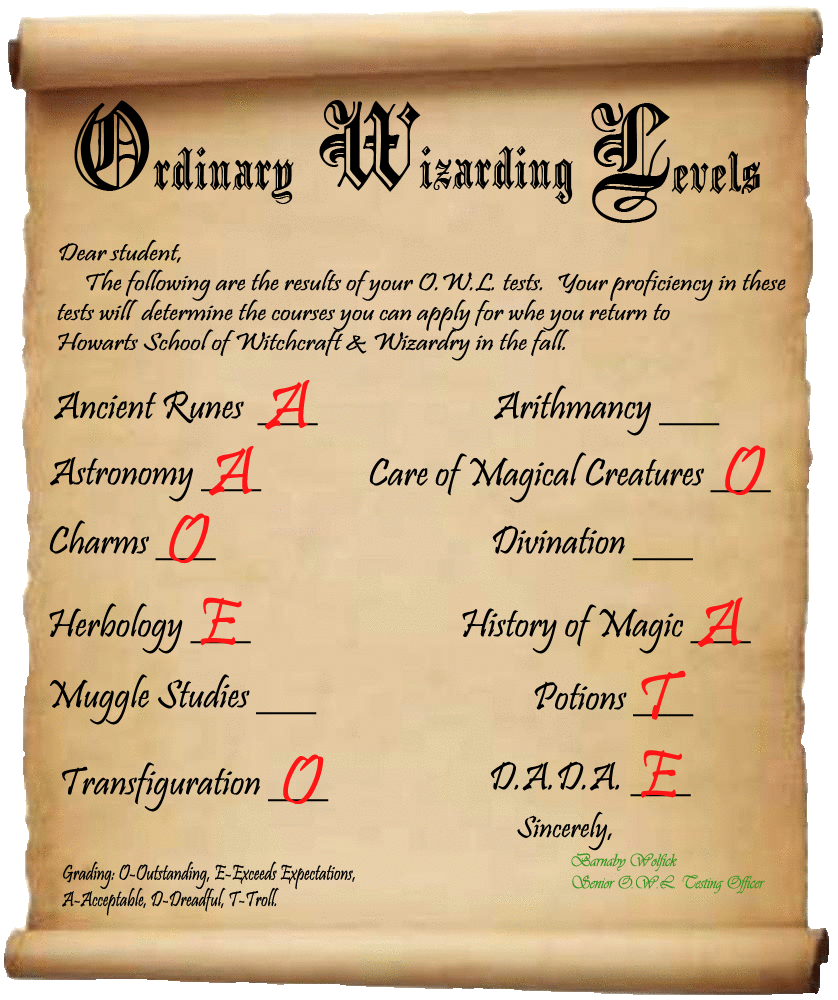
I have been thinking for some time about adapting the Hogwart's Grading system for my classes with my own peculiar bent of obscurity and insanity.
Today, I attended a professional development opportunity and had my mind blown by the possibilities of actually implementing changes into the LMS grade book.
I cannot wait to give TROLLS or OFTs: Outstanding for a Troll.
Thanks for tuning in.
Blog Vacation Two 2022 - Vacation II Post #106
I took a "Blog Vacation" in 2021 from August 31st to October 14th. I did not stop posting daily; I just put the blog in a low power rotation and mostly kept it off social media. Like that vacation, for this second blog vacation now in 2022, I am alternating between reprints, shares with little to no commentary, and THAT ONE THING, which is an image from the folder with a few thoughts scribbled along with it. I am alternating these three modes as long as the vacation lasts (not sure how long), pre-publishing the posts, and not always pushing them to social media.
When immersed in the modern literary masterpiece that is the “Harry Potter” series — what with the classic good versus evil plotline, the moving message of the power of love and friendship and the totally-not-a-retcon reveal of Dumbledore’s sexuality — most people probably don’t devote much attention to the grading system used by Hogwarts School of Witchcraft and Wizardry. Pomona College’s associate professor of history Pey-Yi Chu, apparently, is one exception.
This semester, entering Chu’s Global Environmental Histories class, I was intrigued to learn we (along with her other class) would be using a “modified Hogwarts” grading system to better adjust to the complex realities of distance learning. Having observed this grading system in action for about a month, I feel the Hogwarts grading system is an innovative method to encourage students to put as much participation and effort into the class as they can while taking into account the unique stresses of studying away from campus.
Under the Hogwarts grading system used in Chu’s classes, all assignments are graded on a descending scale of E (Exceeds Expectations), A (Acceptable) and N (Needs Improvement). This is similar to the system that Hogwarts uses in the books, where there are six grades ranging from O (Outstanding) to T (Troll — yes, really). Chu modified this system so that achieving an A or E on all assignments translates to a regular A in the class, and one’s overall grade decreases the more Ns one has; therefore, in terms of class grade, there is no difference between receiving an Acceptable or an Exceeds Expectations on any particular assignment.
In the Global Environmental Histories syllabus, Chu described the grading system as one that “puts greater weight on the completion of assignments to an acceptable standard than on hierarchical distinctions in quality.” This is, therefore, a labor-based grading system: above the minimum standard of quality required to get an Acceptable grade, the only significant distinction in grading concerns the effort put into the work, not necessarily the quality of one’s product. Therefore, the modified Hogwarts grading system’s objective is to push students to try as hard as possible for each assignment, rather than to separate students’ work into quality-based rankings.
This is in no way an “A for effort” situation: I have found that the acceptable standard is not at all easy to meet, and cannot be achieved without a comprehensive understanding of the material.
Speaking from personal experience, under a regular grading system, I have sometimes felt incentivized to put less effort into assignments that will not affect my grade as much; under the Hogwarts system where every assignment effectively has an equal impact on overall grade, students are encouraged to try equally hard on all of them.
Labor-based grading could be uniquely suited to distance learning because, according to Chu, it could help alleviate the inherent disadvantages that some students face when trying to study away from campus. Due to a student’s particular living situation, they may face difficulty maintaining the same quality of work as when they were on campus, even as they put in as much or more effort as previously.
“What we’re trying to do is not to impose these quality distinctions that reinforce existing inequalities, but to lift everyone to that acceptable standard level, and acknowledge the labor that goes into that work — meeting people where they are,” Chu told me.
Furthermore, Chu repeatedly emphasized that this system places the onus on the professor to clearly specify their expectations, which she believes can be especially helpful to students from disadvantaged backgrounds.
“There’s all this literature about the ‘hidden curriculum,’ which means the intuitive ways of ‘doing school,’ that people who come from more advantaged socioeconomic backgrounds will pick up, because they go to schools that are more well-resourced,” Chu said. “[Labor-based grading] encourages the instructor to be transparent; what does Acceptable mean? People who may not be able to intuit that will have it actually spelled out, and know what it takes to make the Acceptable level.”
Since an Acceptable is as good as an Exceeds Expectations in terms of cumulative class grade, some might say that this system pushes students to “settle” for an Acceptable rather than working to their highest “Exceeds Expectations” potential. Personally, though, I feel the Hogwarts system encourages one to try as hard as possible to ensure one meets the threshold for an Acceptable; getting an Exceeds Expectations (which Chu gives relatively rarely) is nice but ultimately incidental.
“To the extent that you can still get an A [in the class] without doing exceptional work, maybe that would affect how much people work at the margins,” said Michael Kuehlwein, professor of economics at Pomona, speaking about how such a system would affect student incentives. “But if you want to be sure that you get an A, you would probably try to get above the bar so you can get an E. As long as the standards are high, I don’t think there would be any problem there; I think the incentives would be fine.”
A survey of my Global Environmental Histories class found an overwhelmingly positive reception for the Hogwarts grading system, with an average score of nine on a scale of one to 10 (10 being most favorable). All respondents said they would prefer that the class use the Hogwarts grading system over the regular system, and two-thirds said the Hogwarts grading system had increased their participation and effort in the class (the rest said it had no effect).
In the end, any grading system is only as good as the professor using it, and the Hogwarts system works in tandem with the great efforts Chu takes to encourage everyone to participate in her class. There are some classes that might not be as well-suited to a Hogwarts grading system, like math and science classes where most assignments consist of solving problems, as there is less leeway in grading and the ability to solve problems correctly is ultimately paramount (in Chu’s Global Environmental Histories, practically all assignments are writing-based).
Still, labor-based grading certainly merits further experimentation, and the current conditions of distance learning provide the perfect opportunity to mix things up.
Ben Reicher PO ’22 is from Agoura Hills, California. He joined his high school newspaper in ninth grade because he loved to argue, and hasn’t stopped since.
Oh, come off it. Yep — nine ‘Outstandings’ and one ‘Exceeds Expectations’ at Defence Against the Dark Arts. You're actually disappointed, aren't you?" -- Ron Weasley on Hermione's O.W.L.s
"Whoops ...Another zero, then, Potter." -- Professor Snape (OP29)
The grading scale for Hogwarts classes, Ordinary Wizarding Level (O.W.L.) exams, Nastily Exhausting Wizarding Test Level (N.E.W.T.) exams, and the Wizards’ Ordinary Magic and Basic Aptitude Test (W.O.M.B.A.T.) are as follows (HBP5):
On the W.O.M.B.A.T. test the Grades are further explained (JKR:W1):
Outstanding – CONGRATULATIONS! Your exemplary powers of deduction and a formidable knowledge of the inner workings of the magical world reveal you to be a witch or wizard of genuine skill and learning.
Exceeds Expectations – Well done – a most creditable performance!
Acceptable – demonstrates real magical potential.
Poor – Alas – we regret to inform you that you have narrowly failed. This may have been due to factors outside your control (eg: poltergeist intervention, examination nerves or a malfunctioning quill.) Please do not disconsolate.
Dreadful – We are sorry to inform you that you have failed.
Troll – You would appear either to have abandoned the test due to factors outside your control (eg, earthquake, poltergeist attack), or else you are a troll, in which case you are to be congratulated on being able to use a computer and have achieved the grade of O.F.T. (Outstanding for Trolls).
These distinctions are clearer when put into action, as when Snape graded the fifth-year potions essay on Moonstone as if it was part of the O.W.L. exam (OP15). When he handed them back, he said most of the class “would have failed” their O.W.L. exams. Hermione made an EE for Exceeds Expectations, which she accepted as a “baseline” for improving to an Outstanding. Draco must have done well, because he laughed at the thought of anyone making a “Dreadful,” which is unfortunately what Harry received in the form of a “spiky D” on his paper. Ron made a P for “Poor,” which was higher than Harry’s grade, but still considered a failure by O.W.L. standards.
However, Harry did quite well on his O.W.L. results (HBP5), except for classes he found dull, like History of Magic and Divination. In Potions he made the same grade as classes he enjoyed, such as Herbology or Care of Magical Creatures.
Astronomy A
Care of Magical Creatures E
Charms E
Defense Against the Dark Arts O
Divination P
Herbology E
History of Magic D
Potions E
Transfiguration E
Occasionally grades are given in numerical values or percents:
Hermione received a 320 percent score in Muggle Studies, before dropping the class (PA22).
Hermione made 120 percent on a Charms test once (OP30).
When Harry's Confusing Concoction wouldn't thicken, he saw Snape write "something that looked suspiciously like a zero onto his notes before moving away" (PA16).
Harry assumed he made a "zero for the day" when he left Hellebore out of the Draught of Peace (OP12)
When Harry made an Invigoration Draught in Potions class, he thought he did pretty well until the flask got broken and Hermione cleaned the rest of it out of his cauldron. Snape, who was angry at Harry anyway for sneaking a peek into his Pensieve memories, gave him a zero for the task (OP29)
Harry received a "bonus point" for creating a corporeal Patronus during his DADA O.W.L. exam (OP30).
- Bloggery committed by chris tower - 2206.10 - 10:10
- Days ago = 2534 days ago
- New note - On 1807.06, I ceased daily transmission of my Hey Mom feature after three years of daily conversations. I plan to continue Hey Mom posts at least twice per week but will continue to post the days since ("Days Ago") count on my blog each day. The blog entry numbering in the title has changed to reflect total Sense of Doubt posts since I began the blog on 0705.04, which include Hey Mom posts, Daily Bowie posts, and Sense of Doubt posts. Hey Mom posts will still be numbered sequentially. New Hey Mom posts will use the same format as all the other Hey Mom posts; all other posts will feature this format seen here.
A Sense of Doubt blog post #2627 - Does Grammar Matter - Prescriptivists vs. Descriptivists
Amazingly, I had set this post for today, and so since it's the day for a share in my rotation in the BLOG VACATION II, then rightly so, time to share.
ALSO, this subject seems fitting since in a few days I interview for a full time position at LCC, my school, and I want to be at the top of my game. I consider this interview and job application the most important of my life thus far, and if I do not get it, I hope they open two more positions in the near future (as they are expected to do), and I manage to get one of those.
Also, I need to fix in my mind the difference between prescriptivism and descriptivism as it's a concept that seems to escape my consciousness even after I review it. I hope this entry cements it in my consciousness for possible use.
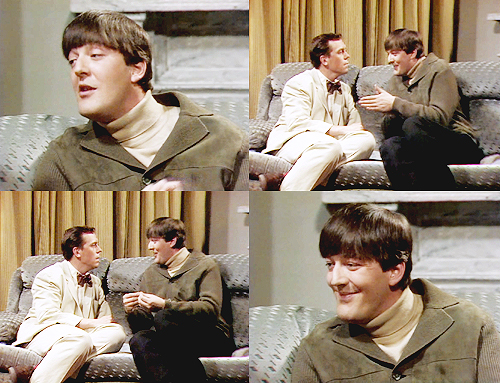
In a cult sketch on language, Stephen Fry compares the inexhaustible creative potential of language to that of music. The structure of language comprises a limited set of parts, just as a piano keyboard has a limited set of keys. However, they are both capable of producing an infinite number of combinations, each representing, as Fry puts it so vividly, “a unique child delivered of a unique mother”. And yet, he continues, we end up saying the same things over and over again. Could prescriptivism have something to do with that?
The genius of Fry is that he manages to touch upon a very serious subject and make a very valid point about it while being hilarious at the same time. What he is actually referring to is how we have tried to stifle linguistic creativity with rules regarding just about any part of language usage, starting from simple grammatical rules, to complex rules referring to collocational patterns, style, appropriateness, the logic of a construction, and so forth.
As a non-native speaker of English, I have always felt that English is one of the rare languages in the world that has that great creative potential which allows a speaker to express exactly what they feel even if they are using an unusual combination of words. I always felt that, for instance, you can unleash your linguistic creativity and combine any verb or adjective with any preposition as long as it makes sense and expresses what you are trying to say more accurately, even though usage guides advise otherwise. It turns out, I have been living in delusion. Native speakers of English tend to have really specific ideas about which combinations are acceptable and which are not; these ideas do not differ greatly from what one would encounter in a prescriptive usage guide. Allan Metcalf, professor of English, author, blogger, AND a native English speaker, was recently the subject of scathing criticism regarding the non-standard use of ‘centered around’, instead of ‘centered on’, in one of his blog entries. He was accused of being careless about language rules, which is especially unacceptable for someone careful about language.
You might wonder how someone like him would react to accusations of using wrong/bad English. Explaining the etymology of the term and citing a dictionary entry is a very good option and the standard way of proving the point, which Metcalf did. However, he went one step further and created a prescriptivist contest! People are expected to come up with their own prescriptive rule, explain and exemplify it. Pullum succinctly expresses his views on this by calling it ‘fake prescriptive poppycock’, which I agree with. Nevertheless, after a few minutes of browsing through the newly invented rules, I came across some very interesting – and I have to admit, impressive – pieces of linguistic prescription. It struck me to what extent native speakers are aware of patterns of usage and how rule-conscious they are.
I am not sure whether that was the author’s goal in creating the contest, but I felt that one purpose of it was to make people aware of the absurdity and redundancy of prescriptive rules. By this, I do not mean that rules are bad in general; they make learning a second language easier and offer language users a sense of security about linguistic correctness. Some areas of language, however, should remain beyond the realm of rules. Language users should always be able to have some room left for unbridled linguistic improvisation.
How about you? Have you ever felt that rules restrain your linguistic freedom?
Blog Vacation Two 2022 - Vacation II Post 63
I took a "Blog Vacation" in 2021 from August 31st to October 14th. I did not stop posting daily; I just put the blog in a low power rotation and mostly kept it off social media. Like that vacation, for this second blog vacation now in 2022, I am alternating between reprints, shares with little to no commentary, and THAT ONE THING, which is an image from the folder with a few thoughts scribbled along with it. I am alternating these three modes as long as the vacation lasts (not sure how long), pre-publishing the posts, and not always pushing them to social media.
- Bloggery committed by chris tower - 2204.28 - 10:10
- Days ago = 2491 days ago
- New note - On 1807.06, I ceased daily transmission of my Hey Mom feature after three years of daily conversations. I plan to continue Hey Mom posts at least twice per week but will continue to post the days since ("Days Ago") count on my blog each day. The blog entry numbering in the title has changed to reflect total Sense of Doubt posts since I began the blog on 0705.04, which include Hey Mom posts, Daily Bowie posts, and Sense of Doubt posts. Hey Mom posts will still be numbered sequentially. New Hey Mom posts will use the same format as all the other Hey Mom posts; all other posts will feature this format seen here.