A Sense of Doubt blog post #4075 - Senegal Stripped of AFCON title; WAFCON postponed
So, for a couple of years, I have been following Football (soccer). I browse the scores each morning. And though I track a lot of English, German, and Italian soccer, I am most interested in Scottish and African soccer. WHY? Well, I am Scottish, so obv.
I posted two months ago about the huge controversy at the African Cup of Nations in which Senegal won a much disputed set of events in extra time.
Obviously, Senegal is furious that their title has been stripped and they paraded with the trophy anyway.
Such drama!!
Read all about it below.
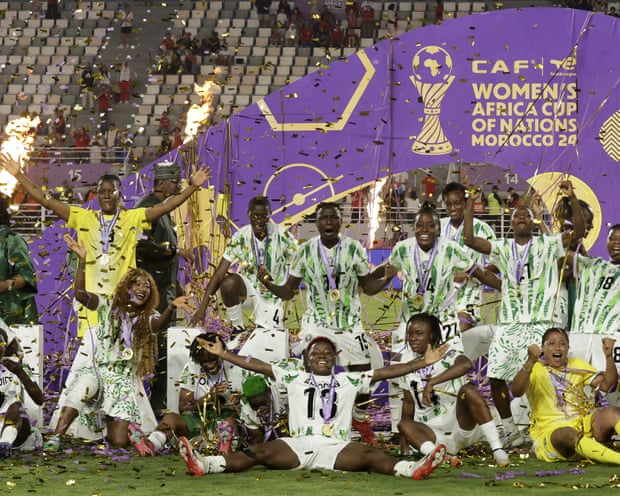
On 13 February, Patrice Motsepe, the president of the Confederation of African Football (Caf), promised that this year’s Women’s Africa Cup of Nations (Wafcon), scheduled to be played in Morocco between 17 March and 4 April, would go ahead as planned. One of the reasons he had to make that statement was the 2024 tournament had been postponed for a remarkable 19 months, until July 2025.
That supposedly solemn presidential promise was broken on 5 March, 12 days before the start of the tournament, with many of the teams – including Nigeria, the defending champions, Cameroon and Ghana – playing friendlies across Africa and Asia to prepare for the showpiece, which also determines which teams get to represent the continent at next year’s World Cup.
“After discussions between Caf and its partners, Fifa and other stakeholders, Caf decided to reschedule the dates of the Wafcon 2026, to 25 July–16 August 2026; to ensure the success of this important women’s competition, in the light of certain unforeseen circumstances,” Caf said in its statement. The Guardian asked Luxolo September, the Caf head of communications, to clarify what those unforeseen circumstances were, but received no reply.
The recurring uncertainty about Wafcon, which has been continually disrupted since 2020, has enraged African women’s football. “It’s not really fair,” Desiree Ellis, South Africa’s coach, told the South African Broadcasting Corporation as rumours were circulating that the tournament would once again be postponed. “I’m just going to raise a question with this Wafcon: would this be happening with the men’s game?”
Ellis’s frustration is shared by an executive committee member of the Nigeria Football Federation, who did not want to be named. “It is a huge shame that the women’s game is treated with so much levity on the continent,” they said. “How can Caf repeatedly treat the Wafcon so shabbily, with so much disrespect towards the players?
“Before the postponement, we played two friendly games against Cameroon in Yaoundé to prepare. This was to help our buildup to the tournament. All that is squandered now. We have to start all over again.” As Nigeria’s Rinsola Babajide, who plays for Roma, bluntly put it on a social media post: “It’s actually embarrassing at this point.”

“The whole situation [with the conflict] has been difficult to handle. The days have been moving in the wrong direction,” he told Moving the Goalposts from Dubai, before they left the country. “It affected our players in different kinds of ways. Some people are stressed, some people are more relaxed, some struggle to sleep and some people can. Sometimes, you hear the bombs during the night.
“We are very disappointed [about the postponement of the Wafcon]. We had been planning for it for a long time.”
It is not only players and coaching staff who have been affected. Many journalists had made plans to cover the tournament too. Firdose Moonda, a Guardian contributor, was to travel from Kolkata in India to Morocco, with her return home to South Africa being the final leg of her journey. Moonda has now had to buy a new ticket to return home. “Flight prices are more than double at the moment … I’m so frustrated with this … Caf should carry this cost,” she says.
Gayton McKenzie, South Africa’s sports minister, agrees with Moonda. “Caf should strongly consider booking flights for all journalists that can prove that they lost money, [as the] media is going through a very rough period currently, financially. This will just be the right thing to do.”
McKenzie also suggested that the hosts have been playing politics with the staging of Wafcon and that the hosting crisis was deliberately caused to embarrass Motsepe because of Morocco’s loss to Senegal in the final of the men’s Afcon in January. He said that South Africa was prepared to host the tournament should Morocco abandon the responsibility.
The Moroccan football federation, the host association of Wafcon, declined to comment on why it was unable to honour its commitment to Caf and whether the rescheduled tournament in July would, in fact, take place in the north African country.
With the rescheduled Wafcon to begin six days after the men’s World Cup final on 19 July, and during the Commonwealth Games in Glasgow, taking place from 23 July to 2 August, it would be a tall order for it to receive the global attention it deserves.
It is a pathetic situation that Motsepe, as well as key Caf staff, such as Véron Mosengo-Omba, the general secretary, must take full responsibility for, as governance incompetence has brought about this miserable state of affairs.
Fans Link CAF's AFCON Verdict to WAFCON Postponement After Morocco Get Senegal's Title
Key Points:
CAF faces mounting skepticism and calls for transparency as fans demand answers about possible links between the WAFCON postponement and Senegal's stripped title.
They needed the appeal verdict sorted before taking on another hosting right. Now Morocco can happily host WAFCON in July. 😅
— Emmanuel Etim (@Emiearth) March 17, 2026
“I am shocked by this decision, because as a person who sat on the @CAF_Online Appeals Board for SIX YEARS, I know that the Appeals Board does not have the power to change the on-field decision of a referee.”
— Osasu Obayiuwana (@osasuo) March 17, 2026
This is what I was told by a former member a few minutes ago. Hmm! https://t.co/SS75ea8STq
🔴🔴🔴🔴🔴🔴🔴🔴🔴🔴🔴
— robertmarawa (@robertmarawa) March 17, 2026
Apparently according to these CAF chaps, Morocco are AFRICAN CHAMPIONS of #Afcon!!
Amidst all this madness, I can guarantee you that WAFCON can now be played as of tomorrow in Morocco!!!
Wow!!! https://t.co/MW5WYklcHC
Morocco was stunningly awarded the Africa Cup of Nations title Tuesday by appeals judges who overturned Senegal's victory in a chaotic final in January.
The Confederation of African Football said its appeal board ruled Senegal was "declared to have forfeited the Final" and its 1-0 win in extra time becomes a 3-0 default win for host nation Morocco.
The Senegalese Football Federation (FSF) on Wednesday said the decision "discredits African football," and that it will appeal "as soon as possible" to the Court of Arbitration for Sport in Lausanne, Switzerland, a process that would typically take a year to deliver a verdict.
"The FSF reaffirms its unwavering commitment to the values of integrity and sporting justice and will keep the public informed of developments in this matter," the federation said in a statement.
In the Jan. 18 final in Rabat, Senegal players, led by coach Pape Thiaw, left the field in protest during stoppage time for 15 minutes -- and fans tried to storm the field -- when Morocco was awarded a penalty that was set to decide the match.
When play resumed, Morocco forward Brahim Díaz's spot kick -- a controversial slow chip shot known as a "Panenka" -- was saved by goalkeeper Édouard Mendy and Senegal scored the only goal in extra time.
Tension in the stadium was already raised by Senegal being denied a goal minutes before the penalty was given to Morocco.
In the second minute of stoppage time, Senegal's apparent go-ahead goal was ruled out for a foul by Abdoulaye Seck, but TV replays showed little contact on Morocco defender Achraf Hakimi.
After the Senegal walk-off, the team's return to the field seemed to be as a result of urging by star forward Sadio Mané to complete the game.
At an initial disciplinary hearing, CAF imposed fines of more than $1 million and bans for Senegal and Morocco players and officials but left the result unchanged.
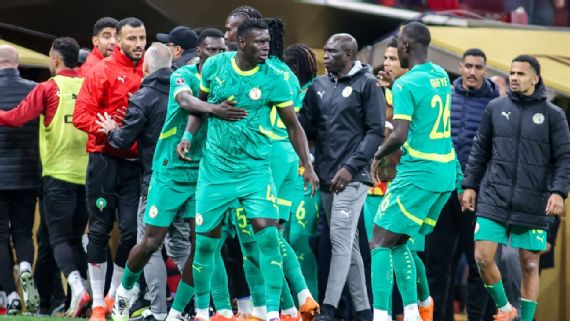
Senegal defender Moussa Niakhaté posted an image on his private Instagram account of himself holding the trophy with a message in French that said: "Come and get it! They're crazy!"
In a similar post on his Instagram story, left back El Hadji Malick Diouf added: "It's not what I expected ... this thing isn't going anywhere."
Abdoulaye Seydou Sow, secretary general of the Senegalese Football Federation, said the organization will file an appeal.
"We will not back down. The law is on our side," Sow told the public broadcaster Radiodiffusion Télévision Sénégalaise late Tuesday.
He called the ruling a "shame for Africa."
"This decision is a travesty that rests on no legal basis. We felt that the panel was not there to apply the law, but to carry out an order," Sow said.
CAF cited article 82 of tournament regulations for its marquee event to justify the verdict enforced on appeal, though not at the first hearing.
It states "if, for any reason whatsoever, a team withdraws from the competition or does not report for a match, or refuses to play or leaves the ground before the regular end of the match without the authorization of the referee, it shall be considered loser and shall be eliminated for good from the current competition."
Still, the appeal verdict did seem to override the referee's authority making field-of-play decisions.
In a statement, the Royal Moroccan Football Federation (FRMF) said "its approach has never been intended to challenge the sporting performance of the teams participating in this competition, but solely to request the application of the competition's regulations.
"The Federation reaffirms its commitment to respecting the rules, ensuring clarity in the competitive framework, and maintaining stability within African competitions," it added.
"It also wishes to commend all the nations that took part in this edition of the AFCON, which has been a major moment for African football."
The verdict Tuesday awarded Morocco its first African title since 1976 and denied Senegal its second title, and second within three editions after also lifting the trophy in 2021.
Both teams play at the 2026 FIFA World Cup being co-hosted by the United States, Canada and Mexico.
Senegal has been drawn to play in a group with France, Norway and a playoff bracket winner this month, which could be Iraq. The games against France and Norway will be at MetLife Stadium near New York.
Morocco was drawn to face Brazil, Scotland and Haiti, with an opening game also at MetLife against Brazil.
Under coach Walid Regragui at the 2022 World Cup in Qatar, Morocco became the first African team to reach the semifinals.
Regragui left the job two weeks ago following fierce criticism for not winning the AFCON title, saying "the team needs a new lease of life before the World Cup."
Morocco now will go the U.S. as African champion.
The Associated Press contributed to this report.
Senegal parade AFCON trophy in France despite CAF ruling
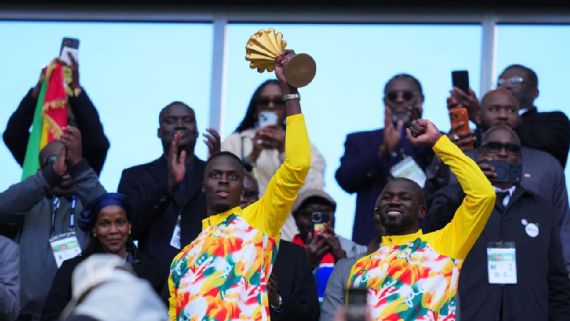
Senegal players paraded the Africa Cup of Nations trophy in front of thousands of fans on Saturday, despite the Confederation of African Football's decision to strip the country of the title and award it to Morocco.
Ahead of a friendly match against Peru at Stade de France, Senegal players led by captain Kalidou Koulibaly took to the pitch with the trophy as part of pre-game celebrations.
The Senegalese Football Association had announced it would present the Africa Cup trophy to its fans before the game in the Paris suburb of Saint-Denis. Paris has a significant Senegalese diaspora.
Earlier this week in the French capital, Senegalese FA president Abdoulaye Fall said Senegal was the victim of " the most grossly unfair administrative robbery" in the history of soccer and pledged that the country would defend its players' "honour" at the Swiss-based Court of Arbitration for Sport.
Senegal is challenging CAF's surprise ruling last week to strip the team of the title won in a chaotic final in January and give it to host nation Morocco.
Senegal's legal team said the country still considers itself the champion of Africa. The CAF 's appeals board ruled that Senegal is "declared to have forfeited the final" and their 1-0 win in extra time became a 3-0 default win for Morocco.
The rationale was that Senegal players led by their coach had left the field in protest when Morocco was awarded a penalty, leading to a 15-minute stoppage.
- Senegal to appeal CAF's decision to hand AFCON title to Morocco
- CAF decision on AFCON title has 'scarred and blemished' African football
- Morocco cannot, in clear conscience, claim Senegal's title after CAF debacle
Senegal's appeal to be reinstated as champion was registered this week by CAS, which set no timetable for a likely long process toward a verdict. The appeal was promised by the Senegalese government, which also called for an international investigation "into suspected corruption" within CAF.
An appeal to CAS can typically take months to schedule a hearing then weeks or months more to announce a verdict. Senegal's lawyers, however, will ask CAS to open an expedited procedure and hope the Moroccan federation and the CAF agree so that the case can be dealt with within two months.
+++++++++++++++++++++++++++++++++++++++++++++++++++++++++++++++++++++++
+++++++++++++++++++++++++++++++++++++++++++++++++++++++++++++++++++++++
- Days ago: MOM = 3939 days ago & DAD = 593 days ago
- New note - On 1807.06, I ceased daily transmission of my Hey Mom feature after three years of daily conversations. I post Hey Mom blog entries on special occasions. I post the days since ("Days Ago") count on my blog each day, and now I have a second count for Days since my Dad died on August 28, 2024. I am now in the same time zone as Google! So, when I post at 10:10 a.m. PDT to coincide with the time of Mom's death, I am now actually posting late, so it's really 1:10 p.m. EDT. But I will continue to use the time stamp of 10:10 a.m. to remember the time of her death and sometimes 13:40 EDT for the time of Dad's death. The blog entry numbering in the title has changed to reflect total Sense of Doubt posts since I began the blog on 0705.04, which include Hey Mom posts, Daily Bowie posts, and Sense of Doubt posts. Hey Mom posts will still be numbered sequentially. New Hey Mom posts will use the same format as all the other Hey Mom posts; all other posts will feature this format seen here.