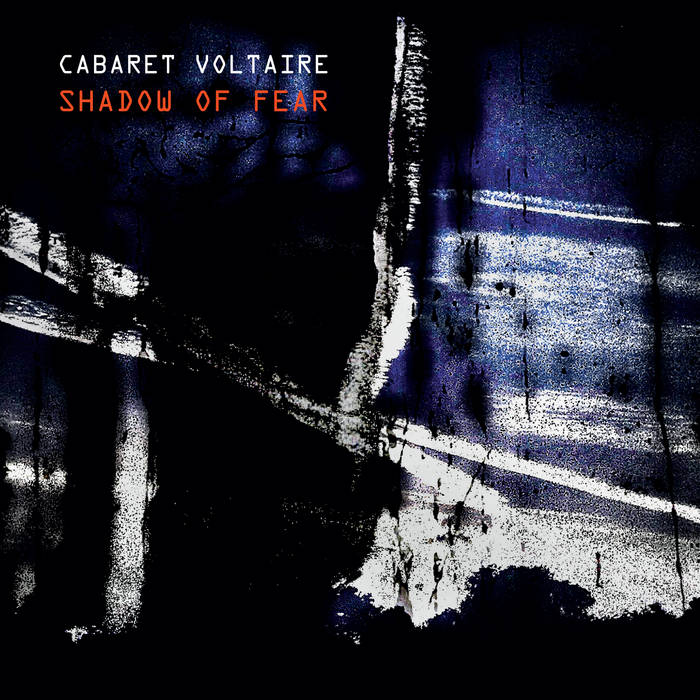
A Sense of Doubt blog post #2113 - New CABARET VOLTAIRE: Shadow of Fear - Musical Monday for 2011.30

I am a huge fan of Cabaret Voltaire, named for the Dada night club in Zurich, a band that is difficult to define with labels. Called post-punk, industrial, techno, EBM (Electornic Body Music), avant-funk, electro, and acid house, what they were and are is an English-based group of musicians formed in 1973 and dedicated to experimentalism with cut up re-assemble of different DIY effects, tape loops, and samples.
They are a band for me that marks entry into a whole new world, when I journeyed to Chicago in the early Eighties and discovered WAX TRAX. I remember vividly entering that magical place full of music that no one had heard of in Kalamazoo (or so I thought) and certainly no stores, even music stores, sold. I didn't have much money at the time, so I could not afford very much. I cannot remember how many records I bought during that first trip, but I am sure I bought my first Cabaret Voltaire album, an EP of "Sluggin' fer Jesus" / "Your Agent Man" (March 1981).
So, needless to say I was thrilled when news broke last week that Cabaret Voltaire was releasing its first studio album in 26 years: Shadow of Fear.
Little did I know at first glance at the notification on my phone of "new album" by one of my beloved bands that it was a reunion of Cab Voltaire without Stephen Mallinder. Though I was also excited to discover that last year Mallinder released a solo album of his own. Given that Kirk, now defacto leader of Cab Voltaire, criticized Dada in a recent interview, and Mallinder's album is called Um Dada, there's definitely some bad blood between the musicians.
I don't care. It's like TWO Cabaret Voltaire albums at once.
If you journeyed here dear reader, I hope you love this great music as much as I.
Here's a bunch of players, links, reviews, and interviews of all recent Cabaret Voltaire and Stephen Mallinder work.
ENJOY.
Shadow of Fear
by Cabaret Voltaire
https://daily.bandcamp.com/album-of-the-day/cabaret-voltaire-shadow-of-fear-review
To anyone wondering why there’s a new Cabaret Voltaire album—their first in 26 years—careening across speaker cones in 2020, the answer’s right in the record title: Shadow of Fear. Kinda sounds like our collective state, doesn’t it? A bleak mindset we simply can’t shake, no matter how positive today’s news is. A shadow of fear.
Richard H. Kirk’s solution is simple: dance. Dance like no one’s watching—because you’re probably holed up at home—and restless techno rippers like “Papa Nine Zero Delta United,” “Universal Energy,” and “Vasto” are downright rejuvenating. In other words, Shadow of Fear is less “Nag Nag Nag,” more get up and go.
Kirk wouldn’t have it any other way. Ever since he rebooted the Cabs—sans longtime singer-turned-academic Stephen Mallinder—in 2014, the multi-instrumentalist/producer has made it his mission to keep things moving. According to a FACT interview, he even said no to a “very fucking large amount of [Coachella] money” because “Cabaret Voltaire was always about breaking ground and moving forward. It would be so sad to see it as a nostalgia act. You can’t make yourself that age again.”
Therein lies the irony, because Cabaret Voltaire sounds as spry as they’ve ever been, and if Kirk has decided to pour all that fountain-of-youth energy into one of the year’s most gleeful cases against giving up. As paranoid as his scrambled vocal samples appear to be, there’s no denying how full of life this LP is. Maybe we can outrun that shadow together?
Cabaret Voltaire - The Power (Of Their Knowledge)
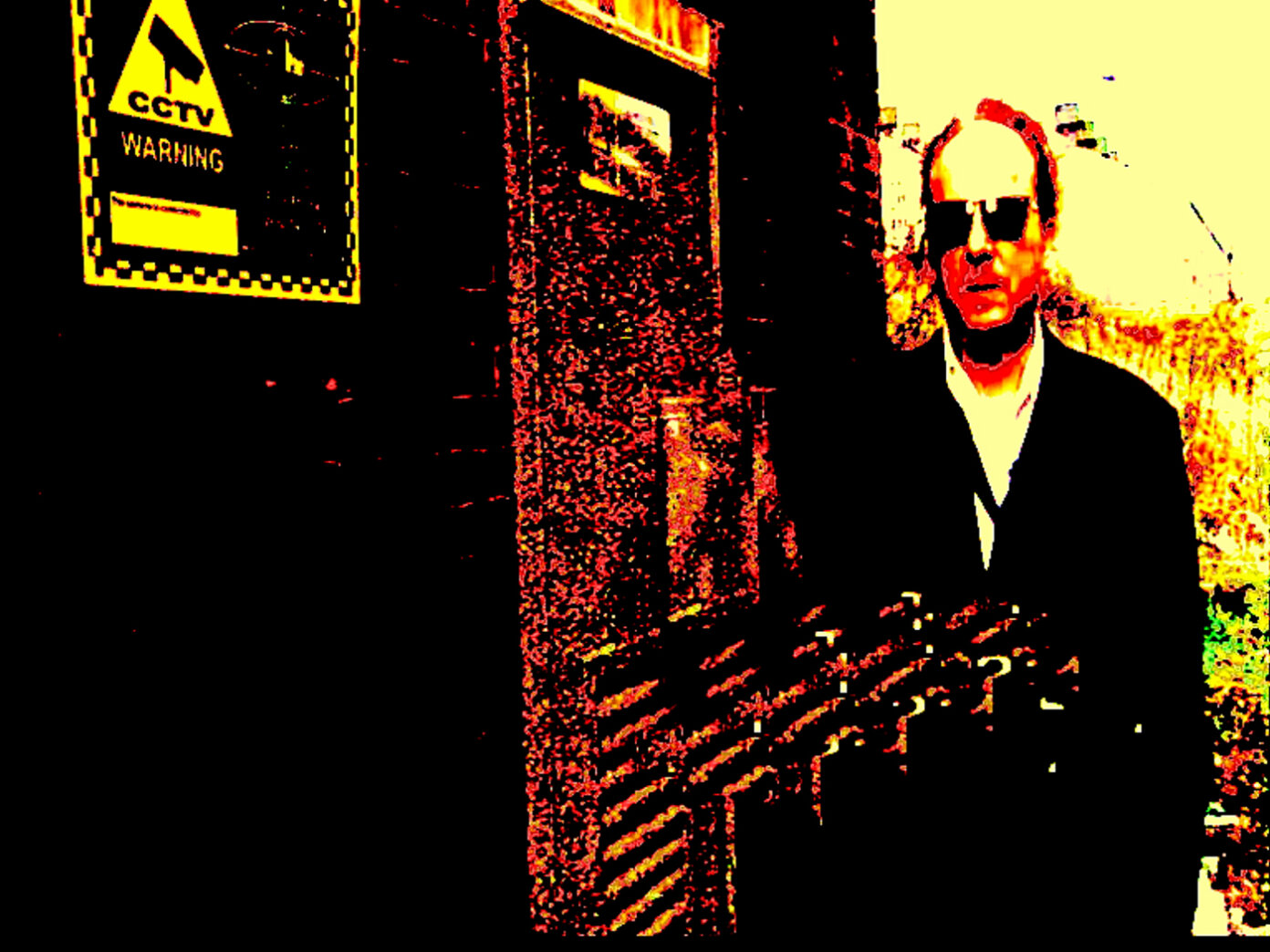
Cabaret Voltaire
Shadow Of Fear

It may have taken 20 years, but observant fans of Cabaret Voltaire might not have been entirely surprised to see Richard H Kirk bringing the name out of cold storage in 2014. As far back as 2005 he admitted he was considering reactivating CV but “planning to get some young people involved”. But judging by some dismayed reactions online, few realised this would mean rehabilitating the band as a one-man operation, without long-time creative partner Stephen Mallinder, and that Kirk would take an uncompromising “year zero” approach on re-emerging.
Given that, on the face of it, CV were coming back in the traditional manner – live shows first, worry about a new record later – we might have expected CV to at least throw a backward-looking bone to fans of a quarter-century’s worth of Cabs studio output, rather than performing sets of entirely unfamiliar music at the new shows. But as Richard H Kirk tells Uncut, he regards not giving people what they expect as part of Cabaret Voltaire’s mission statement.
Many a musician talks a good game about being above the “nostalgia circuit”, but few actually walk the walk so uncompromisingly. As it turns out, though, the string of live shows Kirk has played over the past six years has helped him shape a long-awaited studio album that is more user-friendly than we might otherwise have expected.
He admits that playing live is “always a good research thing… because when some of these tracks drop, people go mental”. That might explain why large parts of Shadow Of Fear throb with a clubby urgency and immediacy that was less evident in the last new Cabs material from the early ’90s – the chilled, sparse technoscapes of early ’90s triptych Plasticity (1992), International Language (1993) and 1994’s The Conversation – or in the austere electronica of Kirk’s last solo set, 2016’s Dasein.
“Papa Nine Zero Delta Zero” quickly hits its stride with an infectiously impish synth pulse, underpinning breathy female vocal samples, cuckooing motifs, fizzing cymbals, distorted imam cries and melodramatic chimes of sonic portent. The 11-minute “Universal Energy” sees the energetic peak of the album, driven by a pounding electro beat as a spitting hi-hat and speeding, saucer-eyed timpani rattle frantically in accompaniment. Meanwhile, fractured vocal samples offset a female voice repeating the title like a sacred mantra with a brooding basso profondo muttering darkly beneath it.
The sense of something wicked this way coming is a recurring one, with many of the lower-end synth textures throughout Shadow Of Fear creating noirish, almost horror soundtrack-style atmospheres. “Night Of The Jackal” resembles the soundtrack to a film of that name that is yet to be made, opening up with a chattering clamour of ghostly voices as industrial chimes and tinny automated beats gather to resemble an early drum machine experiment in a haunted warehouse in 1982.
Opening track “Be Free” is punctuated by warped movie dialogue samples warning “this city is falling apart” and asking “where is your place in this world?”, establishing one eye firmly on contemporary anxieties. “The Power (Of Their Knowledge)” then also features a Big Brother-ish figure offering booming pronouncements in the background, returning to the theme of individualism under threat and the ever-present danger of fascism that can be traced throughout CV’s past work.
Shadow Of Fear isn’t a uniformly dark affair, though. We end on something of a high note as “What’s Goin’ On” nods at the feeling of a troubled planet that Marvin Gaye more explicitly articulated, while channelling some of the more hopeful and uplifting soul sounds that era gave us. A plaintive-sounding voice repeatedly makes the titular enquiry over the swampy twang of a guitar loop before exultant horns echo over a fuzzy bed of wah-wah funk, all of which sound like they’ve been sampled from a 1970 Curtis Mayfield album and then mangled in the customary Cabs fashion. Not so, Kirk explains, sparing many a rare groove anorak the task of working out where he’s culled those snippets from: “There are no samples on that track. It’s utilising quite an old rhythm generator and the rest was played with my own two hands.”
It’s the sound of an act that seems rejuvenated, maybe because of, rather than despite, Kirk’s years (as he puts it, “I’m 64 and I don’t give a fuck”), even if the chance to try to test future material (Kirk says more is imminent) at live shows doesn’t look like a viable option for the time being. The abiding atmosphere may be rather uneasy to suit the world it was created in, but Shadow Of Fear is a brash and confident rebirth.

https://thequietus.com/articles/29239-cabaret-voltaire-shadow-of-fear-review
The Dada Man: Cabaret Voltaire Return With Shadow Of Fear
Jeremy Allen , November 19th, 2020 08:52
Sole remaining member, Richard H. Kirk dusts off the Cabaret Voltaire moniker for the victory lap he has always deserved, finds Jeremy Allen
All the conditions have been met for Cabaret Voltaire’s return now that the dystopian future we were promised is upon us. A first album in 26 years comes with one sole survivor at the helm. Chris Watson left the band in 1981 to become a Tyne Tees soundman, and Stephen Mallinder departed in 1994 in order to plough his own furrow. Now, following an interregnum that spans a generation, Richard H. Kirk has decided to continue alone under the moniker he’s best known by.
Despite the fanfare, Shadow of Fear isn’t technically the first output from Cabaret Voltaire since The Conversation. Kirk remixed Kora in 2009, and revived the name for a lowkey collaboration with the Tivoli, though it was apparently a festival appearance in 2014 under the appellation that really reignited the idea of a reformation of one. The Cabs move in mysterious ways, though according to their own manifesto, they only move in one direction... inexorably forward. “I just don’t like the idea of retreading old ground,” Kirk told biographer Mick Fish back in 1983, “and that is why we try to keep moving on all the time.” No nostalgia has always been the mission statement, and Kirk apparently prefers not to talk about former glories in interviews. “It's nice that people appreciate what you've done in the past,” he said more recently, “but it's a dangerous place to dwell.”
And therein lies the paradox of Shadow of Fear. It is brand new music, and yet every second is haunted by the sonic signifiers of the past. Following a software failure and an aborted attempt to update to digital, Kirk returned to the analogue equipment of yore and everything seemed to fit perfectly again. The method remains the same, with tracks like ‘Be Free’ and ‘Night of the Jackal’ building samples and atmospherics upon the foundations of an old drum machine pattern. Side A is full of lopsided, unnerving music featuring a distorted, virilized voice barking out barely audible slogans like “this city is falling apart”, adding to a sense of alienation. It’s the musical equivalent of a particularly foreboding Michael Haneke film, with the same troubling themes of disturbance, paranoia, detachment and a preoccupation with surveillance, all cut and pasted over an 808.
There are references in the work that are never explicit. ‘Night of the Jackal’ is perhaps one of the more obvious ones. ‘The Power (Of Their Knowledge)’ presumably tips a chapeau to Foucault. Whether or not there’s been an epistemic shift since the founding members and their coterie were coming home drunk from the pub and experimenting with patched up magnetic tape is not something I’m qualified to comment upon, but there’s certainly a sense that we’ve come full circle socially and economically and the ennui of forty years ago is upon us again.
Mick Fish’s book Industrial Evolution: Through the Eighties with Cabaret Voltaire is an odd hotchpotch of his experiences following the band when his appetite for Throbbing Gristle wanes, juxtaposed against the sisyphean drudgery of working for the council and the steady descent into alcoholism that comes with trying to escape the mundanity of existence. If you can get past the author’s homophobia in the intro, it’s a fascinating social document of postwar Britain with a backdrop of pubs, grubby basements, fuliginous skies, brutalist warehouses and bedsits, and entertainment so thin on the ground that you either make something to alleviate the boredom or you call your speed dealer.
Bleakness permeates Kirk’s music now just as it permeated ‘Nag Nag Nag’. Side one exemplifies 2020 in that it’s not entirely successful. While there are great ideas bursting to get out, it also lurches mechanically and is difficult to love. It often feels laboured, like Kirk is giving himself a migraine trying to reinvent something because you suspect he feels that’s his job. Flip the record over and the outlook changes. Once he submits to the pulsating rhythms and allows himself to be free then there’s a gold rush. ‘Universal Energy’ is banging, soaraway techno and ‘Vasto’ too is pulverising, fucked up dance music. Whether or not any of it is groundbreaking is really immaterial. Richard H. Kirk has more than contributed to the rich fabric of our culture and warrants this victory lap calling himself anything he wants to.
Cabaret Voltaire – alienated synthesists (as Phil Oakey would have it) – invented ideas from the peripheries, untrammelled by the conformity of the mainstream, except when they did try to have some hits themselves and discovered they were too idiosyncratic for popular tastes (M|A|R|R|S jumped into their slipstream somehow and had the weird, massive chart topper). It shouldn’t have to be stated that it’s not necessary to be prescient and innovative all the time, and if you’re raising a plucked eyebrow then expectations have been set too high, which is only to be expected when a quarter of a century has passed. There’s a received wisdom that Cabaret Voltaire have always been the bridesmaid, but from anecdotal evidence and observing with my own eyes, being a bridesmaid looks to be a wholly entertaining and fulfilling obligation.
Perhaps most amusing of all is the fact that while Richard H. Kirk is using the Cabaret Voltaire name again, he never went away. The albums made under a variety of pseudonyms are legion. Search Google or Discogs or your streaming app of choice and you’ll find seemingly endless reams of quietly seditious techno under a plethora of aliases: Sandoz, Electronic Eye, Al Jabr, Biochemical Dread, Blacworld, Sweet Exorcist, Vasco de Mento, and so on, as well as under his own name. When I pitched this article I had the idea to farm as much of this sonic landscape as possible, in direct opposition to Kirk’s need to keep moving forward, though it turns out his collective works are unfarmable and he is like a skint aristocrat in a tatterdemalion mansion looking out over vast acres of untamable verdure.
There really is so much of it that all you can do is dive in and take a little bit of what you need. Except for maybe a small hardcore, it seems impossible to catalogue everything, though there are worse things you could do with the Richard H. Kirk discography in all its incarnations than work inexorably backwards. Personal favourites I’ve come across include the ethnotechno electronica of Sandoz’s 1993 album Dark Continent, the early 2000s Electronic Eye albums that aren’t that dissimilar to the new Cabaret Voltaire record, and 1987’s Hoodoo Talk recorded with the Box’s Peter Hope, which mines a similar industrial rock to the concomitant Nitzer Ebb on tracks like ‘Leather Hands’.
The harvest is there for the taking and you should feel no shame looking to the past for inspiration. “Dada is not modern at all,” said the movement’s gospel writer, Tristian Tzara. “It is rather a return to a quasi-Buddhist religion of indifference.” If much of what Cabaret Voltaire did was in the spirit of the Dada, then in a sense, they won. Dada and cut-up culture is all around us now. And as everyone knows, the least interesting thing about Dada is the name itself.
Stephen Mallinder - "Working (You Are)"
•Aug 6, 2019
Stephen Mallinder, co-founder and frontman of the iconic Cabaret Voltaire, has returned with his first solo album in over 35 years: Um Dada. Out 10.11.19 on Dais Records. Take a listen to the lead single "Working (You Are)" - and order the album here:
http://stephenmallinder.bandcamp.com
https://stephen-mallinder.tmstor.es/
Laced with leftfield house and cut-up sound collages, Um Dada is a melding of energies that are an exercise in simplicity and motion. Sincere, playful realism that beckons your body to move, always reminding you to never take yourself too seriously without forfeiting your agency.
While steering Cabaret Voltaire through the 1980’s, Mallinder was already busy piecing together his first solo album entitled “Pow Wow," which would help define Mallinder’s interest in the more leftfield electro sounds shaping England at the time. It was this diverse and abstract hybrid that helped inspire generations of artists and musicians through steeping raw machine funk within the whimsical and absurdist ideology.
Since the release of “Pow Wow” in 1982, Mallinder continued his pioneering work with Cabaret Voltaire, as well as recording and touring with his electro projects Wrangler, Creep Show, Hey Rube, Kula, and Cobby & Mallinder. In addition to his non-stop schedule in electronic music, his professional life as a journalist, broadcaster, producer and now a professor of Digital Music & Sound Art at the University of Brighton, has lead Mallinder to a unique point in his career. Most in his position would be caught up in rosy retrospection, but Mallinder himself says, “There’s too much digital finger-licking right now; every thought and desire at the turn of a dial… well a click of the mouse. And there’s a giddy, false nostalgia about the analogue past. Sorry to burst your bubble but the truth of history is more mundane: practical, pragmatic...Um Dada is about ‘play’ – cut and paste, lost words, twisted presets, voice collage, simple sounds – things that have been lost to technology’s current determinism. Let the machines talk to each other, let them dance .. they lead, we follow.”
Stephen Mallinder, co-founder and frontman of the iconic Cabaret Voltaire, has returned with his first solo album in over 35 years: Um Dada. Laced with leftfield house and cut-up sound collages, Um Dada is a melding of energies that are an exercise in simplicity and motion. Sincere, playful realism that beckons your body to move, always reminding you to never take yourself too seriously without forfeiting your agency.
While steering Cabaret Voltaire through the 1980’s, Mallinder was already busy piecing together his first solo album entitled “Pow Wow”, which would help define Mallinder’s interest in the more leftfield electro sounds shaping England at the time. It was this diverse and abstract hybrid that helped inspire generations of artists and musicians through steeping raw machine funk within the whimsical and absurdist ideology.
Since the release of “Pow Wow” in 1982, Mallinder continued his pioneering work with Cabaret Voltaire, as well as recording and touring with his electro projects Wrangler, Creep Show, Hey Rube, Kula, and Cobby & Mallinder. In addition to his non-stop schedule in electronic music, his professional life as a journalist, broadcaster, producer and now a professor of Digital Music & Sound Art at the University of Brighton, has lead Mallinder to a unique point in his career. Most in his position would be caught up in rosy retrospection, but Mallinder himself says, “There’s too much digital finger-licking right now; every thought and desire at the turn of a dial… well a click of the mouse. And there’s a giddy, false nostalgia about the analogue past. Sorry to burst your bubble but the truth of history is more mundane: practical, pragmatic...Um Dada is about ‘play’ – cut and paste, lost words, twisted presets, voice collage, simple sounds – things that have been lost to technology’s current determinism. Let the machines talk to each other, let them dance .. they lead, we follow.”
Um Dada opens up with the exact machine-led surrealism that Mallinder recommends in “Working (You Are)”. A thick, stripped back dance floor groove provides the ideal foundation for Mallinder’s eccentric vocal cuts. The frisky chops present an almost twisted irony, subtly bringing to mind the role we’re all forced to play as just another cog in the ever grinding capitalist machine of life. Yet, somehow, the listener is left feeling optimistic. A prime example of simplicity at work.
Tracks such as “Satellite” give a skillful illustration of Mallinder’s adeptness with his musical expertise while preserving his core historical context as only simple reference. The underlying bassline and percussion, coupled with the floating melodies and airy vocal refrain disclose the vulnerabilities of love and loss without a hint of irony or nostalgia.
Um Dada is mischievously idealist, however never loses touch with reality. Offering structure while simultaneously dismantling any and all preconceptions. The spirit of sincerity that sustained Cabaret Voltaire’s lengthy career is abundantly present within founder Stephen Mallinder’s journey through his own whimsical utopian consciousness and staking claim to an identity that is solely his own.
Learn more at: www.daisrecords.com
credits
https://www.factmag.com/2017/02/05/richard-h-kirk-interview-cabaret-voltaire-sandoz/

In five
decades of key-bashing and knob-twisting, Richard H. Kirk has remained at
the vanguard of electronic music, first as part of the incalculably influential
post-punk outfit Cabaret Voltaire, and later through his experimental side
project Sandoz, bleep techno crew Sweet Exorcist and numerous remix aliases. As
Mute releases two deluxe box sets of highlights from Kirk’s vast solo
catalogue, he tells Daniel Dylan Wray why he never looks back.
A
spoon clinks the rim of a coffee cup as Richard H. Kirk stirs sugar into his
cappuccino froth. ‘Computer Love’, a track from his favourite Kraftwerk album,
is playing through the speakers. The synth melody wrestles for prominence above
the clatter of plates and the hiss of the overworked coffee machine. A few yards
around the corner from this hip café once stood Western Works, a cutlery
factory that produced coffee-stirring utensils of a quality and satisfying
clang soon matched by the building’s next tenants: Kirk’s band Cabaret
Voltaire.
“It
was a bit of dump, really,” Kirk says of the space, which became a recording
studio shared by Cabaret Voltaire with the Human League before Kirk’s group
took over the entire place and stayed for two decades.
“I
was more or less living in the space when we first got it in 1977,” he
continues. “It just became somewhere to go after the pubs closed. We started
getting a lot of videos in the early ‘80s and building up a massive collection
of films and trash TV and B-movies, so people would come round and have a
spliff and watch this mad stuff until five in the morning.”
When
it wasn’t hosting film screenings, the studio was a place of furious and
persistent work. From the industrial clang and dystopian electronic gargle of
Cabaret Voltaire’s early work through to New Order’s first post-Joy Division
recordings and Kirk’s numerous solo ventures, Western Works became a factory
for Sheffield electronic music. Kirk’s contribution to that lineage has
recently been collected in two box-sets, Richard H. Kirk #7489 (Collected Works
1974 – 1989) and Sandoz #9294 (Collected Works 1992 –
1994), the former amassing early material made in Kirk’s mum’s
house through to several pivotal solo releases, while the latter contains
Kirk’s exploration into fusing African music with European electronic sounds.
“Well,
that and taking a lot of amphetamines,” he adds. “You just get this work ethic
from it. I was also doing a lot of collage and montage work in the studio – it
was like the Velvets being with Andy Warhol, it was just this cultural hub
where it was cool to keep putting things together.”
The
eerie throb that drives some of Kirk’s solo albums, such as on Disposable
Half-Truths and Time High Fiction, maintaing
a loose link to Cabaret Voltaire’s output. Yet with Sandoz, Kirk took on a new
moniker for a new sound, applying a Detroit and Chicago influenced kick to the
grooves of acid house while charging through the fog of a lifetime’s worth of
listening to Jamaican and African music.
“The
great thing about Sandoz was it was the time that people were just putting out
white labels and no one knew who was behind it,” he says. “That was great for
me because you’re always carrying around that baggage – ‘Oh, it’s him out of
Cabaret Voltaire’ – but when Sandoz came out, nobody had a fucking clue.”
As
the ‘90s approached, the Sandoz project became a way back into the clubs he’d
abandoned earlier in that decade, becoming as much a product of the ecstasy
boom as the cross-continental sonic explorations he had in mind.
“I
stopped going to clubs in the mid-80s because it all got a bit cocaine-ified
and it was all designer clothes with a violent undertone,” he recalls. “It was
only when the house thing came along that I started going out again. I think a
different drug made a different vibe. I’m not saying it was just about that,
but it was nice to see football hooligans in there hugging each other instead
of kicking the shit out of each other.”
The
yuppie era saw “Thatcherism transferred into music”, he says of the artists who
followed Cabaret Voltaire’s lead into electronic pop. “It was weird in the ‘80s
after post-punk, when you had your ABCs and
a lot of these bands who wanted to be glamorous and rich, as well as the New
Romantic thing. There were people that were [politically] militant but there
were also people who just wanted to have a good time. In some respects, when
things are collapsing what do you do? You party, what else can you do? Either
you get on the barricades or you get off your fucking head, and I think a lot
of people chose the latter.”

“Sweet Exorcist was the right music
at the right time. It was kind of liberating”
Cocaine
and New Romantics weren’t the only thing Kirk was glad to see gone at the turn
of the decade. “Margaret Thatcher I would hold responsible for the decline of
the north of England,” he says with a bite. “There are people from the mining
communities that haven’t worked since the ‘80s, that’s where the rot set in. We
were on tour in the mid-80s during the miners’ strikes and I remember getting
pulled up by police roadblocks, it was like the country was under siege. We’d
get stopped because they thought we were pickets because we had a mini-bus.
You’d turn off a motorway and there’d be a roadblock waiting. It’s like, ‘hold
on, this is England, not Nazi Germany’.”
As
the ‘90s arrived and Cabaret Voltaire grew into their second decade as a group,
relationships began to strain, both within the band and with record labels, but
Kirk’s work rate remained almost rabid. In 1990 he collaborated with DJ Parrot
as Sweet Exorcist for early Warp single ‘Testone’, a blueprint for bleep techno
and IDM.

“I
was still signed with EMI at the time when it was made and it nearly got me in
a shit load of trouble,” he recalls. “I wasn’t happy where Cabaret Voltaire was
going around that point – Groovy, Laidback and Nasty –
I thought that was a really watered down version of Cabaret Voltaire. EMI were
chucking all this money at it and getting it totally wrong, and then I went in
the studio with Parrot and did Sweet Exorcist, which somehow got to about no. 4
in the national dance chart. All that money from EMI hadn’t been able to do
that for Cabaret Voltaire – it was the wrong fucking music. Sweet Exorcist was the
right music at the right time. It was kind of liberating.”
It
was a moment that spurred on Kirk’s Sandoz project through the ‘90s. “Groovy… got
us dropped from our American label,” he reflects. “If we’d made an industrial
album we probably could have gone bigger than Nine Inch Nails, but that choice
was taken away from us. I also wanted to work with Todd Terry and Derrick May,
to me that was where things were going. I thought house had lost a lot of its
edge and I thought techno was it. That’s what I was more interested in and
that’s what came through with what I was doing with Sandoz.”
In the mid-90s Cabaret Voltaire
collapsed while Kirk continued with Sandoz, releasing several more solo albums
into the next decade and taking on a staggering number of aliases alongside a
healthy stream of remix work, from Ekoplekz to Factory Floor. In 2014, he
finally picked up the Cabaret Voltaire name again for a series of live
performances of new material. Rather than re-living past glories, Kirk says
he’s using the project as an antidote to nostalgia.
“It’s
totally new, I don’t play anything from the past,” he says staunchly. “I think
being 60, it feels more dignified than a band full of old guys wobbling about
on a stage. I’ve been a big fan of Miles Davis for many years and he would
never play anything from the past and the only time he ever did that was before
he died. I just feel like, what’s the point? It’s not going anywhere, who wants
to be playing stuff that you did 30 years ago and constantly repeating yourself?
I always make it really clear that if you think you’re going to come and hear
the greatest hits then don’t come because you’re not. What you might get is the
same spirit.”

Kirk
has also used the reborn Cabaret Voltaire as a means to play alongside younger
artists he feels are leaping forward at a recognisable pace. “When I play I try
and select bills that are all contemporary artists. I get offered loads of
nostalgia gigs where they wheel out loads of ‘80s bands, and even though they
offer shit loads of money… I mean, the Coachella Festival asked me to reform
Cabaret Voltaire and there was a very fucking large amount of money on the
table, and I said, ‘No, this is Cabaret Voltaire, we don’t go back’.
“Some
people might think I’m daft for not taking the money but I wouldn’t feel
comfortable within myself doing that,” he adds. “Cabaret Voltaire was always
about breaking new ground and moving forward. It would be so sad to see it as a
nostalgia act. You can’t make yourself that age again. The way forward is to
keep trying new things.”
Daniel Dylan Wray is on Twitter
Richard
H. Kirk #7489 (Collected Works 1974 – 1989) and Sandoz #9294
(Collected Works 1992 – 1994) are out now on Mute

+++++++++++++++++++++++++++++++++++++++++++++++++++++++++++++++++++++++
+++++++++++++++++++++++++++++++++++++++++++++++++++++++++++++++++++++++
+++++++++++++++++++++++++++++++++++++++++++++++++++++++++++++++++++++++
- Bloggery committed by chris tower - 2011.30 - 10:10
- Days ago = 1977 days ago
- New note - On 1807.06, I ceased daily transmission of my Hey Mom feature after three years of daily conversations. I plan to continue Hey Mom posts at least twice per week but will continue to post the days since ("Days Ago") count on my blog each day. The blog entry numbering in the title has changed to reflect total Sense of Doubt posts since I began the blog on 0705.04, which include Hey Mom posts, Daily Bowie posts, and Sense of Doubt posts. Hey Mom posts will still be numbered sequentially. New Hey Mom posts will use the same format as all the other Hey Mom posts; all other posts will feature this format seen here.


