
A Sense of Doubt blog post #4027 - Stakes for Characters in Fiction and Other Reasons Readers Stop Reading - Writing Wednesday for 2602.25
I have collected here many articles about stakes in fiction, stakes for characters.
The articles to follow vary in quality but there's lots of good things to think about if you're writing.


https://darlingaxe.com/blogs/news/stakes
Who Cares?! The importance of stakes in fiction
By Michelle Barker
Making the Reader Care
When an editor mentions stakes in their feedback on your novel, it’s a polite way of saying, who cares? The answer of course is that the reader should care about what’s happening in your story. If you want them to keep reading, they must care. Your job as the author is to make them care. It’s probably the most important task you have. If your reader doesn’t care what happens to the protagonist, they’ll put the book down.
So how do you make them care?
By raising the stakes for your protagonist. What happens to them has to matter. It has to make a difference in their life. There must be consequences—significant ones—if they fail to get what they’re after. They must stand to lose something important.
Which presupposes another important thing: they should be going after something in the first place. They must have a goal—something to gain. And it should be specific, tangible, and measurable. If the reader doesn’t know what the protagonist wants, there’s no way for them to care about what will happen if they don’t get it. They can’t root for someone who’s aimless.
So your protagonist must want something—badly. And it must be something worth wanting. The protagonist must want it for a good reason (not necessarily the right reason), and the reader should understand why it’s important to them.
The key with stakes is what happens if they don’t get it. What they stand to lose. The stakes must be high. Not necessarily the end of the world—since not every story can involve a world war or an apocalypse. But in a personal sense, yes: the end of something big. Emotional breakdown. A loss of love, or of life. You get to decide what that bad thing is. And you’re free to make it escalate. Bad can get worse. Not just humiliation; jail. Not just jail; death row.
Remember the ring Frodo has to destroy? The story doesn’t start out that way. At first, he thinks he has to find a good hiding place for it. Then he figures he’ll just leave town. Then he decides to drop the ring off with the elves. They try to destroy it; that doesn’t work. By the time they realize they have to take it to Mordor, the reader has a clear idea of what Mordor is, what it means to go there, and what’s at stake if Frodo doesn’t succeed.
It All Starts with the Inciting Incident
The inciting incident is your first chance to introduce stakes into your story. The reader meets the protagonist in their ordinary circumstances and then something happens to turn their world sideways.
We see the idyllic life of the hobbits and then Frodo finds the ring that will bring unimaginable danger to his community. We learn what Katniss Everdeen is willing to do for her family in the harsh world of District 12, and then her sister Prim is chosen for the Hunger Games, prompting Katniss to volunteer in her place. In Pride and Prejudice, we understand the challenges facing a family of five unmarried daughters in the early nineteenth century and then the eligible bachelor, Mr. Bingsley, arrives in town. We watch as orphaned Anne Shirley arrives at Green Gables, only to realize that the Cuthberts were expecting a boy. We journey with Holden Caulfield in New York City, unraveling after his expulsion from Pencey Prep.
It should always be the case that once this inciting incident happens, the protagonist is not free to go back to their simple existence as though it had never taken place. Even if they initially turn down the call to adventure, there’s no way to deny it: the call has happened; the adventure exists. Sure, the protagonist could go back to business as usual, but now they know there’s something else out there for them. Maybe someone desperately needs their help. Maybe this call to adventure is the only way out of their crappy life that they’ve been waiting for, for years. On the surface it might seem like business as usual, but emotionally? No way. Everything has changed. They’ll never be happy unless they answer that call. They know it, and the reader knows it.
Could Anne Shirley just accept being sent back to the orphanage after Marilla’s initial disappointment in not getting a boy? In theory, yes. But she'd never quell the yearning for a place and family to call her own, especially given her fondness for Matthew and the beauty of Green Gables.
Could Holden Caulfield just stay quiet and go along with the phoniness he perceives all around him in society? In theory, yes. But he'd never reconcile with the inauthentic world he so deeply despises.
This is why the inciting incident is so important. It is literally a catalyst. It starts something that, once begun, cannot be undone. It’s your chance to show the reader: this is what the protagonist wants, and this is why it matters.
It must matter. It must be the most important thing to them. If they care, the reader will care. If they have a ho-hum attitude, then the reader will yawn and find something else to do.
How Do You Make It Matter?
By making it personal.
Katniss Everdeen doesn't only volunteer to participate in the Hunger Games to save her sister Prim from certain death. That alone would be brave and selfless. But Suzanne Collins gives her more motivation. Katniss has already lost her father to a mine explosion and lives with the daily pressure of feeding her family. She knows the weight of loss and sacrifice.
Similarly, Frodo isn't just handed a ring to take to Mount Doom. He learns of its dark history and the calamity it can unleash on Middle-earth. But J.R.R. Tolkien goes further, showing us Frodo's love of his uncle Bilbo and the Shire, the bond he forms with the members of the fellowship. The fate of his friends, family, and beloved homeland hangs in the balance, making his quest deeply personal.
Novels must contain conflict on two levels: external and internal.
External conflict is essential to keeping the story moving. But you can have all the car chases and explosions you want in order to raise the external stakes; if they’re not happening to people the reader cares about, the pyrotechnics won’t save you—or your book.
It’s the internal conflicts of your characters that make the reader care. The threat must be personal, and it must be happening to people who seem so real they could materialize in the reader’s living room.
Think of Die Hard. The building could blow up, and yes, that’s bad… but it becomes much worse because John McClane’s wife is in there. Not just his wife; his estranged wife with whom he hopes to get back together. It’s Christmas. They have children. He has something personal to lose.
Use your character’s backstory to both create and deepen their internal conflict. Show the reader how this story is personal to them. It’s an immediate way to raise the stakes.
What Else Can You Do?
Here are some more things to consider when it comes to raising the stakes in your novel:
Honor the chain of causality: Everything your character does should have consequences. Make sure those consequences create bigger obstacles to the achievement of the protagonist’s goal.
Add a ticking clock: Remember that television series, 24? The ticking clock would pop up on the screen as a reminder to viewers that if Jack Bauer didn’t figure out the situation soon, something terrible would happen. But this strategy doesn’t just apply to thrillers, and it doesn’t have to be a literal clock. Make it a deadline. A pregnancy. A diagnosis. Age. The ticking clock element adds automatic urgency to any story situation.
Make sure every scene has stakes: Every scene in your novel should contain a goal, a conflict, and a disaster or newly created obstacle. Something should be different by the end of the scene, either externally or internally. And if different means better, then in the next scene it should take a turn for the worse. Things can always get worse. Your reader is counting on that.
If things remain the same in a scene on both an external and internal level, you either need to rewrite it so that it contains change, or it should be summarized—or removed.
Don’t be afraid to tell the reader the stakes: Tell them again. And again. How many times are we reminded of what will happen if Frodo doesn’t throw the ring into Mount Doom? Several. Gandalf tells us. Galadriel tells us. We see the Orcs, the Uruk-hai, Saruman with his tragically long fingernails. We look into the palantirs. We KNOW. And we’ve already formed an attachment to the members of the fellowship. We don’t want this terrible thing to happen.
Consider the family motto of House Stark in Game of Thrones: “Winter is coming.” How many times do we hear that phrase? And we know that winter will be even worse than expected because we’ve seen the White Walkers.
Let Failure Be One of the Possible Outcomes: This is why George R. R. Martin unexpectedly kills off his heroes. He lets us know early and often that it can happen to anyone and he’s not afraid to do it.
Let your characters do stupid things, make bad decisions, take risks. Let things go wrong for them. Let your reader be afraid for them. As I often say to clients at the end of a chapter, give us something to worry about.
Keep a Leash on It: The end of the world sounds great as a threat, but it must make sense in your story. Not all stakes have to be that dramatic. The more you push the envelope here, the more you risk straining credulity and alienating your reader.
If there is a secret sauce to novel-writing, it’s this: give your readers a reason to care about your story and they will forego Netflix and Instagram and bedtime in order to keep turning pages.

Michelle Barker is an award-winning author and poet. Her most recent publication, co-authored with David Brown, is Immersion and Emotion: The Two Pillars of Storytelling. Her fiction, non-fiction, and poetry have appeared in literary reviews worldwide. She has published three YA novels (one fantasy and two historical fiction), a historical picture book, and a chapbook of poetry. Michelle holds a BA in English literature (UBC) and an MFA in creative writing (UBC). Many of the writers she’s worked with have gone on to win publishing contracts and honours for their work. Michelle lives and writes in Vancouver, Canada.
https://www.writersdigest.com/improve-my-writing/3-key-stakes-that-drive-novels
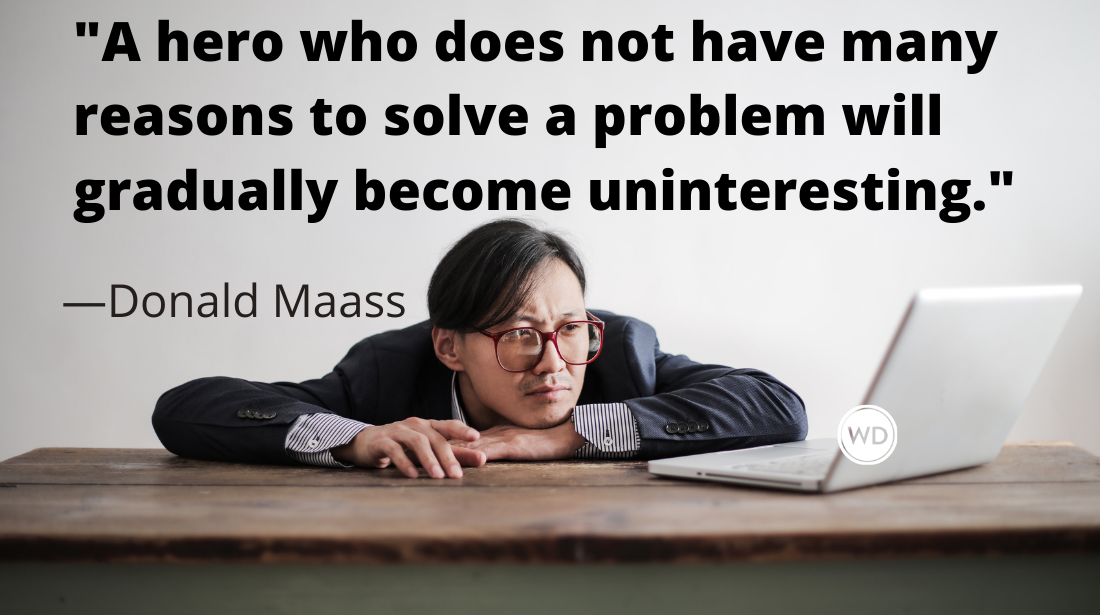
A hero who does not have many reasons to solve a problem will gradually become uninteresting. As the story grinds on, the reader will wonder, Why go through all that grief if you don’t have to? Why not just let someone else handle it? You don’t want that. You want your reader to hope hard or even cheer for your protagonist’s success, right?
Raising the stakes, whether they arise from internal forces or from external ones, makes your protagonist’s character interesting and her story memorable.
PERSONAL STAKES
It’s easy to dismiss a protagonist’s personal stakes as just another way of saying what motivates him. But that’s simplistic. Personal stakes are more than just what a hero wants to do. They illustrate why: why this goal and the action that must be performed to that end matters in a profound and personal sense. And the more it matters to your hero, the more it will matter to your readers, too.
The narrator of Anita Diamant’s The Red Tent is a minor Old Testament character, Dinah, the daughter of Leah and Jacob. In the novel’s opening, we find out why Dinah is so compelled to tell her story—she simply wishes to be remembered the way she actually was.
It turns out there’s another reason, too, why she feels compelled to tell her story, as we learn that Dinah, an only daughter, also wishes for the other women in her life to be remembered. Those would be sufficient reasons to occasion Dinah’s long and layered tale, but Diamant continues to raise the personal stakes as the novel unfolds. The world of women, the culture and the traditions of the red tent shape and define Dinah. Indeed, the company of women ultimately means more to her than the love of men, and telling their story grows in importance. Dinah wants these women to be celebrated for their strength, and, in Diamant’s richly imagined novel, they are.
Every protagonist has a primary motive for doing what he must do. It wouldn’t be much of a story without that. Outward motives are easy to devise from plot circumstances, but inner motives most powerfully drive a character forward. Don’t just look at all the possibilities: Use all of them. That’s exactly what raising personal stakes is all about.
ULTIMATE STAKES
Why do we do what we do? Get up in the morning? Skim the paper? Struggle through rush hour? Placate the boss? Mow the lawn? Save for vacation? Help the kids with their homework? Send birthday cards? Bring a tuna casserole to the reception after the funeral? We have our reasons. We may not think about them all the time, but if pressed we could explain what they are: We care. We feel that what we do matters, however small it may be.
When life tests us to the utmost, our motives grow exponentially greater. Our deepest convictions rise close to the surface. We care still more. We become more determined than ever to make a difference, to persist, to overcome all problems and obstacles. At the moment of ultimate testing, we summon our deepest beliefs and swear that nothing will stop us.
The hero of your novel also will be tested to the limit of his convictions—at least, I hope so! (If not, are there enough obstacles in the way of your protagonist?) How does she respond at this supreme moment? The way that you or I would, let’s hope, but even more strongly.
The hero of Dennis Lehane’s mystery novel Mystic River is homicide detective Sean Devine. At the outset of the novel, his convictions are at low ebb. He has returned from a suspension following an on-the-job “incident” that put his partner on medical leave. At the scene of the murder of Katie Marcus—the 19-year-old daughter of Sean’s one-time friend Jimmy—Sean’s boss, Detective Lieutenant Martin Friel, is wary of Sean. Is he up to the investigation that lies ahead? Sean’s dedication to the case is, as yet, weak. But he gropes for belief and conviction, and borrows it, albeit abstractly, from Martin.
Later, the murdered girl’s father searches Sean, too, for his commitment to the case. In the morgue to identify Katie’s body, Jimmy recalls the crucial childhood event that he and Sean have in common: While planning to steal a car with a third tag-along friend, Dave Boyle, two men in a car took Dave, who was missing for four mysterious, presumably horrible days. Survivor guilt plagues both men, and Sean again comes up short.
As the murder investigation unfolds, the emerging evidence and suspects gradually engage Sean’s mind, and then his heart. He seeks to lay to rest the past, and at one point visits his father, a retired cop with knowledge of the arrest and jail cell suicide of one of the men who kidnapped Dave. His father sees no good in stirring up memories, and the encounter leaves Sean still unsatisfied.
In reality, Sean is moving closer to the heart of his motivation. It’s the guilt of not protecting his friend that has made him a detective, and that continues to drive him now. He feels he should’ve known how to protect Dave back then, but because he didn’t act, now he sure as hell is going to find out who killed Katie Marcus.
At the end of the novel (spoiler alert) he learns that it was none of the suspects, but instead some other kids, who killed Katie. Surprising the murderers at home, Sean finds himself in a standoff and, facing death, discovers why he truly cares. It turns out that Sean cares for the same reasons that all of us get up, fight the traffic and all the rest: because he loves his family. It’s a simple discovery, really, a fundamental commitment that is obvious to almost everyone.
Yet the unfolding of this primary motivation and its revelation to Sean himself at the moment of his ultimate testing gives it a force that not only carries him to the finish, but also resolves the conflicts at the heart of the novel’s two secondary plot layers. Lehane deftly fuses the layers together and brings Sean’s inner journey to a climax all at once. Sean has to live not only to enact justice, but also to put to rest the past and truly love in the present. He searches for, and finds, his irrevocable commitment.
PUBLIC STAKES
Things can go wrong in so many different ways. We sometimes think: It can’t get any worse than this. But it can. That is the essence of raising the outward, or public, stakes: making things worse, showing us that there is more to lose, promising even bigger disasters that will happen if the hero doesn’t make matters come out OK.
Raising the public stakes is easy in thrillers, mysteries, action-adventure novels and science fiction and fantasy stories. The action in such novels usually has significance for more than just the characters involved. Public safety and security are issues. But what about sagas, coming-of-age stories, romances and family dramas?
Mary Alice Monroe’s Skyward offers an example of public stakes and their escalation in a story that has no immediately obvious public consequences. In Skyward, Ella Majors is a burned-out ER nurse from Vermont. She accepts a position as live-in nanny to a South Carolina preschooler, Marion Henderson, whose single dad, Harris, is overwhelmed and unable to cope with Marion’s childhood diabetes.
Quickly, plain-looking Ella falls in love with tall and visionary Harris, the head of a rescue clinic for birds of prey. More slowly, she brings discipline, order and compassion to both the Henderson household and, later, the clinic itself. Harris gradually discovers the wonder of Ella and falls in love with her, too.
This happiness cannot last, right? Right. Just as the inner obstacles and past hurts that each carries have been overcome, outside obstacles crash down upon them. Ella learns that Harris is married. Yet Marion’s young and beautiful mother, Fannie, is a drug user who has walked out on her family several times for extended periods. However, when Ella learns Harris has not sought a divorce, her newfound happiness is dashed. Still, there is hope. Harris might change his mind about Fannie. Shortly thereafter, Fannie indeed returns.
Fannie turns out to be on the wagon and hoping to change her life and regain her family, and Marion clings to her. Fannie, however, doesn’t know how to manage Marion’s diabetes and makes a dangerous mistake with candy, angering Ella, but leading to a turnabout. Eventually (spoiler alert) Ella realizes that she must leave Harris and Marion. She takes a new job at an emergency room in Charleston. Monroe raises the stakes so far that Ella actually fails. What? Is that it? you ask. Ella loses out. The end?
Well, let me ask you: How would you pull an ending out of this bleak situation? Is there any hope for her happiness? Of course, though it may not be exactly the form of happiness that we would like her to have.
What gives Skyward its public stakes? First, the problems that are imposed on protagonist Ella are from the outside: conflicts not inward and circumstances not of her own making. Second, these problems deepen to a degree that finally makes them so big that they attain a universal scale.
Everyday problems presented in an ordinary way, problems that anyone might have on any given day, do not have the power to resonate within us and remind us of humanity’s eternal struggles. But when stakes rise to a high enough order of magnitude, a protagonist’s problems will become the problems that we all have.
*****
Killing Characters!
Someone has to die in fantasy fiction, right? But why?
Two main reasons for me are…
1 – To have an effect on another character.
It could be an inciting incident near the beginning of the book.
It also works to weaken the character just as they’re close to their goals.
Or, it could send the character spiralling, and another character is forced to step up and prove themselves.
2 – To remind readers of the stakes.
There are so many god-like characters with seemingly unlimited powers these days. They’re immortal, invicible, and this means they can’t die, so there are no stakes.
Killing off a significant character early on makes it clear that they do have weaknesses, and readers feel that threat better.
Sure, some are resurrected or found in the underworld, which is a whole different story.
I don’t mind when it’s an instant resurrection or when the MC goes on a quest to the underworld to get their loved one. But I hate when a deceased character suddenly pops up out of nowhere.
I’m currently pondering a character’s death myself. It’s a complicated one in that I could use their POV in this limbo that they’re stuck in, or I could have another character sense them so it’s obvious to readers that they’re not fully dead.
I’ve discussed it with others, and I’m still undecided. But I will make it clear right after the supposed death that the character it not entirely dead. That way, I don’t annoy readers with a random resurrection.

https://self-publishingschool.com/stakes-in-writing/
We all know novels and stories in general are a hodgepodge of many techniques and methods and elements all at play at once. We do many of these things naturally, but others we have to learn and tweak in order to tell the story we want to tell. The stakes in writing is one of these elements.
We’ve all felt the effects of a book’s stakes when reading. It’s what causes the anxiety, the tension, and the desire to keep reading to see how the main character handles everything. It’s also what makes us root for the characters to succeed in their goals.
But how do you actually set the stakes in a way that keeps the readers coming back for more? There’s a bit of strategy to it, and I’ll teach you how in this post.
Here’s what you’ll learn about stakes in writing:
- Definition + Examples
- Why are stakes used?
- High Stakes VS Low Stakes
- Create & Set the Stakes
- Raise the Stakes
- Can you change the stakes?
What are the stakes in writing?
The stakes in writing are what can be lost if the characters don’t succeed in their goal. Essentially, it’s what’s at stake when they take any action to further or solve the story’s plot.
In any story, the main character (or more than one in some epic fantasy and sci-fi cases) has to fulfill some sort of plot. By taking actions and furthering the plot, conflict arises. Oftentimes, in order for the main character to proceed in the plot, they have to make decisions, always at the cost or benefit of something.
That something is the stakes.
Some common stakes in writing are:
- losing a life
- loss of a loved one’s life
- losing out on a job or position in something
- being remembered for nothing (or for something terrible)
- going crazy (often a stake for using magic in fantasy)
- loss of love
- losing a friendship
- freedom or societal/social standing
- going to jail
- justice
- inheriting something: money, country/ruling rights, land, etc.
Take any book you’ve read and ask yourself “what was the main character worried about throughout the plot?” That’s usually what was at stake.
Here are more examples of the stakes in popular novels:
- Harry Potter: The entire series has stakes along the lines of life and death, but also in morality. Defeating Voldemort means a safer and less oppressed world, and those are the stakes in writing the story. If Harry and the others fail, that’s what they’d lose.
- The Hunger Games: Societal oppression is most at stake over the series as a whole. However, in the first book specifically, the stakes of the story is death, because Katniss has to survive a game in which only one survives (at least, traditionally that’s been the case).
- The Hating Game: In this romance novel, Lucy is vying for a specific job that her rival (and coworker) wants. Throughout the story, the job is at stake with many of the choices she makes.
- Bridgerton: Not only is love at stake, but the reputation of the characters is often one of the stakes in writing the author uses to create tension and move the story forward. Because of the historical setting and the strict social norms of high society living, any wrong move could destroy not only a single person’s reputation, but that of their family as well.
Note: there can be many stakes in a single story, with them compounding as the story goes on. This is a great way to create conflict in a story, and makes it all the more satisfying when everything comes together. Oftentimes, by the climax of a story, the main character will have lived through the loss of some stakes in their effort to prevent the biggest one from occurring.
Why Stakes are Used as a Primary Element of Story
You never really read stories about how a person did something, at the cost of nothing, and with no problems (conflict) on the way there. That’s not interesting. It’s not a good story. It’s not a story at all, but an account of events.
Stakes are powerful movement for your story. Without stakes, tension is flimsy. Without tension, there isn’t a huge emotional tie to the story for the reader. The stakes also give the character a reason to make certain decisions, and we never really know the outcome as the reader.
So in a way, the stakes in writing are what create the intrigue necessary for readers to finish reading the book. The question of “will they or won’t they” is powerful enough to keep a reader turning pages. If nothing is at stake, and nothing will be lost by the main character’s actions, then what interest does the reader really have in the story? What investment do they really have?
Sometimes it can work, but you’ll be hard pressed to find a book where there are no stakes and it’s still an interesting read.
That said, you can have different kinds of stakes, and they produce unique moods and tones within the story as a whole. Which means, depending on your audience, you’ll want to tweak the height of the stakes in writing: high or low.
High Stakes VS Low Stakes
I’d describe the difference in high VS low stakes like this: The more severe the effect on the main character’s and other people’s lives they care about, the higher the stakes. The less severe, the lower the stakes.
Many genres and subgenres have norms for the stakes in writing, specifically how high or low they are, which is important when considering reader expectations.
Let’s take a deeper look at what high stakes in writing looks like vs low and how you can use them.
High Stakes:
If the stakes are high, there is a lot on the line. This can be both in quantity of stuff that can be lost, as well as severity of the consequences of failure. In The Hunger Games, Katniss’s life was at stake. Those are high stakes because of the severity of the consequences of failing.
High stakes can often look like:
- death
- injury
- harm to masses of people
- being forgotten or other historical consequences
- betrayals
- natural disasters
- moral dilemmas
But your story could also have many things that could be lost as a result of failure, and not necessarily something that’s severe. This situation would still be considered to have high stakes in writing.
Low Stakes:
If the stakes are low, there are still meaningful elements on the line, but the consequences aren’t too severe. This isn’t to be mistaken for a boring or uninteresting read. It’s just a different style where the tension is reduced and the reader gains more intrigue from the characters, world, or plot itself.
Low stakes in writing can look like:
- losing a job
- closing the family business
- missing out on an opportunity
- misunderstandings
- friendship squabbles
- sense of self challenges
- challenges with hobbies
Low stakes are often seen in books labeled as “cozy”, like cozy mysteries, cozy fantasy, and the like. Readers of these genres can expect that they won’t have to deal with too many severe consequences relating to dark themes, like death, destruction, assault, etc.
How to Create & Set the Stakes in Writing
Creating the stakes in writing will drive your story forward, and often impact much of the plot points going forward. The creation part of the stakes takes place when you’re plotting or coming up with story idea, for those of you who don’t plot much.
The other part is setting the stakes in the novel once you know what they are. We’ll talk about both of them.
Creating the Stakes:
This stage takes place during ideation. You’re coming up with story ideas and are gaining and understanding of the plot. More than that, though, is you should have a strong idea of who your character is within the plot and what it is they’re after because that will affect the stakes in writing.
The stakes will impact the decisions the character makes, which is vital to how the plot unfolds.
The character’s decisions will depend on two things:
- What they want
- What they’re willing to do to get it
This is why I can’t really talk about creating the stakes without talking about crafting an in-depth persona for your character. You have to know who they are, what their values are, their morality, and how all of those came to be.
A character’s wants and goals are the stakes in writing.
What they could lose = what they want most.
And what they’re willing to do and give up in order to reach their goals is depending on the type of person they are, and that you create them to be.
That’s what makes for a gripping story, one where the character will go to extreme lengths in order to get what they want, no matter what that is. When it comes down to it, the stakes in writing depend on the character you’ve crafted for the story.
We could get into more about where to start a story, with the plot or the character, and how everyone will have to find their own balance and dance with navigating it. But it’s more useful right now to talk about something more singular you can focus on that will help with the rest, and that’s this:
Readers often enjoy a story when the stakes in writing are something meaningful and import to the main character’s morals. When who they are as a person is challenged, it makes for greater stakes. Here’s some proof of readers wanting just that:
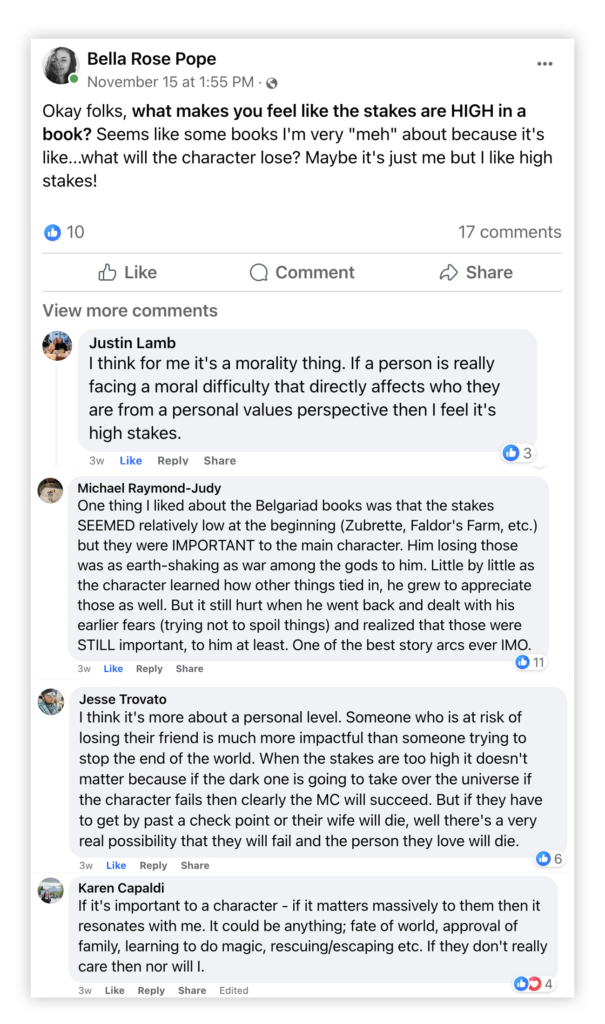
What this might look like is a character who wants to bring their adopted family to a certain safe-haven island. This is a character who just lost one of those family members, and blames herself. She’s relentless in this pursuit, sacrificing much on the way there. The trick here is that the stakes are not “can’t bring family to safe-haven island”. The stakes are “if I don’t bring my family to this place, then I’m a terrible, awful person who doesn’t deserve happiness.”
Therefore, the true stakes in this case are highly tied to the character’s self beliefs.
And yes, this is for a main character in the fantasy story I’m working on 😉
The point is, if you can tie the stakes in writing to a deeper importance to the character, it will feel more powerful.
Setting the Stakes:
Most of the time, this happens very early in the story. It’s part of the hook that makes readers become invested in the character and story. You know the stakes as the writer, but the reader has to know them too—preferably without you needing to explicitly state them.
There can be moments in the story with other characters where they vocalize the stakes or the character has some interior monologue and says them. This can look like moments of planning or just fear and anxiety.
Here’s an example of a moment of inner monologue, when a character is thinking and contemplating, that sets the stakes in writing:
“Lorraine recognized that if she went to the museum, she’d miss the meeting where they’d choose the project manager. If she didn’t get this job, her chances of getting promoted were almost nothing. But Ricardo Richards was at the museum. If she managed to get his attention and get a job with him, she wouldn’t need the promotion at all.”
But you can be less obvious about it, and allow the reader to conclude what the stakes would be. There isn’t a moment in The Hunger Games where the reader needs a full clarification of the stakes. Because the narrative has done a great job of showing the reader the world, its norms, and has taught you about The Games, we can understand what it means when Katniss volunteers as tribute. That moment is when the stakes are set, though there’s nothing said about it.
The reader knows that if she volunteers, she has to compete. If she competes and there’s only one survivor, she could die.
The stakes are that if she loses, she dies.
It’s not as complicated as it sometimes seems to set the stakes in writing.
You can actually set the stakes in three steps:
- Show who your character is.
- Show what they want.
- Show what’s in the way of them getting it.
That can also be the outline for an opening chapter or the first couple chapters, because within these three steps, you also introduce your protagonist, give them a motivation (what they want), and introduce the conflict (what’s in the way).
Three birds, one stone.
How to Raise the Stakes & Progress the Story
Over the course of the story, you’ll want to create more tension, aka raise the stakes. At the midway point when writing a novel, you’ll usually find that a big change has occurred in the plot. Something has come up, information has been revealed, or something has happened to shift the progress of the story.
The stakes in writing can be altered or made worse at this point.
When the stakes—what the main character can lose—become more severe, it’s called “raising the stakes”.
Raising the stakes creates a lot more tension in the story and can make a reader become more invested. There are two primary ways to do this:
- Increase the amount of what can be lost
- Increase the cost of what’s needed to succeed
So you can add more stakes in writing so they pile on top of each other, causing them to feel higher, or you can make the consequences of failure and what must be done in order to succeed that much more significant. Both of these will raise the stakes.
But how do you know what to do in order to raise the stakes? You go back to your character. Specifically looking at what the character values. Over the course of the book, this can change or grow. In order to raise the stakes in writing, take what the character values most and threaten it.
This is why in many stories where a romance is involved, the stakes are raised when the main character falls in love. Now they could lose their loved one and the other thing they don’t want to lose.
Can the stakes in writing ever change completely?
In a way, yes. In the section on creating and setting stakes above, I mentioned tying it to the character arc. If a character changes enough, the stakes can change as a result. If they no longer care about getting that job, because they realize the job was what their parents wanted and they only wanted to feel accepted in their parents’ eyes, then the stakes change to something else.
Now the stakes are their own happiness, not the job they thought would make their parents proud of them.
You do have to be careful with changing the stakes though. It has to be done authentically and with a tie-in to the character, or due to a major plot twist that changes the direction of the story. Otherwise, you’ll end up with plot holes that cause issues.
EXTRA RESOURCES
https://thewritepractice.com/raise-the-stakes/
https://jessicadavidson.co.uk/2018/04/21/buddhist-writing-prompt-remember-whats-at-stake/
https://careerauthors.com/stakes-in-novels/
https://prowritingaid.com/three-levels-of-stakes
http://blog.janicehardy.com/2009/10/whats-at-stake.html
https://rbkelly.co.uk/importance-of-high-stakes-in-fiction/
https://sophie-writes.com/2020/09/04/the-importance-of-stakes/
+++++++++++++++++++++++++++++++++++++++++++++++++++++++++++++++++++++++
+++++++++++++++++++++++++++++++++++++++++++++++++++++++++++++++++++++++
+++++++++++++++++++++++++++++++++++++++++++++++++++++++++++++++++++++++


No comments:
Post a Comment