 |
| spiral galaxy NGC 5134 |
A Sense of Doubt blog post #4037 - SPACE: Dark Matter Galaxy, Solar System that Should Not Exist, and a cool Spiral
Just sharing some of the space stuff I have been collecting lately.
Thanks for tuning in.
https://www.space.com/astronomy/james-webb-space-telescope/spectacular-spiral-galaxy-revealed-by-james-webb-space-telescope-space-photo-of-the-day-for-march-4-2026
Spectacular spiral galaxy revealed by James Webb Space Telescope | Space photo of the day for March 4, 2026
The James Webb Space Telescope (JWST) has captured a truly spectacular view of the spiral galaxy NGC 5134, revealing glowing dust clouds, newborn stars and the ongoing cycle of stellar life and death.
What is it?
NGC 5134 is a spiral galaxy, a type of galaxy characterized by a bright central core surrounded by sweeping arms filled with stars, gas and dust. These arms act as cosmic nurseries where new stars are constantly forming.
his dramatic image combines observations from two of the JWST's powerful instruments: the mid-infrared instrument (MIRI) and the near-infrared instrument (NIRCam). MIRI detects mid-infrared light emitted by warm dust, revealing strands and clumps of gas scattered throughout the galaxy. NIRCam captures shorter-wavelength infrared light that highlights the stars and star clusters embedded deep within the spiral arms.
Why is it amazing?
The glowing dust clouds visible throughout the galaxy are the raw material for new stars. As gravity pulls this gas together, new stars ignite — gradually using up all the galaxy's star-forming fuel. When stars die, they return some of that material back into space. Massive stars explode into supernovas, scattering elements across hundreds of light-years, while smaller stars like our sun shed their outer layers as they expand into red giants.
By studying galaxies like NGC 5134 in infrared light, astronomers can trace this ongoing cycle of stellar birth, evolution and recycling, helping scientists understand how galaxies grow and change over billions of years.
https://scitechdaily.com/ghost-galaxy-made-of-99-dark-matter-discovered-300-million-light-years-away/
“Ghost Galaxy” Made of 99% Dark Matter Discovered 300 Million Light Years Away
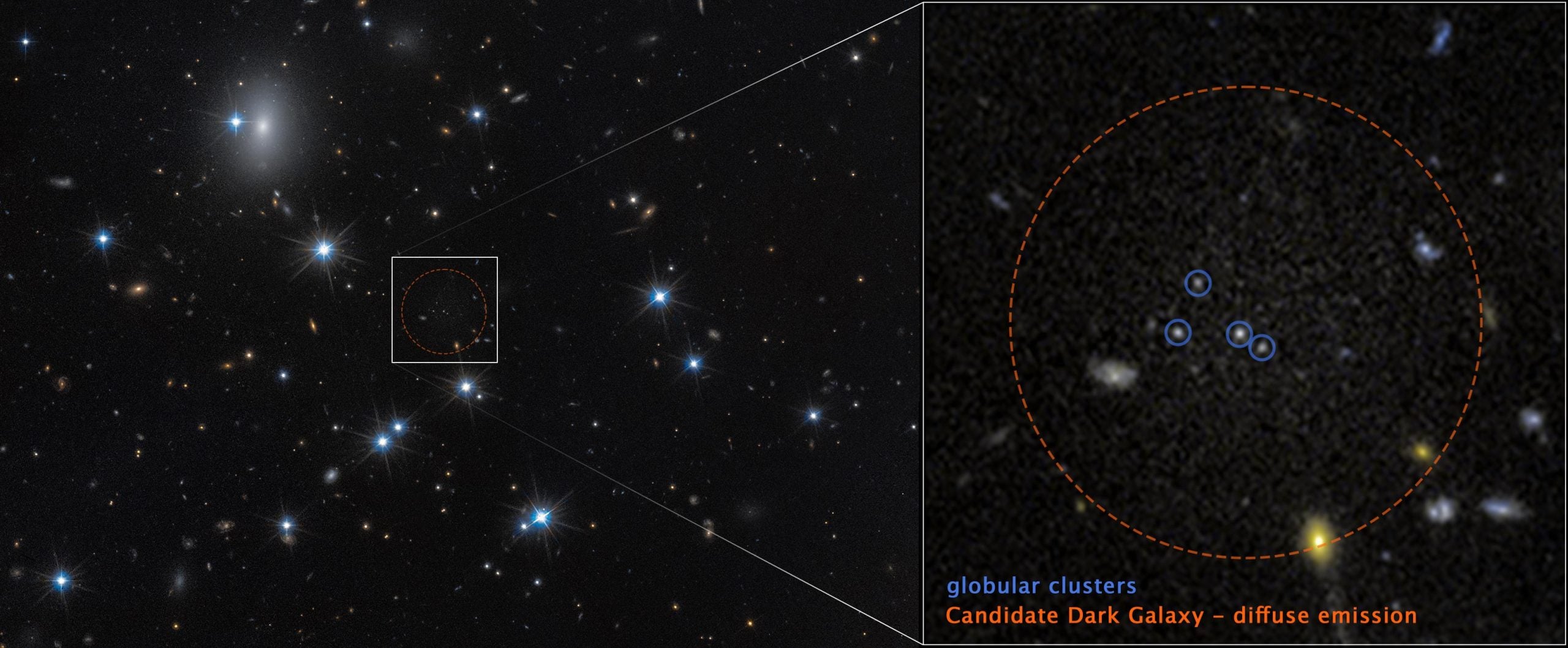
Astronomers have detected a ghostly galaxy that is almost completely made of dark matter. The faint object was revealed by just four globular star clusters hiding in the Perseus cluster.
While most galaxies blaze with billions of stars, a rare few are so faint they are barely detectable. These low-surface-brightness galaxies contain very few stars and are largely made up of dark matter, making them extremely difficult to spot.
One of the most unusual examples, called CDG-2, could be among the most dark matter dominated galaxies ever identified. (Dark matter is an invisible form of matter that does not reflect, emit, or absorb light.) The discovery was detailed in The Astrophysical Journal Letters.
Finding a Galaxy Through Globular Clusters
Because these galaxies emit so little light, they are challenging to detect directly. David Li of the University of Toronto, Canada, and his research team used sophisticated statistical methods to search for patterns instead of brightness. They looked for tight groupings of globular clusters, which are dense, spherical collections of stars that usually orbit larger galaxies. Such clusters can serve as indirect evidence that a faint galaxy is present.
Using this strategy, the team located 10 already known low-surface-brightness galaxies and identified two additional candidates that may qualify as dark galaxies.
Confirming CDG-2 With Hubble, Euclid, and Subaru
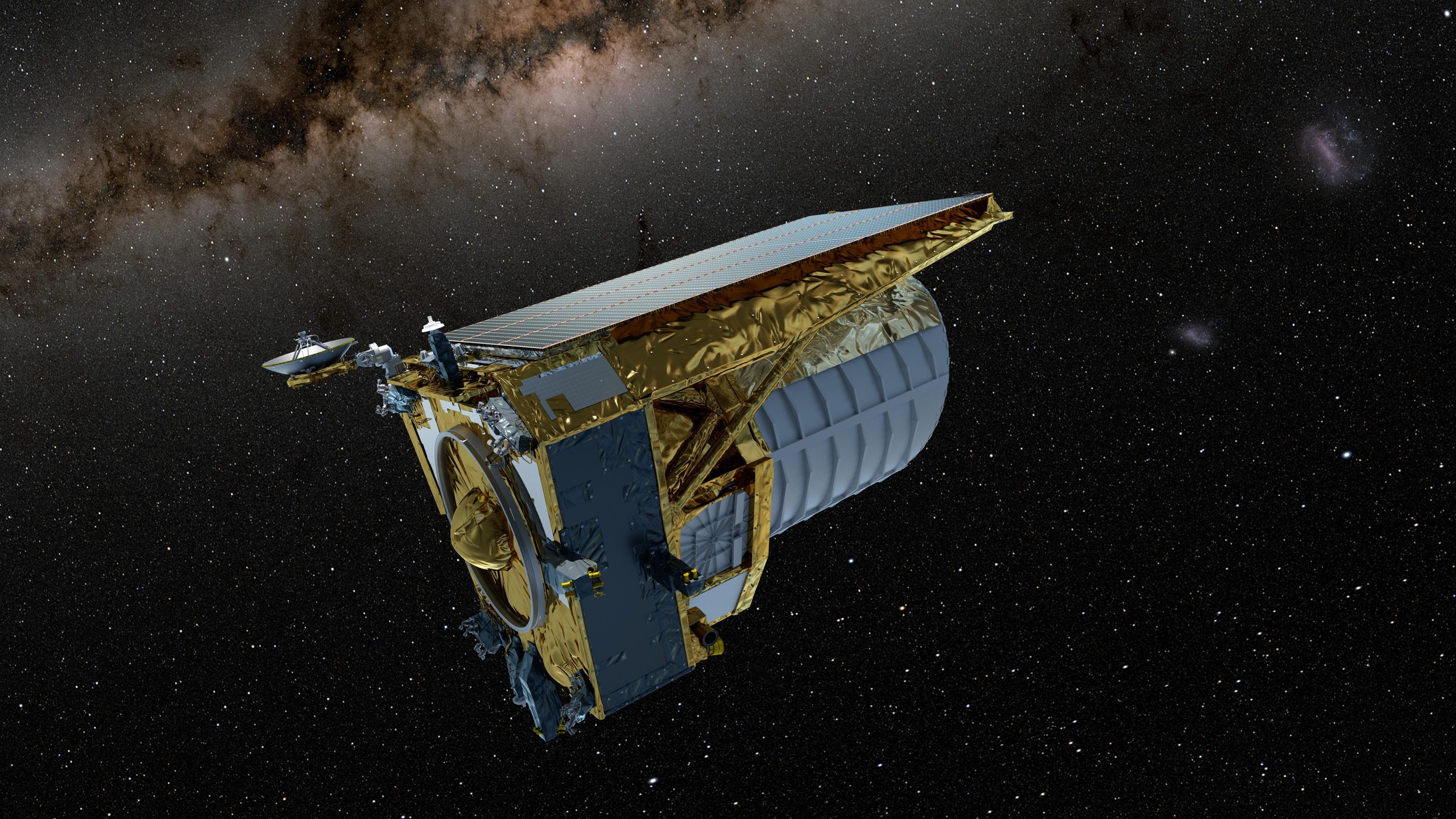
To confirm one of the candidates, astronomers relied on three observatories: NASA’s Hubble Space Telescope, ESA’s (European Space Agency) Euclid space observatory, and the Subaru Telescope in Hawaii. High-resolution images from Hubble revealed four tightly grouped globular clusters within the Perseus galaxy cluster, about 300 million light-years from Earth.
Further observations combining data from Hubble, Euclid, and Subaru detected a faint, extended glow surrounding those clusters. That dim halo provided convincing evidence that a previously unseen galaxy lay beneath them.
“This is the first galaxy detected solely through its globular cluster population,” said Li. “Under conservative assumptions, the four clusters represent the entire globular cluster population of CDG-2.”
A Galaxy That Is 99 Percent Dark Matter
Early estimates suggest CDG-2 shines with the combined light of roughly 6 million Sun-like stars. The four globular clusters account for about 16% of the galaxy’s visible light. Even more striking, about 99% of its total mass, including both visible matter and dark matter, appears to be dark matter.
Most of the ordinary matter needed to form stars, mainly hydrogen gas, was likely stripped away through gravitational interactions with neighboring galaxies inside the Perseus cluster.
Globular clusters are extremely dense and strongly bound by gravity. Their resilience makes them less vulnerable to gravitational tidal disruption, allowing them to remain intact and act as dependable markers of faint galaxies like CDG-2.
Expanding the Search for Dark Matter Galaxies
As major sky surveys continue to grow with missions such as Euclid, NASA’s upcoming Nancy Grace Roman Space Telescope, and the Vera C. Rubin Observatory, astronomers are increasingly using machine learning and advanced statistical techniques to analyze enormous datasets.
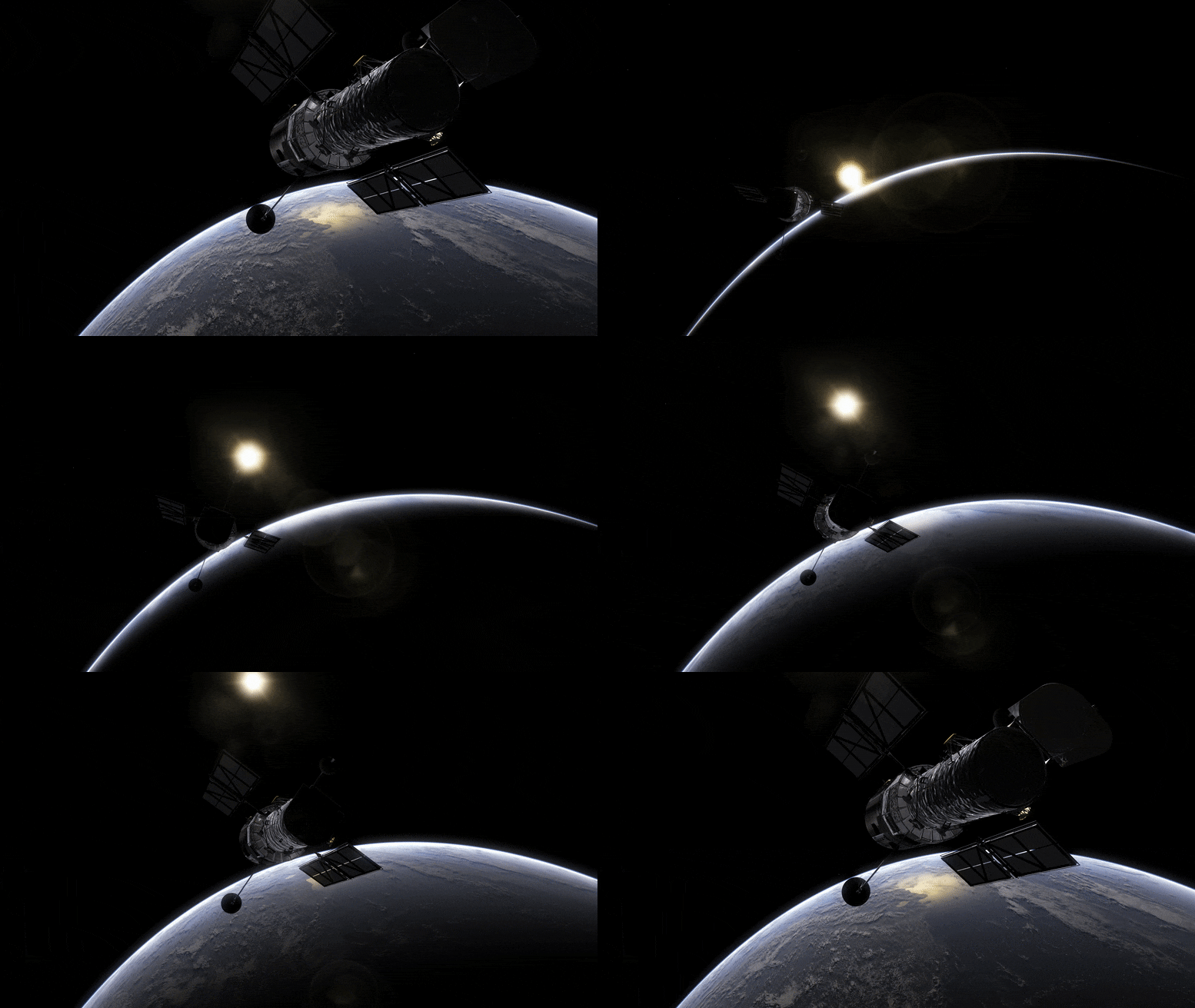
The Hubble Space Telescope has operated for more than 30 years and continues to deliver discoveries that deepen our understanding of the universe. Hubble is a joint project between NASA and ESA (European Space Agency). NASA’s Goddard Space Flight Center in Greenbelt, Maryland, oversees mission operations, with additional support from Lockheed Martin Space in Denver. The Space Telescope Science Institute in Baltimore, operated by the Association of Universities for Research in Astronomy, manages Hubble’s science operations for NASA.
Reference: “Candidate Dark Galaxy-2: Validation and Analysis of an Almost Dark Galaxy in the Perseus Cluster” by Dayi (David) Li, Qing Liu, Gwendolyn M. Eadie, Roberto G. Abraham, Francine R. Marleau, William E. Harris, Pieter van Dokkum, Aaron J. Romanowsky, Shany Danieli, Patrick E. Brown and Alex Stringer, 16 June 2025, The Astrophysical Journal Letters.
DOI: 10.3847/2041-8213/adddab
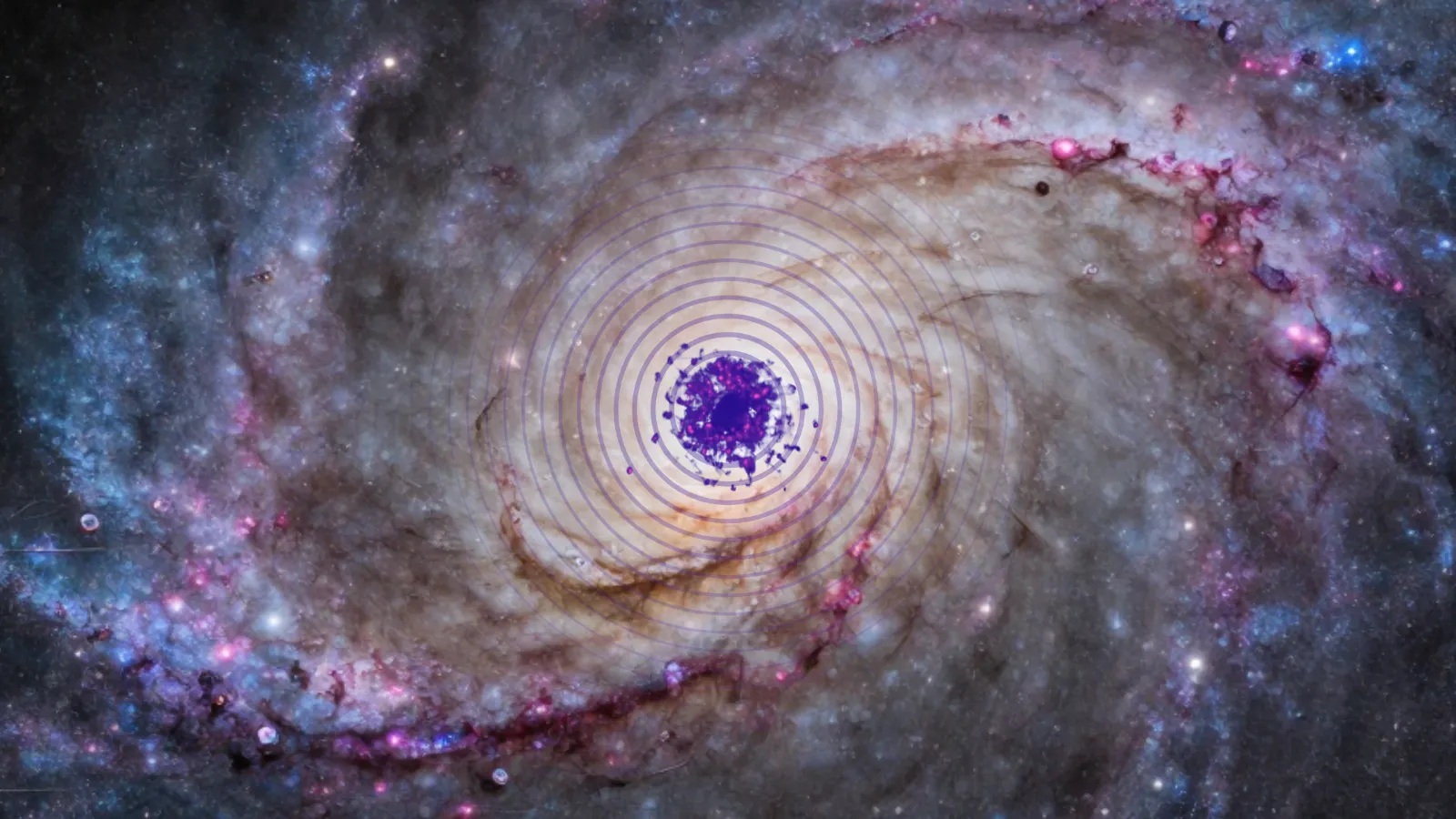
New research suggests the supermassive black hole at the heart of the Milky Way is actually a tremendously massive yet compact clump of dark matter.
Scientists say this clump would exert the same gravitational effects currently attributed to the Milky Way's supermassive black hole, Sagittarius A* (Sgr A*). That includes the violent and rapid dance of stars taking place at the Galactic Center, in which so-called "S-stars" race around the compact heart of our galaxy at speeds as great as 67 million miles per hour (30,000 kilometers per second). For context, that's around 10% of the speed of light. This dark matter clump, the team says, would also account for the orbits of the dust-shrouded bodies, or "G-sources" located in the Galactic Center.
Fermionic dark matter is proposed to be capable of forming a structure that consists of a super-dense, compact core with so much mass that it mimics a supermassive black hole with a mass equivalent to 4.6 million suns, the research team says. That core would be surrounded by a vast and diffuse halo stretching out far beyond the visible matter of the Milky Way — but acting as a single unified entity. This is a structure that other recipes of dark matter can't replicate.
"We are not just replacing the black hole with a dark object; we are proposing that the supermassive central object and the galaxy's dark matter halo are two manifestations of the same, continuous substance," team member Carlos Argüelles, of the Institute of Astrophysics La Plata, said in a statement.
Seeing is believing … but what are we seeing?
The theory, proposed by Argüelles and colleagues, is strongly based on observations conducted by the European Space Agency's star tracking mission Gaia, released as part of the project's third data drop in June 2022.
Gaia allowed the team to precisely map the rotation and orbit of stars and gas in the outer halo of the Milky Way, revealing a slowdown of our galaxy's rotation curve: the so-called Keplerian decline. This team thinks the Keplerian decline can be explained by the diffuse outer halo they saw, which is a factor in their model and one that, as we now know, adds support to the fermionic model of dark matter.
In the standard model of cosmology, also known as the Lambda Cold Dark Matter (LCDM) model (the best description we have of the universe), dark matter is "cold," which means its particles move at speeds significantly slower than the speed of light.
Cold dark matter forms an extended halo tail that struggles to account for the slowdown observed by Gaia. The fermionic model, on the other hand, predicts a tighter and more compact halo tail that could cause Keplerian decline. Remember, in the Sgr A* model, dark matter at the heart of the Milky Way isn't connected in a single structure to the outer halo, thus that tail isn't present in this model.
"This is the first time a dark matter model has successfully bridged these vastly different scales and various object orbits, including modern rotation curve and central stars data," Argüelles said.
So far, so good. The theory that our galaxy may have a clump of dark matter rather than a black hole in its center appears to be fairly credible. However, there is a 4.6 million solar mass elephant in the room: namely, the image of Sgr A* captured by the Event Horizon Telescope (EHT) and revealed to the public in May 2022. Still, the team says their fermion dark matter model can account for this.
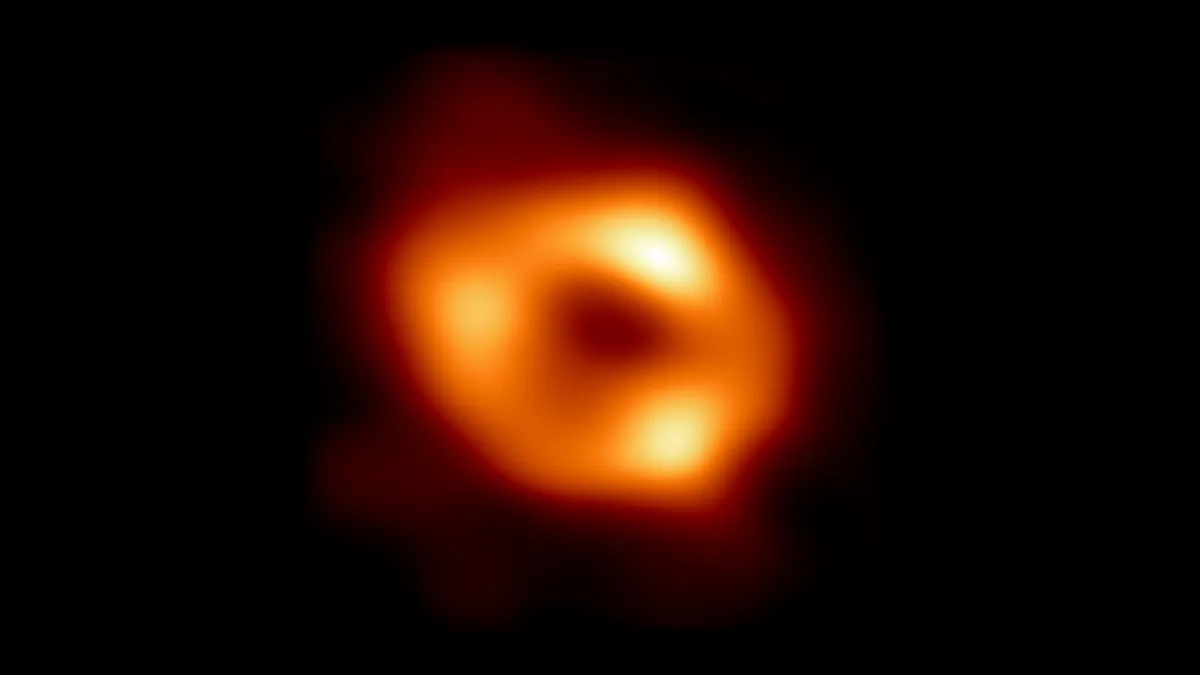
Before diving into that explanation, it is worth considering what we actually see when we look at the EHT image of what we all currently assume to be Sgr A*.
The glowing golden ring in this image is actually superhot matter whipping around whatever lurks at the heart of the Milky Way. What we actually see in this image isn't a black hole at all, understandable because black holes are surrounded by a light-trapping surface called an event horizon; there's no way we could directly see Sgr A*. What we can see, though, is the shadow the black hole casts.
Yet in 2024, researchers demonstrated that a dense core of fermionic dark matter could actually cast a shadow that is similar to that seen in the EHT image. The core would be invisible like a black hole because dark matter famously doesn't interact with light.
"This is a pivotal point," said team leader Valentina Crespi of the Institute of Astrophysics La Plata. "Our model not only explains the orbits of stars and the galaxy's rotation but is also consistent with the famous 'black hole shadow' image. The dense dark matter core can mimic the shadow because it bends light so strongly, creating a central darkness surrounded by a bright ring."
Though the team has statistically compared their dark matter model to the accepted model of a supermassive black hole at the heart of the Milky Way, and the former was able to replicate the behavior of S-stars, G-sources, the structure of our galaxy and the black hole shadow, the researchers emphasize it is definitely still early days for this theory.
The team's research does lay down a roadmap for future observations using the Very Large Telescope (VLT) to hunt for photon rings at the heart of the Milky Way, which will be present for Sgr A*, but absent if the central dominating body of our galaxy is a dense clump of dark matter.
Clearly, Sgr A* isn't ready to relinquish its throne at the heart of the Milky Way to dark matter just yet.
The team's research was published on Feb. 5 in the journal Monthly Notices of the Royal Astronomical Society (MNRAS).

Astronomers
detect a solar system they say should not be possible
By Jacopo Prisco, CNN
| Updated - Feb. 14, 2026 at 8:18 a.m. | Posted - Feb.
13, 2026 at 3:56 p.m.
- Astronomers discovered an unusual exoplanetary system 116 light-years away with reversed planet order.
- LHS 1903's system challenges traditional planet formation theories with its unique rocky-gas arrangement.
- Future observations may reveal more about small planet formation around stars unlike our sun.
WASHINGTON — An exoplanetary system about 116 light-years from Earth could flip the script on how planets form, according to researchers who discovered it using telescopes from NASA and the European Space Agency.
Four planets orbit LHS 1903 — a red dwarf star, the most common type of star in the universe — and are arranged in a peculiar sequence. The innermost planet is rocky, while the next two are gaseous, and then, unexpectedly, the outermost planet is also rocky.
This arrangement contradicts a pattern commonly seen across the galaxy and in our own solar system, where the rocky planets (Mercury, Venus, Earth and Mars) orbit closer to the sun and the gaseous ones (Jupiter, Saturn, Uranus and Neptune) are farther away.
Astronomers suspect this common pattern arises because planets form within a disk of gas and dust around a young star, where temperatures are much higher close to the celestial body. In these inner regions, volatile compounds such as water and carbon dioxide are vaporized while only materials that can withstand extreme heat — such as iron and rock-forming minerals — can clump together into solid grains. The planets that form there are therefore primarily rocky.
Farther from the star, beyond what scientists call the "snow line," temperatures are low enough for water and other compounds to condense into solid ice — a process that allows planetary cores to grow quickly. Once a forming planet reaches about 10 times the mass of Earth, its gravity is strong enough to pull in vast amounts of hydrogen and helium, and in some cases, this runaway growth produces a giant gas planet such as Jupiter or Saturn.
"The paradigm of planet formation is that we have rocky inner planets very close to the stars, like in our solar system," said Thomas Wilson, an assistant professor in the department of physics at the University of Warwick in England and first author of a study on the discovery that was published Thursday in the journal Science. "This is the first time in which we have a rocky planet so far away from its host star, and after these gas-rich planets."
The unexpected rocky planet, called LHS 1903 e, has a radius about 1.7 times that of Earth, making it what astronomers call a "super Earth" — a larger version of our planet with similar density and composition. But why is it there, defying logic and previous observations?
"We think that these planets formed in very different environments from each other, and that is what's kind of unique about this system," Wilson said. "This outer planet, which is rockier compared to the middle two planets, shouldn't have happened, based on the standard formation theory. But what we think happened is that it formed later than the other planets."
'Gas-depleted' formation
The planetary system was first discovered using a Transiting Exoplanet Survey Satellite, or TESS, a NASA space telescope launched in 2018 to discover new exoplanets. The system was then analyzed using the European Space Agency's CHaracterising ExOPlanet Satellite, or Cheops, which was launched in 2019 to study stars that are already known to host exoplanets. The researchers also used data from other telescopes across the world, leading to a large international collaboration.
After they confirmed the odd finding of an "inside out" planetary system, the scientists tested some hypotheses to explain the presence of the outermost rocky planet, hoping to understand whether it could have formed via a collision between other planets, or if it could be the remnant of a gas-rich planet that had lost its outer envelope.
"We ran a lot of dynamical analysis in this study, basically throwing these planets at each other and throwing other planets at these planets, seeing if you could remove the atmosphere, if you could create these planets via impacts," Wilson said, referring to two possible formation processes. "But we cannot make these planets this way."
Once they ruled out these possibilities, the researchers landed on what Wilson calls a "gas-depleted" formation mechanism in which the planets formed one after another and in the opposite order to our own solar system, starting with the innermost planet and moving outward.
"This formation mechanism, where you start with the inner one and then you move away from the host star, means the outermost planet formed millions of years after the innermost one," Wilson said. "And because it formed later, there was actually not that much gas and dust in the disk left to build this planet from."
In our solar system, the gas giants formed first and quickly, followed by the four inner rocky planets. There are also rocky bodies beyond the orbit of Neptune, such as Pluto, but compared with LHS 1903 e, Wilson said, they are far smaller, ice-rich and likely formed much later than the other solar system planets, as a result of collisions.
The finding may offer "some of the first evidence for flipping the script on how planets form around the most common stars in our galaxy," according to Sara Seager, professor of planetary science and physics at the Massachusetts Institute of Technology and a coauthor of the study.
However, she added, the study is centered around a difficult interpretation, so the debate remains open. "Even in a maturing field, new discoveries can remind us that we still have a long way to go in understanding how planetary systems are built," she said in an email.
+++++++++++++++++++++++++++++++++++++++++++++++++++++++++++++++++++++++
+++++++++++++++++++++++++++++++++++++++++++++++++++++++++++++++++++++++
- Days ago: MOM = 3901 days ago & DAD = 555 days ago
- New note - On 1807.06, I ceased daily transmission of my Hey Mom feature after three years of daily conversations. I post Hey Mom blog entries on special occasions. I post the days since ("Days Ago") count on my blog each day, and now I have a second count for Days since my Dad died on August 28, 2024. I am now in the same time zone as Google! So, when I post at 10:10 a.m. PDT to coincide with the time of Mom's death, I am now actually posting late, so it's really 1:10 p.m. EDT. But I will continue to use the time stamp of 10:10 a.m. to remember the time of her death and sometimes 13:40 EDT for the time of Dad's death. The blog entry numbering in the title has changed to reflect total Sense of Doubt posts since I began the blog on 0705.04, which include Hey Mom posts, Daily Bowie posts, and Sense of Doubt posts. Hey Mom posts will still be numbered sequentially. New Hey Mom posts will use the same format as all the other Hey Mom posts; all other posts will feature this format seen here.


No comments:
Post a Comment