Hey, Mom! The Explanation.

Here's the permanent dedicated link to my first Hey, Mom! post and the explanation of the feature it contains.

Also,

Wednesday, February 2, 2022

A Sense of Doubt blog post #2542 - SCHOOL BOARDS HAVE ALWAYS BEEN THE TOOLS OF WHITE SUPREMACY

https://abc11.com/lt-governor-mark-robinson-racism-social-studies-schools/10254732/

A Sense of Doubt blog post #2542 - SCHOOL BOARDS HAVE ALWAYS BEEN THE TOOLS OF WHITE SUPREMACY: CENSORSHIP WEEK

Turn back the clock.

Sometimes it seems like people are trying to remake the 1950s, and at other times, their actions are trying to recreate the 1850s or even 1804, when a Missouri law prohibited black people from speaking in public forums.

Hi, welcome to post #3 of CENSORSHIP WEEK on the blog.

This post brings together some race-related content, including a larger article from Mother Jones on Critical Race Theory (CRT). I have been working on a longer blog post on CRT for nearly a year and keep pushing it back to get the content right. Currently, I have it scheduled for February 19th, if I do not postpone it again.

I added some other things here, too, such as the Jackie Robinson plaque riddled with bullet holes set to be displayed at the Negro Leagues Baseball Museum as a reminder of the racial hatred Robinson suffered in his life as the first African-American player to cross the color line and play in the (at the time) all-white Major Leagues.

I also added a reaction to the political cartoon shown above and below that seemingly targeted (last year at this time) Lt. Governor Mark Robinson of North Carolina, the first black man to hold that office in that state for his stand AGAINST teaching systemic racism, systemic discrimination and gender identity in the state's class rooms because these concepts will lead to "Anti-American sentiment."

Welcome to a year later and also the beginning of BLACK HISTORY MONTH.

Someone once said to me "why do we need BLACK History Month? Why is there no WHITE HISTORY MONTH?"

Because, asshole, EVERY MONTH IS FUCKING WHITE HISTORY MONTH!!!!!!!!!!!!!!!

It's the same fallacious argument against African-American Studies or Women's Studies departments in colleges and universities. Why do we have those? Why is the content not integrated? Because it isn't. It never has been. The only way to teach black history and feminist theory and all that is to have a department and classes specifically dedicated to those subjects so that they get taught at all. And to those who want "White Studies," that's just stupid. It's all about the white people. All the studies.

And that example shows systemic racism and systemic discrimination in practice.

Opponents of Critical Race Theory are all in a lather because they feel it's divisive and anti-American. It teaches kids to hate themselves for being racist and their parents and teachers and their whole country for being racist.

Well....?

Yeah, okay. Let's turn a blind eye to the racism that is embedded in every thing from the criminal justice system to real estate to the banking system to the entertainment industry to the way HISTORY is taught.

How come no one heard of the Tulsa Massacre of 1921 until recently? Why were we not taught about that in school?? That's a major thing. Hundreds were killed. As progressive (and often criticized) as Howard Zinn's ground-breaking book The People's History of the United States is, the Tulsa Massacre is not indexed in it... it's not in there. 

People just didn't learn about it: #BreakingtheSilence.

I have never heard anyone espouse the idea that little white kids should hate themselves or their parents or even their country because of the history of racism.

That's just stupid.

I am baffled at how those who think this is an actual thing do not see how STUPID that idea is.

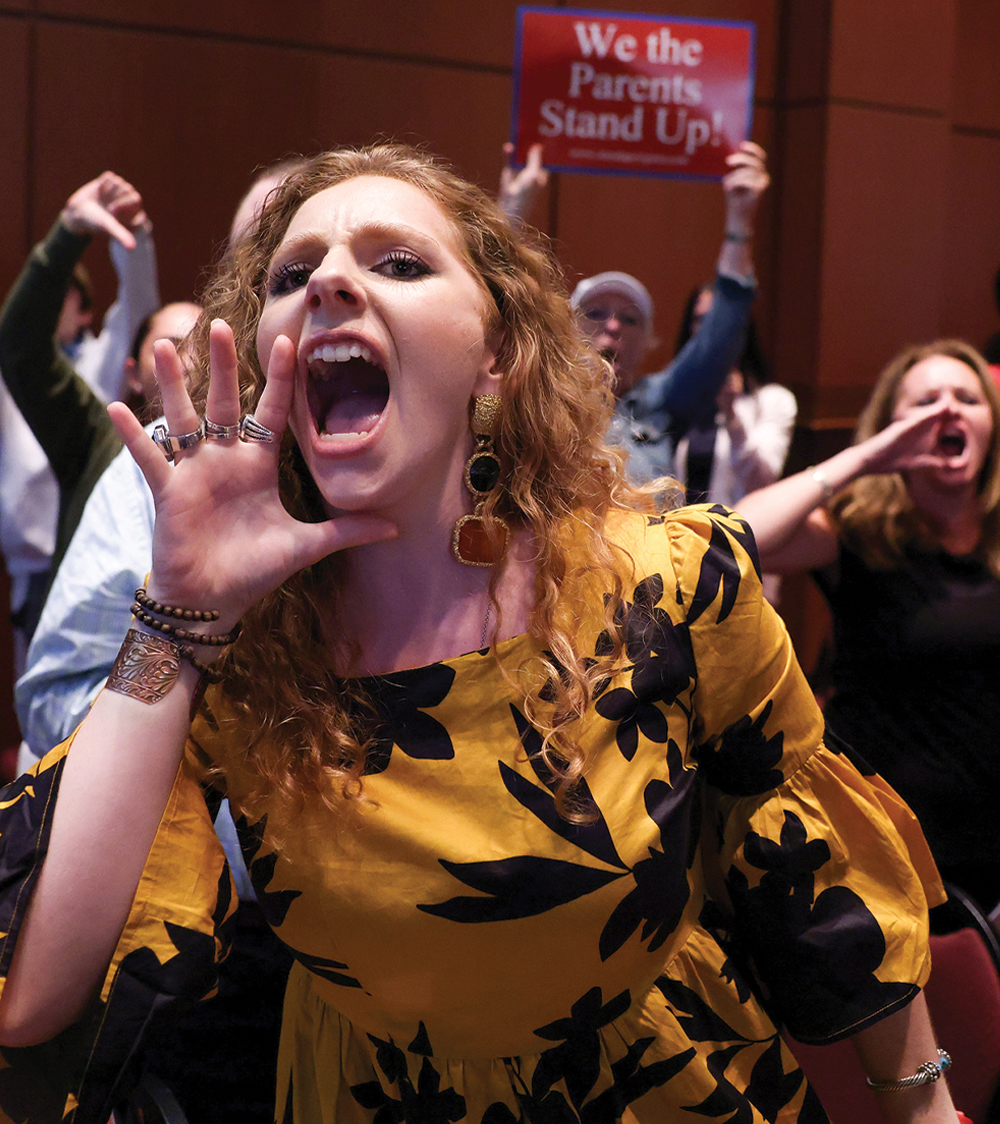
And the picture farther below of people screaming at a school board meeting is truly frightening.

That's the mob that's been whipped into a frenzy mostly by the Fox "NEWS" Propaganda and White Power Network and its THOUSANDS of mentions of CRT throughout 2021. Really. Someone counted. It was up to 2000 by June of 2021. Probably hit 5000 by the end of the year. I think some people grew tired of counting.

If teaching the truth about racism and gender discrimination is anti-American, then what these people are really saying is that education should not be about the truth. It should be about the truth according to fragile white people absolutely terrified of living in reality in which they are complicit in racism and racist practices, enjoying privilege, without even being aware of it because that's just normal life for their sheltered little 1950s bake off sit com worlds.

It continues to be true. Trump's words at his rally. But not for what he thinks. WE who want truth and reality and freedom and no censorship and safety and equality and empathy and compassion and justice and fairness and all those things, WE HAVE TO FIGHT LIKE HELL or we are not going to have a free country anymore with free elections and in which the reality of history is taught in our schools.

We have to fight like HELL for Critical Race Theory and for teaching the truth about gender discrimination or we're going to end up living in a new Nazi Germany.


NC Lt. Governor Mark Robinson slams media company for cartoon depicting GOP as KKK members


RALEIGH, N.C. (WTVD) -- On this second day of Black History Month, an editorial cartoon published on WRAL.com, owned by Capitol Broadcasting, had Lt. Gov. Mark Robinson so upset he called a news conference.

"Depicting the first Black lieutenant governor as Ku Klux Klansman. It's something we cannot stand for, folks. It's something I'm not going to stand for," Robinson said. "What I want to know from WRAL is that who you are? Is that who you want to represent yourself to be in this state?"

The cartoon by Dennis Draughon stems from the state board of education's upcoming meeting regarding K-12 social studies curriculum.

Last week, members of the North Carolina Board of Education discussed whether the concepts of systemic racism, systemic discrimination and gender identity should be discussed in class.

Robinson, a Republican who made history as the first Black man to hold the office, took a strong position against it.

"To call our system of government racist, that is an untruth as far as I'm concerned. I truly believe that is an untruth as far as history is concerned and it does a disservice to our students. It puts the idea in the mind of our children that they live in a nation that has promoted racism," he said at the time.

The cartoon published this week shows the Elephant Klansman representing GOP board members who are against the use of those words.

The elephant's caption reads: "We prefer a clean sheet."

Robinson is also accusing Capitol Broadcasting of bucking its own diversity and inclusion standards. He called the hypocrisy mindnumbing.

During the weekend, the North Carolina National Association for the Advancement of Colored People (NAACP) president the Rev. T. Anthony Spearman rallied for board members to include the words in the curriculum.

But Robinson said we should be teaching history and the horrible things that took place from a victorious perspective.

Should NC social studies courses address systemic racism? One board member says it will stir 'anti-American' ideas

"These standards lead to the wrong direction. They lead to an anti-American sentiment," Robinson said. "If we want to teach children to embrace a system, tell them to embrace a system that ended slavery, that ended Jim Crow, that gave women the right to vote."

Garner 6th grader addresses race, women's empowerment in 1st published children's book

But as Robinson slammed Capitol Broadcasting, he again was questioned about his own controversial private Facebook posts that went viral last year, as he ran for office.

In previous interviews, Robinson has refused to apologize or walk back those posts, saying instead that he is not ashamed of them.

"When I made those posts as a private citizen, I was speaking directly to issues that I'm passionate about. But as a public servant -- and I said this to you -- as a public servant, I have to put those opinions behind me and do what's right for everyone in North Carolina," Robinson said.

Capitol Broadcasting's opinion editor Seth Effron released a statement in response to the controversy:
"Editorial cartoons are creative and provocative, using hyperbole and satire. No one believes Republicans on the State Board of Education are members of the Ku Klux Klan. The editorial cartoon by Dennis Draughon is meant to point out that these members of the State Board are trying to wipe out from the social studies curriculum the record of racism which includes the Klan and the segregationist practices that were imposed in our state and nation's history."

Robinson does not want the state school board to make a decision this week on the social studies standards. He said the topic is too divisive and more time is needed to speak to people on both sides of the issue.

He said he has talked to the NAACP and those talks have been respectful.


Vandalized Jackie Robinson plaque set to be displayed at Negro Leagues Baseball Museum


https://www.espn.com/mlb/story/_/id/33186645/vandalized-jackie-robinson-plaque-set-displayed-negro-leagues-baseball-museum

KANSAS CITY, Mo. -- A plaque honoring baseball legend Jackie Robinson that was vandalized in Georgia is coming to Kansas City's Negro Leagues Baseball Museum to be put on display.

The sign was erected in 2001 outside the birthplace of Robinson near Cairo, Georgia. Community members there discovered last year that someone had shot the plaque multiple times.

Curator and museum vice president Ray Doswell told the Kansas City Star that displaying the defaced marker is an opportunity to teach the public about Robinson's story and combat hate. Robinson broke Major League Baseball's color barrier in 1947 when he became the league's first Black player.

Robinson's hometown replaced the damaged marker, with help from the league, and added another marker at a library last week.

The vandalized marker is slated to go on display around mid-April, after a display case is built and spot secured in the museum, to coincide with the museum's celebration of the 75th anniversary of Robinson's debut with the Brooklyn Dodgers. The plaque is expected to be permanently loaned to the Kansas City museum for regular display.

Museum community engagement manager Kiona Sinks said in a tweet that the vandalized marker will "serve as a reminder that the ugliness of America's past persists to this day."

SEE THE BULLET HOLES!


https://www.motherjones.com/politics/2022/01/school-boards-have-long-been-a-tool-of-white-supremacy/

School Boards Have Long Been a Tool of White Supremacy

Our history of letting white Americans veto racial progress in schools.

At raucous school board meetings across the country, disgruntled parents have grabbed the mic to represent the political desires of the Republican Party. Once-innocuous local gatherings have become anti–critical race theory caucuses administered by white people.

In July 2021, the Missouri state legislature’s joint education committee held an invite-only hearing on how educators in public K–12 schools teach about racism. “I felt today it was important to hear from people who have tried to go through the official cycle of authority within their districts and have basically been turned away,” said Cindy O’Laughlin, a Republican senator and the committee’s chair. For O’Laughlin, “people” has a precise meaning, as no Black person spoke and the only people allowed to give testimony were opponents of critical race theory. Of course, giving primacy to white speakers has a history far older than CRT. As an 1804 Missouri law said, “no negro or mulatto shall be a witness except in the pleas of the United States against negroes or mulattoes or in civil pleas where negroes alone shall be parties.”

The parallels did not go unnoticed. “It is the height of irony that a hearing to consider censoring curriculum would censor those who are allowed to speak,” said Ingrid Burnett, a Democratic representative from Kansas City who pointed out the hearing’s one-sidedness.

As even the state’s Republican governor noted on social media the day after the meeting, there’s no evidence that CRT, an academic framework for analyzing how racism is embedded in American law and culture, is being taught throughout Missouri. There is certainly no evidence, as O’Laughlin advanced, that local authorities have stymied its opponents. CRT “has no business being taught in Missouri classrooms—but the vast majority of our schools are not doing that,” Gov. Mike Parson wrote. He later elaborated, “Look, the only way critical race theory can be taught in a school—the only way—is if the locals let it happen. That’s controlled by the local school boards.” In short, Parson argued that the system already works for conservatives. Indeed, out of more than 400 districts, the Missouri Board of Education has identified only one with CRT in the curriculum: Kansas City, where 54 percent of students are Black.

But most Missouri districts have starkly different demographics and are represented by local officials who reflect the wishes and anxieties of white people. O’Laughlin lives in Shelby County, where roughly 95 percent of residents and students are white, and which Trump won with 80 percent of the vote. Even in more diverse communities, school boards, thanks partly to decades of attention from conservative activists, lean right. A 2018 Vanderbilt study using data from Ohio showed that school board members are generally “more likely to come from wealthier, whiter, and better educated neighborhoods”—trends that advantage the GOP.

As Missouri’s 1804 law privileging white testimony shows, those advantages are rooted in history—and can be found nationwide. Take Connecticut, where, in 1833, the general assembly enacted the “Black Law,” which prohibited anyone from establishing an institution for the “education of colored persons…without the consent, in writing, first obtained of a majority of the civil authority, and also of the select men of the town.”

That law enshrining local control was passed in response to abolitionist Prudence Crandall’s move to turn the school she ran into one “for young ladies and little misses of color.” Until she admitted 20-year-old African American Sarah Harris Fayerweather, Crandall’s all-white Canterbury Female Boarding School was esteemed by the town.

Fayerweather, considered the first African American to enroll in a white school, was known as a churchgoing young woman of high character. But when she sought admission, Crandall hesitated, knowing the backlash it would bring. Many of her pupils’ parents were members of the American Colonization Society, an organization that wanted to send Black Americans to Africa to settle Liberia—parents who, as abolitionist Samuel May wrote, “would not have it said that their daughters went to school with a nigger girl.”

But Crandall, a Quaker, came from an anti-slavery family. (In 1835, her younger brother, Reuben, would be prosecuted for possessing abolitionist literature and contracted a fatal case of tuberculosis while jailed.) She also believed in the power of education and was moved by Fayerweather’s plan to become a teacher in her own community. After Fayerweather enrolled, the school made a quick shift in course, taking out an ad in the Liberator, the nation’s abolitionist paper of record, spreading word that it would exclusively serve young Black women—and seeking applicants from all corners.

A week later, a town meeting was convened where Crandall’s new project was denounced. At the vanguard was Andrew Judson, an officer of the American Colonization Society, a member of the Connecticut House of Representatives, and a man of good standing in the anti-Black community. Judson was incensed at the idea of a “school for nigger girls” and insisted “there shall not be such a school set up anywhere in the State.” That opinion was widely voiced at the meeting, which barred Crandall’s few supporters from speaking. A series of resolutions against Crandall passed, warning that the school would result in “incalculable evils” and letting her know that the reimagined institution “meets with our unqualified disapprobation, and it is to be understood, that the inhabitants of Canterbury protest against it, in the most earnest manner.” A committee was formed to convince Crandall of the “injurious consequences that would inevitably result from the introduction of colored children into the town,” as abolitionist Henry Benson, who attended the meeting, wrote in the Liberator. He summarized the crowd’s objection: “Her unpardonable sin lay altogether in her wish to elevate the moral and intellectual condition of the blacks, and attempting to carry her plans into operation, without consulting them.” The Black Law soon gave the town’s sentiment teeth, nominally entrusting it and all other Connecticut localities with the power to ban such schools.

This is the “local control” that Gov. Parson favors, where a “select” group is given legal authority to rebuke the evils they are convinced critical race theory will impart on white society. Throughout history, the “unpardonable sin” of educators moving toward racial progress without white consent has been atoned for in the same way: disgruntled white people band together on a school board or committee to erase unwanted Black people, texts, and consciousness. Today, it is happening even where CRT cannot be found but where attacks on it hang like a specter. Texas school librarians have pulled books by Black authors, hoping to preempt controversy after legislators assembled a list of titles they sought to ban; a Black principal there was fired by his school board after pushing back against false accusations he had promoted CRT. In January, Florida lawmakers backed by GOP Gov. Ron DeSantis advanced a bill outlawing lessons that might make students feel “guilt” or “discomfort” about their race.

Recent polls show that Black parents are far more receptive to the teaching of the tenets of critical race theory than white parents. But across the country, parents in favor of interrogating America’s racial history have been disregarded. “It seems as though Black and Brown voices were ignored, and the voices were centered on White parents and their concerns,” Rakelle Mullenix, a Black mother of two in Annandale, Virginia, told the Washington Post for an article on how the debate over teaching racial injustice powered Republican Gov. Glenn Youngkin’s 2021 election. “I’m constantly hearing, ‘Oh, no, suburban women, suburban moms and their vote.’ And when I look around me and see these suburban moms and housewives, a lot of them look like me. But when I hear the conversations on the news, it doesn’t sound like they’re talking about me.” (Youngkin’s first executive order tasked education officials with rooting out CRT and other “inherently divisive concepts.”)

Despite the town’s opposition, Crandall’s school went ahead and enrolled more than 15 Black girls from Boston, Philadelphia, and Providence. Store owners refused to sell Crandall and her students food, clothing, and supplies. The well near Crandall’s house was filled with manure, her house battered with stones and rotten eggs. Citizens of Canterbury made attempts to prosecute Crandall’s teenage students using an obsolete 1750 vagrancy law that threatened whipping and weekly fines. One 17-year-old student was arrested after receiving a warning; wealthy Crandall supporters responded by bankrolling a $10,000 fund to fight such arrests, preventing Canterbury’s authorities from punishing the students.

Crandall was arrested and tried twice under the new Black Law. In the first trial, the jurors could not agree to convict her even though the presiding judge endorsed the law as “constitutional and obligatory on the people of the state.” A second before the state’s Supreme Court was dismissed on a technicality. But legal success offered no protection. After a failed attempt to burn down Crandall’s house, her windows were smashed. For safety, supporters told Crandall to abandon her mission. The school closed in September 1834.

As a local historian later wrote, “If the Canterbury people had quietly accepted the situation and left them in peace the difficulty would soon have ended.” But the town’s racists would not quietly acquiesce to anti-racist education. What animates much of today’s white backlash to critical race theory is the same germ that caused anxiety over Black education in Canterbury. And formal bans on CRT or similar anti-racist teachings—now law in eight states—have again created an environment of intimidation. As Crandall’s loss and similar indignities targeting today’s educators show, that force can have a power even greater than law.


https://iowaculture.gov/history/education/educator-resources/primary-source-sets/reconstruction/union

+++++++++++++++++++++++++++++++++++++++++++++++++++++++++++++++++++++++
+++++++++++++++++++++++++++++++++++++++++++++++++++++++++++++++++++++++
+++++++++++++++++++++++++++++++++++++++++++++++++++++++++++++++++++++++

- Bloggery committed by chris tower - 2202.02 - 10:10

- Days ago = 2406 days ago

- New note - On 1807.06, I ceased daily transmission of my Hey Mom feature after three years of daily conversations. I plan to continue Hey Mom posts at least twice per week but will continue to post the days since ("Days Ago") count on my blog each day. The blog entry numbering in the title has changed to reflect total Sense of Doubt posts since I began the blog on 0705.04, which include Hey Mom posts, Daily Bowie posts, and Sense of Doubt posts. Hey Mom posts will still be numbered sequentially. New Hey Mom posts will use the same format as all the other Hey Mom posts; all other posts will feature this format seen here.



Tuesday, February 1, 2022

A Sense of Doubt blog post #2541 - BANNING BOOKS 2022: WTF?!? They banned Maus on the eve of International Holocaust Remembrance Day??? Welcome to the 1950s and the new Satanic Panic!


A Sense of Doubt blog post #2541 - BANNING BOOKS 2022: WTF?!? They banned Maus on the eve of International Holocaust Remembrance Day??? Welcome to the 1950s and the new Satanic Panic!

What is happening? 

How did I get here? 

This is not my beautiful house. That is not my beautiful wife.

Same as it ever was.

Same as it ever was.

What is even happening???

A Tennessee school board banned Maus from its schools and happened to do so on the eve of International Holocaust Remembrance day.

I saw that, and I lost my fucking shit.

And now, it's censorship week on the SENSE OF DOUBT blog, and I have zero doubt that CENSORSHIP is fucking evil, dangerous, and sick.

Is this how we make America great again?

Is that when America was great? Should we ban books, build huge bonfires to our Satanic panic, close our minds, shut out history, deny science, live with our heads in the sand?

I guess so. That's what people seem to want.

The flimsy bullshit for banning Maus is simply a very thin veil for Anti-Semitism. It doesn't even seem like the veil is even thinly there at all. It's just blatant.

Lines of dialogue with "God damn" and a part of a woman's breast that is almost imperceptible.

And so they ban this PULITZER PRIZE winning graphic novel about the Holocaust because GOD FORBID children read about ACTUAL HISTORIAL EVENTS OF GENOCIDE and, I don't know, hate the white people who perpetrated them. Because let's not forget that ALL THE PEOPLE the Nazis hated were lined up and marched into those death camps not just the Jews. It was just mostly Jews. Black people, gay people, whomever didn't fit the Aryan ideal (which Hitler didn't either, BTW).

Read these news accounts because the pathetic BULLSHIT that these school board assholes said out loud for why they banned this book are the WORST examples of closed-minded censorship dogma.

One guy would pull his kid out and home school if Maus was taught or even available in the library?

REALLY?

Did they even READ THE FUCKING BOOK (two volumes actually)???????

One good thing is that this is simply one isolated school board banning THIS book in Tennessee, and because they did, sales for Maus soared and Amazon is out of stock on it. Buy out your local comic shop, which probably only stocked a couple of copies and those are gone now, too.

As you can I am SUPER HOT on this topic. I just want to type FUCK YOU over and over, but even that will not vent the outrage I feel. Granted, I am over-protective of all comic books, but Maus especially, which is amazing and wonderful and has been a favorite for most of my adult life from when I first read one of the chapters in RAW Magazine in 1985.

And I was already going to write about the bans all over the country on Gender Queer, which I just finished reading and LOVED.

And these assholes are banning books and all the work of some authors all over the place, so that bullshit is NOT an isolated case of these dimwits in Tennessee, so more on that later this week because it's CENSORSHIP WEEK on the blog, my blog, this blog.

WE MUST FIGHT LIKE HELL OR YOU WON'T HAVE A COUNTRY ANYMORE!

Does that sound familiar?

That's because Donald Trump said it on January Sixth at the STOP THE STEAL RALLY, which became the Insurrection at the Capitol in 2021.

Basically, everything TRUMP says can be turned around and seen from the other side. It's all projection. What they're accusing liberals and democrats of doing? That's why they did and/or tried to do. When Trump tells his people to fight, it's also true that we have to fight them. Not by trying to kill police officers and elected officials ("Hang Mike Pence," remember?) but by beating them at their own game. 

Take back the school boards. Take back the state and local governments. Ensure voting rights for all. And vote these fuckers out office and prosecute where appropriate and necessary.

Because if we don't fight like Hell, there's not going to be democracy, freedom, rule of law, free speech, and the open exchange of ideas and free press.

It's Oceania if we don't stop it.

Oceania, the government/country in Orwell's Nineteen Eighty-Four.

It's Gilead in Atwood's The Handmaid's Tale.

We must stop it.


https://www.openculture.com/2022/01/tennessee-school-board-bans-maus.html

Tennessee School Board Bans Maus, the Pulitzer-Prize Winning Graphic Novel on the Holocaust; the Book Becomes #1 Bestseller on Amazon


Last week, a Tennessee school board voted unanimously to ban Maus, the Pulitzer-winning graphic novel about the Holocaust, citing instances of profanity and nudity. Specifically, the McMinn County school board objected to utterances of the words “God damn” and a small, barely-perceptible breast. (Look closely, and you may eventually find it.) Rather uncomfortably, the banning came on the eve of International Holocaust Remembrance Day, and it figures into a larger right-leaning effort to ban books countrywide.

Happily, bad decisions can have good unintended consequences. In recent days, Art Spiegelman’s Maus has soared to #1 on Amazon’s bestseller list. (Another edition of the book sits at #3 on the list.) Elsewhere, a college professor has created a free online course on Maus designed solely for students from McMinn County. And within Tennessee itself, bookstores are giving away free copies of Spiegelman’s classic, while a church has decided to convene conversations on the groundbreaking book.

Above, you can watch Spiegelman respond to the ban and wonder whether it’s “a harbinger of things to come,” a step in a larger effort to efface the memory of the Holocaust.

Related Content

How Art Spiegelman Designs Comic Books: A Breakdown of His Masterpiece, Maus

Artist is Creating a Parthenon Made of 100,000 Banned Books: A Monument to Democracy & Intellectual Freedom

The 850 Books a Texas Lawmaker Wants to Ban Because They Could Make Students Feel Uncomfortable

America’s First Banned Book: Discover the 1637 Book That Mocked the Puritans


#CNN #News


Jan 27, 2022


CNN

The McMinn County Board of Education in Tennessee voted 10-0 to remove "Maus," the Pulitzer Prize-winning graphic novel about the experiences of Holocaust survivors, from it's eighth grade language arts curriculum. The book's author, Art Spiegelman, responds to the school board's action. #CNN #News


An open letter to the McMinn County Board of Education regarding MAUS

Gregory Paul Silber addresses a Tennessee school district that banned Art Spiegelman's Pulitzer Prize-winning MAUS.


Earlier this week, it was reported that the McMinn County Board of Education in Tennessee voted unanimously to remove Art Spiegelman‘s seminal Holocaust graphic novel, Maus, from school libraries over apparent concerns about the book’s minimal use of profanity and one image of nudity.

Dear McMinn County Board of Education,

My name is Gregory Paul Silber. I’m a Jewish-American writer, editor, and critic specializing in comics and pop culture. Like many people who I am sure have contacted you over the past few days, I am saddened, furious, and insulted to learn of your decision to ban Art Spiegelman’s Pulitzer-Prize winning graphic memoir Maus from your schools.

I was just 13 when I read Maus for the first time. I didn’t find it in school nor was it assigned reading; I simply discovered it. Regardless, I am now a 30-year-old man and can confidently tell you Maus changed my life for the better. It saddens me to think that your students will be deprived of that experience. Maus not only taught me about The Holocaust in ways that I hadn’t yet absorbed from conventional education, but about life after trauma, about the pain children inherit from their parents, and about hope.

I don’t know how much, if anything, your students have learned about the Holocaust. By the time I was their age, I had known about Hitler, the death camps, and related monstrosities for many years. I knew antisemitism has existed throughout the long history of the Jewish people, and I knew it was still out there. I’m not just talking about Neo-Nazis and other hate groups that are easy for some to brush off as irrelevant fringe groups. I had experienced antisemitism first-hand from my own peers, like the first grade classmate who told me I was going to Hell for not believing in Jesus.

For Jews like myself, the Holocaust is not some distant historical event. I heard about it from my family and religious school teachers. I met Holocaust survivors. It’s existentially difficult to come to grips with the fact that some of the same people who were starved, tortured, and forced to watch their friends and family die in ways that most of us can hardly imagine are still alive to tell their stories, but it’s not ancient history. Today, most living Holocaust survivors would have been the same age when they experienced such unimaginable horror as your students are now.

One of the many things that made Maus such an impactful work when I discovered it at 13 was its aching humanity. Vladek Spiegelman, the author’s father and the focal point of Maus, is not presented as a hero, and the other victims of Nazi atrocity whom we meet throughout the book presented as martyrs. They are simply human, with a bevy of vices and virtues like anyone else, forced to contend with a political force that sought to strip them of their humanity. We remember Vladek’s story because his son chose to present him as the man he knew, neither praising nor condemning. Vladek could have been a member of any of our families.

In contrast with the anthropomorphic mice, cats, and other personified ethnic groups that give Maus its distinct visual identity, I was stunned by its unflinching realism. I’m not talking about violence or profanity or anything of that nature. I mean that Vladek’s story isn’t embellished or romanticized. The fact that almost half of Maus takes place in what was present day when Spiegelman was writing and drawing it, the 1980s, went a long way towards helping me come to grips with the fact that the aftermath of the Holocaust is far from over. The trauma led Art’s mother to commit suicide, and his father, for all the resilience he was forced to develop, to become bitter and hot-tempered. Seeing it through the eyes of the son is just another way to build empathy.

I needed that. I needed Maus because I needed to see those who went through the concentration camps not as victims or statistics, but as people. Your students need that, too. And they’re not going to get it if you continue to place trivial notions of civility and comfort over actual education.

I would assume that most of your students are not Jewish; a 2010 survey showed none of the county’s residents claimed Judaism as their religion. But learning about histories that are not your own is key to a well-rounded education, in childhood and beyond. To do otherwise breeds ignorance and bigotry. 

I also understand that you do not have a vested interest in making your students fall in love with comics as much as I did. But research shows that there are several educational and developmental benefits to reading comics, and they can be a powerful tool for learning about material that can otherwise intimidate people of all ages. As much as Holocaust education needs to be uncomfortable, it also needs to be accessible. Eli Wiesel’s Night is wonderful, but it does not have the immediate, universal appeal for young people as a comic like Maus.

Those who support the 10-0 vote to ban Maus claim it’s because of ostensibly risquè content like “naked pictures” and profanity. There’s a lot to unpack from that aspect of the ban alone, so let’s start with the obvious: I can virtually guarantee that the vast majority of your 8th grade students have already heard worse than “goddamn” and seen worse than nude cartoon mice. That’s not because you’ve failed as guardians or educators, or because your students are disobedient. Nor is it because they’ve been exposed to R-rated movies or violent video games or internet pornography.

It’s because the world is messy, and often mean. No amount of perhaps-well-intentioned sheltering is going to prevent children from learning that for long, especially by the time they’ve reached their teens. How long do you plan on continuing this charade of pretending you can shield your students from anything remotely unsavory?

Which brings me to my next point: you claim the ban isn’t because Maus is about the Holocaust (although it’s just as much about Spiegelman’s relationship with his survivor parents), but because you find the aforementioned profanity and nudity age-inappropriate. But the wholesome, nudity and violence and profanity-free book about the Holocaust you may think your students should read instead does not exist. You may think it does, but you cannot adequately teach the horrors of the Holocaust, or the importance of “never again,” without emphasizing the inherent perversity of The Holocaust. I’ve read sanitized stories of the Holocaust, and they’re more obscene than anything Spiegelman ever wrote or drew. As he once said when a German reporter asked if he thought a comic about the Holocaust was in bad taste: “no, I thought Auschwitz was in bad taste.”

Art Spiegelman posing with an image from Maus

At one point during the meeting in which the vote was held, one of your members, Tony Allman, claims Maus is like “when you’re watching tv and a cuss word or nude scene comes on it would be the same movie without it.” No, Maus would not be the same without language and imagery some may consider shocking. If a work of art about the Holocaust isn’t provocative, it isn’t doing its job in illustrating the depravity of that series of historical events. If you aren’t shocked, horrified, and heartbroken learning about the Holocaust, something is seriously wrong.

He goes on to note that Spiegelman “did graphics for Playboy.” This too, is absurd. Spiegelman made a few contributions to a racy magazine at one point in his career, so that disqualifies everything he’s ever written and drawn as obscene? At some point you’re going to have to accept that if you’re in the business of giving students a good, honest education, you’re going to have to do away with some notions of purity politics.

I wonder if you care about any of this, though. After everything I’ve just written, I can’t help but feel this may be an exercise in futility. I’m writing to you on January 27th, Holocaust Remembrance Day. And the more I think about your ignorant decision to ban Maus from your schools, the more I’m forced to reach the conclusion that from an objective standpoint, your actions are antisemitic and fascist. That’s the conclusion I must reach when you appear to be more offended by mild profanity than genocide.

I don’t know any of you well enough to know whether you are antisemites or fascists, even if banning Maus is an antisemitic, fascist act. I’d like to believe that your intentions are good, and you simply don’t realize how ignorant and harmful your actions are. But there is still time to change course. You can still educate yourselves, so that you may better educate the students in your district.

Perhaps I’d feel less harshly if Spiegelman’s book was taken off of the official curriculum, but remained in the school for students who choose to read it. But no, it’s been banned outright. How are you going to explain that to your students when you teach them about the first amendment? Does book banning sound like something a free society would engage in? You have no business teaching children about American civics if you’re so cavalier about suppressing free expression. It’s unpatriotic.

I hope that you reverse this decision and prove me wrong. But the sad, infuriating truth is that what you’re doing isn’t unique. Censorship is spreading across the United States. Many of the same self-styled free speech warriors railing against a perceived “cancel culture” have no problem banning books simply for suggesting that history is peppered with violence and bigotry that we’re still grappling with today. They pretend it’s because they’re protecting children from “objectionable” material, but we know what they find objectionable is the existence of queer people, America’s history of oppression towards non-white people, and in this case, the reality of antisemitic violence. 

Please prove me wrong. Please prove to me that you’re nothing like the Nazis who murdered millions of people, including 6 million Jews, with members of Spiegelman’s family and mine among them. Nazism didn’t start with murder, though. It started with bigotry, and scapegoating, and suppression of free speech. You’d know that if you read more books about the subject.

Maus would be a great place to start.

Regards,

Gregory Paul Silber


Outcry after Tennessee school board unanimously votes to remove Maus

The school board was concerned about mild swearing and a single panel of a naked woman in a non sexual situation.

Amid rising attempts to ban books from school libraries and curriculums, the McMinn County school board in Tennessee has voted to remove Maus from the school library by a 10-0 vote. The book was to be used as part of an eighth grade language arts curriculum.

Maus, the only graphic novel to win a Pulitzer Prize, depicts the Holocaust through the story of creator Art Spiegelman’s parents, and depicts Jews as mice and Nazis as cats. Spigelman’s parents survived the extermination camps but continued to struggle with what we would now call PTSD.

The school board objected to language (“god damn”) and a single panel of a naked mouse-headed woman which showed Spiegleman’s mother after committing suicide in her bathtub.

In addition to being one of the most acclaimed graphic novels of all time, Maus has become one of the primary texts used to educate children and adults about the Holocaust, as many public figures and institutions tweeted after the story broke.

Once again, this book was intended for 8th graders – 13 years old, an age by which many have heard curse words and are aware of human anatomy…but possibly not the Holocaust.

As the story has been picked up by all major media, Spiegelman has been making the media rounds, On CNBC, he professed himself baffled by the move. 

Spiegelman also said he suspected that its members were motivated less about some mild curse words and more by the subject of the book, which tells the story of his Jewish parents’ time in Nazi concentration camps, the mass murder of other Jews by Nazis, his mother’s suicide when he was just 20 and his relationship with his father.

“I’ve met so many young people who … have learned things from my book,” said Spiegelman about “Maus.” The image in the book that drew objections from the board was of his mother.

The vote took place on January 10th but was reported yesterday by Tennessee Holler. The minutes of the school board meeting are available online and suggest that the baord found a few curse words more upsetting than a story about the extermination of six million Jews, and several million more Poles, Russians, Roma, disabled and LGBTQ people.
FKEELCeXwAgXVnX.jpeg

Today is  Holocaust Remembrance Day, the the US Holocaust Museum (among many others) tweeted their support of Maus as an educational tool.

Retailers and public figures have offered to supply copies of Maus to anyone in McMinn county who wants one, and an online course is also being offered.

The story highlights the growing grassroots movement to remove books that are about the non-white American experience, LGBTQ+ themes and many other facts of life from libraries and school curriculums. For obvious reasons, illustrated graphic novels are often easy targets for this movement.

Maus can be ordered online from Bookshop.org. It’s currently on back order from Amazon (affiliate link) – as is usual when a book is banned, sales are going up.


+++++++++++++++++++++++++++++++++++++++++++++++++++++++++++++++++++++++
+++++++++++++++++++++++++++++++++++++++++++++++++++++++++++++++++++++++
+++++++++++++++++++++++++++++++++++++++++++++++++++++++++++++++++++++++

- Bloggery committed by chris tower - 2202.01 - 10:10

- Days ago = 2405 days ago

- New note - On 1807.06, I ceased daily transmission of my Hey Mom feature after three years of daily conversations. I plan to continue Hey Mom posts at least twice per week but will continue to post the days since ("Days Ago") count on my blog each day. The blog entry numbering in the title has changed to reflect total Sense of Doubt posts since I began the blog on 0705.04, which include Hey Mom posts, Daily Bowie posts, and Sense of Doubt posts. Hey Mom posts will still be numbered sequentially. New Hey Mom posts will use the same format as all the other Hey Mom posts; all other posts will feature this format seen here.