
A Sense of Doubt blog post #3997 - "To Be Insulted by these Fascists is so Degrading" - It's No Game - David Bowie Month - Music Monday 2601.26 (and Scary Monsters and Super Creeps album recap) (and a DAILY BOWIE)
Image above taken from:
Originally, I had scheduled a post on BOWIE COVERS that I have postponed many times. It's postponed again (next Monday, possibly).
However, given what is happening in Minneapolis, it was time for Bowie's response to fascism.
"To Be Insulted by these Fascists is so Degrading"
Truth.
I disagree with these lyrics.
Thanks for tuning in.
https://en.wikipedia.org/wiki/It%27s_No_Game
[Intro]
"1, 2, 1-2-3"
[Verse 1: Michi Hirota]
シルエットや影が革命を見てる
もう天国の自由の階段はない
[Verse 2: David Bowie]
Silhouettes and shadows
Watch the revolution
No more free steps to heaven!
[Chorus: David Bowie]
It's no game
[Verse 3: Michi Hirota]
俺、現実から締め出され
何が起こっているのかわからない
どこに教訓はあるのか
人々は指を折られている
こんな独裁者に戒められるのは悲しい
[Verse 4: David Bowie]
I am barred from the event
I really don't understand the situation!
And it's no game
[Bridge: David Bowie]
Documentaries on refugees
Couples 'gainst the target
You throw a rock against the road
And it breaks into pieces
Draw the blinds on yesterday
And it's all so much scarier
Put a bullet in my brain
And it makes all the papers (新聞は書きたてるぞ!)
[Verse 5: Michi Hirota]
難民の記録映画
標的を背にした恋人達
道に石を投げれば
粉々に砕け
昨日に蓋をすれば
恐怖は増す
俺の頭に弾をぶち込めば
新聞は書きたてる
[Verse 6: David Bowie]
So where's the moral
When people have their fingers broken?
To be insulted by these fascists
It's so degrading
And it's no game
[Outro: David Bowie]
Shut up!
Shut u...
https://bowiesongs.wordpress.com/2011/08/08/its-no-game-pts-1-2/


4. Scary Monsters (And Super Creeps)
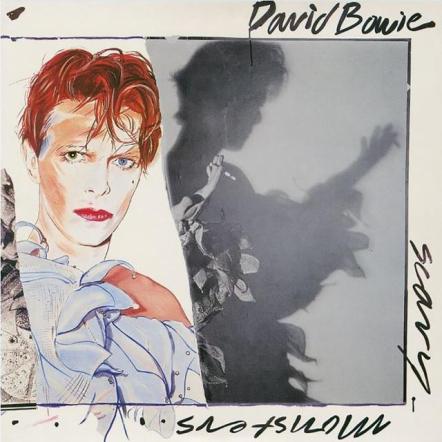
“Scary Monsters (And Super Creeps)” is David Bowie’s 14th studio album, originally released on 12th September 1980.
By the start of 1980 and the new millennium, Bowie was artistically on top of the world. He had just completed his massively influential and critically acclaimed “Berlin Trilogy” and spent much of 1978 on his hugely successful Isolar II world tour. There were very few artists that dominated the 1970’s as much as David Bowie, with a collection of 11 studio albums that continue to inspire artists to this day.
So Bowie approached making a new album at start of 1980 with lots of confidence and excitement, keen to continue his musical successes. After working with Brian Eno on his last 3 albums, Bowie decided to approach this album with a more commercial focus and with less emphasis on the experimental. Bowie was keen to record a killer album.
So out was Eno from his recent previous albums, but he retained his ever faithful and reliable MOR rhythm section in George Murray, Carlos Alomar and Dennis Davis. From his recent past, he also recruited the excellent Robert Fripp on guitar who made such a valuable contribution on the “Heroes” album and who’s distinctive guitar sounds gives this album much of its magical edge. Also from his past Bowie brought in Roy Bittan who previously appeared on “Station To Station“. Into the mix Bowie also added Chuck Hammer on guitar synthesizer, Andy Clark on synthesizer and Pete Townsend (yes, that Pete from The Who) on guitar on the track “Because You’re Young“.
In the Producer’s chair sitting next to Bowie was the ever reliable Tony Visconti again, who had worked on and off with Bowie for much of the previous decade. Visconti would contribute acoustic guitar and backing vocals as well as adding his usual magic to the overall album production.
Recorded between February and April 1980 primarily at The Power Station studios in New York, Bowie would make a monster album that was hugely influential in the upcoming “New Romantics” movement in the UK and that many consider to be the last great album of his “Golden” period. It’s an album in which Bowie first began to look back at what has been as much as he looked forward. A number of the tracks had its origins in earlier pieces (such as “It’s No Game” and “Scream Like A Baby“) or simply had the past very much in mind such as in “Ashes To Ashes“. But any earlier references or reminisces were very much framed in music that was either current at worst or ground breaking at best…
Things kick-off with some weird studio noises as Visconti rewinds a tape before hitting the play button, followed by a countdown before “It’s No Game (No. 1)” jumps out at us. With panicked Japanese vocals first making an appearance (courtesy of Michi Hirota), Bowie does not sound happy at all as he enters the scene and literally screams at us the English translation of the lyrics that indeed life is no game (“So where’s the moral, When people have their fingers broken, To be insulted by these fascists, It’s so degrading, And it’s no game“). The music is brutal and thumping and with Fripp’s manic guitar, it’s the heaviest Bowie has sounded in years. Bowie doesn’t really do protest songs as such, but here Bowie is clearly stating his anger at the current state of things. The track ends brilliantly with some playful Fripp guitar sounds as Bowie screams for him to just “SHUT UP, SHUT UP” !! Bowie hasn’t sounded quite this anguished since “Five Years“. The track had its origins, especially lyrically, in a much older unreleased song called “Tired Of My Life” that goes back to the pre-Ziggy days (available though on many bootlegs). A track that I don’t think Bowie has ever performed live.
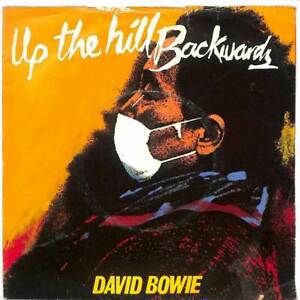
Things mellow slightly with “Up the Hill Backwards“, with Visconti’s acoustic guitar starting things off before the catchy melody and chant like vocals of Bowie/Visconti/others in unison kicking in. The MOR rhythm section sound great here as does Fripp’s guitar that makes an appearance between verses, but really shines during the outro. Bowie is typically cryptic with lines such as “The vacuum created by the arrival of freedom, And the possibilities it seems to offer” again suggesting that politically things need to be reassessed. It’s a track I’ve always enjoyed in that it doesn’t really sound like anything he’s quite done before or since. It was released as the 4th single off the album but as almost everyone who would be interested already owned the album, it flopped and only reached No. 36 in the UK. It was backed by the previously unreleased “Crystal Japan” which is but one reason why it’s in my collection (the other being I bought anything that had Bowie’s name on it). A track Bowie rarely performed live although it did make an early appearance in the “Glass Spider’s” tour set-list.
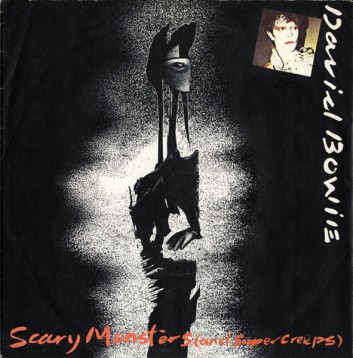
Next comes the superb title track in “Scary Monsters (And Super Creeps)” and we’re back in disturbed territory again. With themes of insanity and murder, the track is one Bowie’s very best “hard rock” pieces with again both the MOR rhythm section and Fripp’s amazing guitar work really shining here. Visconti also deserves much credit, with a wonderfully atmospheric dense vibe and crunching bassline sounding both threatening and catchy at the same time. The lyrics tell of a mentally unwell girl who has suffered at the hands of the protagonist “She asked me to stay and I stole her room, She asked for my love and I gave her a dangerous mind, Now she’s stupid in the street and she can’t socialise“. It’s such a great song and one that Bowie has performed live on numerous tours. Released as the 3rd single off the album, it wasn’t the monster hit of its two predecessors and managed to only reach No. 20 in the UK.
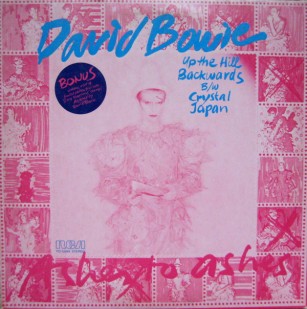
“Ashes to Ashes” is THE killer track off the album and in my estimation, one of the top 3 songs Bowie has ever recorded. It’s a song that is so unique in its sound and atmospherics that it’s hard to imagine anyone other than Bowie (and Vistonti’s production) able to create such a piece. Famously referencing again Major Tom from “Space Oddity“, things have gone from bad to worse for our wayward astronaut as it turns out the reason for his disappearance and erratic behaviour is that “We know Major Tom’s a junkie“. Musically, this has everything. A wonderful central rhythm section with treated bassline, beautiful synthesizer atmospherics, a brilliant lyric and accompanying vocal performance and a simply gorgeous nursery rhyme outro (“My mother said, to get things done, You’d better not mess with Major Tom“) with Chuck Hammer’s beautiful guitar synthesizer refrain the perfect way to finish the piece. It’s THE perfect combination of pop meeting avant-garde. Released as the first single off the album prior to the album release, it became Bowie’s only second visit to the No. 1 position in the UK single’s chart (with coincidentally the re-released “Space Oddity” being his first No. 1 in 1975). Interestingly, it flopped in the US, where only Bowie’s disco period had really charted well prior to the “Let’s Dance” juggernaut to come. The success of the single certainly wasn’t hurt with the wonderful accompanying video, which remains my favourite Bowie video. Based very much on Bowie’s appearance on the “Kenny Everett Video Show” (watch performance here) with his 1979 “Space Oddity” remake (discussed later), it features the 3 key characters (the Clown/Pierrot, the Madman and the astronaut/Major Tom) in a surreal, dreamlike world. Directed by David Mallet (who Bowie met on the Kenny Everett show), it still holds today as a masterpiece in the music video genre. Just to be absolutely certain the single would sell well, RCA released it with 3 different covers that in turn each had 4 different sets of Bowie “stamps” along the border. So that’s potentially 12 different covers for the Bowie completionist to collect. Being literally a penniless student at the time, I had to settle for just the one copy of the single. Watch the stunning video here.
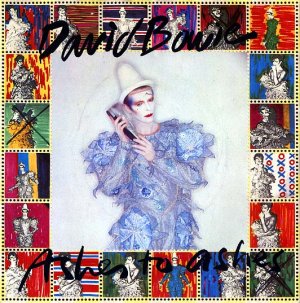
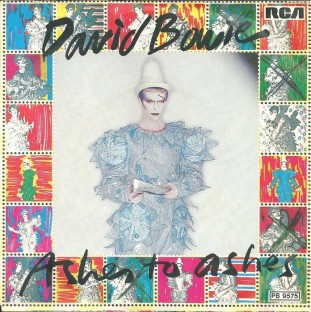
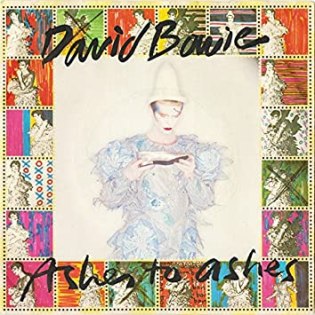
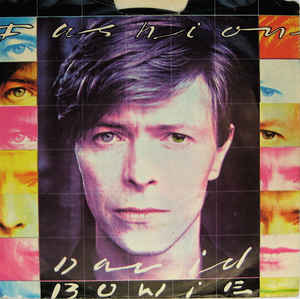
Side 1 finishes with the other monster hit off the album, “Fashion“. Although Bowie was always at the head of any fashion trend, here the topic of fashion was more centred around politics and how being left or right minded politically was often a question of fashion for many, especially the young. But the line “We are the goon squad and we’re coming to town, Beep-beep” is one of my all-time favourites and makes me smile every time I hear it. Musically, everything again centers around the solid MOR rhythm section and Fripp’s amazing blasts of guitar, this possibly being Fripp’s best performance on the album. The track is that rare mixture of rock anthem and catchy pop, disco groove that is almost impossible to resist. Released as the 2nd single off the album, it reached No. 5 in the UK charts. At least there was only the one cover to collect this time. Watch the music video here.
Side 2 begins with the epic “Teenage Wildlife“, as Bowie reflects somewhat sombrely on the current grim state of affairs and likely not so rosy future with a younger self (think any number of those within New Romantics movement). Bowie seems both frustrated that he’s seen as some kind of prophet “”Well, David, what shall I do?, They wait for me in the hallway”, I’ll say, “Don’t ask me, I don’t know any hallways“” and at their overly naive and unoriginal outlook “A broken-nosed mogul are you, One of the new-wave boys, Same old thing in brand new drag, Comes sweeping into view“. It’s Bowie at his most reflective and cynical as he produces one of his very best vocal performances. Musically, Fripp is the star here with his guitar work the centerpiece of the whole thing and not unlike his work on the song “Heroes”. I’ve always loved this song and all the pity that he’s not performed this live to my knowledge.
The superb “Scream Like a Baby” is however THE star of side 2. The track is musically based on a old piece called “I Am A Lazer” he wrote for a group he put together in the mid 70’s called “The Astronettes” that featured his girlfriend at the time Ava Cherry. Musically, it’s very similar with a wonderfully powerful drum beat by Davis, an Alomor guitar riff that drives the whole piece along and with all sorts of musical flourishes creating a dark atmosphere. Lyrically it’s totally different and one of his more chilling as Bowie recounts how he and “Sam”, society misfits due to their sexuality (“Well, they came down hard on the faggots, And they came down hard on the street“) are taken by the authorities, tortured and brainwashed with drugs to conform, else face the finality of the furnace (“Blindfolded, chains, and they stomped on us, And took away our clothes and things, And pumped us full of strange drugs“). Bowie’s anguished vocals are again brilliant, especially when he can’t quiet get the word society out “Now I’m learning to be a part of socie-soc-soci-tsociety“. But the highlight is the bridge where the vocals are split into two tracks, one in each speaker with one speeding up while the other slows down as Bowie laments “No athletic program, no discipline, no book, He just sat in the backseat swearing he’d seek revenge, But he jumped into the furnace singing old songs we loved“. It reminds me of the schizophrenic hell of “All The Madmen” and leaves us thinking that Bowie is perhaps Sam all along. It’s a Bowie gem that has sadly never graced the live stage.
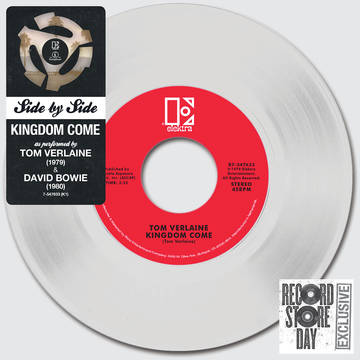
“Kingdom Come” is the obligatory cover, although it’s actually the first one to appear on a studio album since “Wild Is The Wind” on “Station to Station” (there would be many many to come in Bowie’s upcoming 80’s albums). By Tom Verlaine (of “Television” fame), it’s my personal low-point of the album although it does fit the overall dark themes of Side 2 and quite nicely flows on from the previous track. Telling the experiences of being in prison (perhaps the madmen from the previous “Scream Like A Baby“), “Well I’ll be breaking these rocks, And cutting this hay“, Bowie just wants one day where he can be free before his inevitable end “Sun keeps beating down on me, wall’s a mile high, Up in the tower they’re watching me hoping I’m gonna die“. It’s a depressing piece that lacks the musical adventurism of most of the album. The track was actually released as a limited edition white vinyl single many many moons later in 2015 as part of the always exciting Record Store Day promotion.
“Because You’re Young” features the great Pete Townsend (if you say Who, I’ll laugh) on guitar and is kinda special on that basis alone. As one would expect, Townsend’s distinctive guitar is the feature of the track although the bass line throughout is rather nice as well. Coming back perhaps to the troubled girl from the title track, here Bowie describes people he cares about having a troubled relationship, due in part perhaps because they’re so young “He punishes hard, Was loving her such a crime?, She took back everything she said, Left him nearly out of his mind“. It’s another track that Bowie would discard and never perform live.
The album comes full circle and ends as it began with “It’s No Game (No. 2)“. Unlike the frantic start, here the music is much slowed down with Bowie singing this time with a sad, resigned tone rather than the anger at the start. It’s almost as if after all we’ve been through in the album, Bowie has now simply given up on everything. Only the 3rd verse differs from No. 1 “Children round the world, Put camel shit on the walls, They’re making carpets on treadmills, Or garbage sorting“. Life is no game indeed as things end with the end of the tape reel flapping around in the player…
This really is an amazing album, with Bowie at the height of his powers and one which I continue to enjoy playing from start to finish. Bowie has taken much of the originality and experimentalism of his Berlin Trilogy and polished it up with a slightly more commercial edge and reflective set of lyrics. The final result is a Bowie masterpiece which set the high standard by which he was to be subsequently measured.
The album cover is one of my favourites that took as its base a photo of Bowie by Brian Duffy in Pierrot costume, only for it to be cutup (to Brian’s annoyance) and made into a part real, part cartoon collage by Edward Bell. The final effect is I think fantastic (the wonderful “David Bowie Is” exhibition had a large display of how this was all created).
There have been a number of re-releases of the album over the years, but at this stage no major box set or special anniversary edition. Hopefully that might change with it being this year 40 years since it was released (oh my God, I’m getting soooo old).
RCA released this on CD in 1983 (and is one of the very few RCA CDs I don’t actually own) but the most significant re-release was the excellent Rykodisc CD release in 1992 that featured the following bonus tracks:
“Alabama Song” written by Bertolt Brecht/Kurt Weill was first made popular in a rock context by The Doors. David Bowie included this as part of his set during the 1978 Isolar II world tour (which kinda fitted in with his “German/Berlin” period songs) and recorded it as a single in 1980. The result is somewhat bizarre, odd sounding experience with Bowie’s vocals never quite matching the key and pace of the backing band. Having said that, I love this interpretation although Alomar has described it as his least favourite Bowie recording experience. The single was a minor hit in the UK, reaching No. 23.
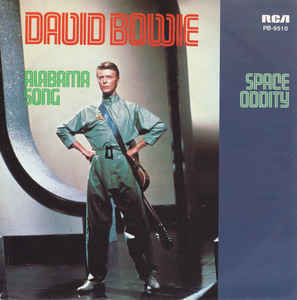
The “Alabama Song” single was backed with a newly recorded acoustic version of “Space Oddity“. After initially rejecting the opportunity to produce the original track back in 1969, Visconti didn’t miss the chance to finally produce this iconic song. Whereas the original “Space Oddity” was a massive production piece, here everything has been stripped back to a bare minimum, which just a basic drum and acoustic guitar arrangement. Even the “take-off” sequence has been reduced to just 10 seconds of silence. It’s interesting but a mere shadow of the original masterpiece. Bowie performed this on the Kenny Everett Show where the ground work for the “Ashes To Ashes” video was laid. Watch it here.
“Panic in Detroit” is a drastically re-worked version from 1979. Whereas the original “Aladdin Sane” version had a menacing edge to it all, Bowie here seems to be just taking the piss, with the way he sings the “Panic in Detroit” line simply hilarious. It’s a fun listen but ultimately dispensable.
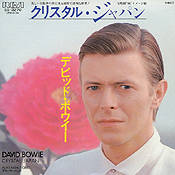
“Crystal Japan” is a slow, synthesizer-based instrumental that was released in Japan as a single (instead of “Alabama Song” which was its b-side). Recorded during the Scary Monsters sessions, it was ultimately scrapped when Bowie decided he didn’t want Low/Heroes type instrumentals to impact the album’s commercial appeal. Bowie was fascinated with Japan, with Japan a key influence in the album, not only here but with the Japanese vocals on “It’s No Game (No 1)” and the key line in “Ashes To Ashes” (“Pictures of Jap girls in synthesis“). It’s a very nice, moody piece that would have fitted in rather well on the “Heroes” album next to “Moss Garden“.
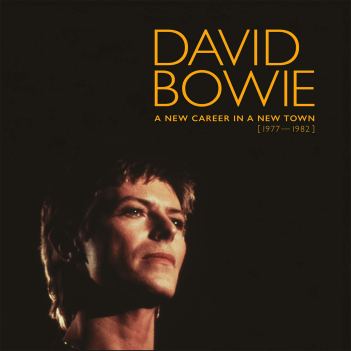
“Scary Monsters (And Super Creeps)” also featured on the rather excellent “A New Career In A New Town” 1977-1982 Box Set. If you ever want to explore Bowie’s last collection of albums with RCA, this is the best place to start.
Bowie would in the end not tour the album. Initially, he was already committed for the remainder of 1980/early 1981 in playing his acclaimed role as deformed John Merrick in the Broadway version of “The Elephant Man“. But any plans of touring the album in 1981 were dashed when on 8 December 1980, Bowie’s friend John Lennon was so tragically murdered. Bowie had no stomach for any subsequent touring and live performances and we had to wait until 1983’s “Serious Moonlight” tour to see him on the concert arena again.
“Scary Monster (and Super Creeps)” marks the end of an era on numerous fronts.
He would never record again with his MOR rhythm section who have collectively worked with Bowie since the “Station To Station” tour in 1976. Although Carlos Alomar would work with Bowie again on numerous projects, neither Dennis Davis or George Murray worked with Bowie again.
He would also end his partnership with Tony Visconti. Although Visconti would produce the “Baal” EP in 1981, Visconti would not produce another Bowie studio album for over 20 years, until “Heathen” in 2002. I can’t help thinking many of Bowie’s subsequent albums suffered and really missed the master in the producer’s chair.
Bowie also formally ended his management commitments with his previous manager Tony Defries. After being ripped off by Defries for years, Scary Monsters marked the last album in which Bowie had to make royalty payments to Defries (and a reason why we had to wait until 1983 until his next album). In some ways, this actually helped Bowie in that he wasn’t primarily focused on just making money, knowing the more successful the album, the more Defries benefited. If Bowie recorded an experimental commercial flop, at least it meant Defries also financially suffered. This “constraint” was gone post 1982 and I’m not sure having a more commercial focus helped Bowie in the long run.
Finally, it marked the end of his relationship with his label RCA and so ended Bowie’s so-called “Golden Era” that started way back in 1971 with “Hunky Dory“. Although RCA were always a little questionable in their promotion of Bowie and in their handling of his catalog (the debacle that was the “Bowie Rare” album springs to mind), they at least supported Bowie (more or less) during all his various ch-ch-changes throughout the 70’s. Scary Monsters marks the last studio album with RCA, subsequently signing with EMI for a monster fee to record the subsequent commercial monsters that were Bowie’s 80’s albums. But with big money comes big responsibilities and Bowie struggled to record albums that were artistically satisfying while ensuring EMI got the commercial success such a massive sign-on fee demands. RCA for all their dysfunction at least provided an environment by which Bowie could record albums as diverse and remarkable as “Ziggy Stardust” to “Diamond Dogs” to “Young Americans” to “Low” and finally all the way through to “Scary Monsters”.
“Scary Monsters (And Super Creeps)” would be the standard and the extremely high bar set for which all subsequent Bowie albums would be measured. Although Bowie would sometimes come close (“The Next Day” was close, “1. Outside” was ever closer), it was a standard by which Bowie would never quite reach again.
As much as I love this album, there are still 3 other albums from his RCA era that I rank higher. But that’s a story for another day…
Best Tracks: “Ashes to Ashes“, “Fashion“, “Scream Like a Baby“
+++++++++++++++++++++++++++++++++++++++++++++++++++++++++++++++++++++++
+++++++++++++++++++++++++++++++++++++++++++++++++++++++++++++++++++++++
+++++++++++++++++++++++++++++++++++++++++++++++++++++++++++++++++++++++
- Days ago: MOM = 3860 days ago & DAD = 515 days ago
- New note - On 1807.06, I ceased daily transmission of my Hey Mom feature after three years of daily conversations. I post Hey Mom blog entries on special occasions. I post the days since ("Days Ago") count on my blog each day, and now I have a second count for Days since my Dad died on August 28, 2024. I am now in the same time zone as Google! So, when I post at 10:10 a.m. PDT to coincide with the time of Mom's death, I am now actually posting late, so it's really 1:10 p.m. EDT. But I will continue to use the time stamp of 10:10 a.m. to remember the time of her death and sometimes 13:40 EDT for the time of Dad's death. The blog entry numbering in the title has changed to reflect total Sense of Doubt posts since I began the blog on 0705.04, which include Hey Mom posts, Daily Bowie posts, and Sense of Doubt posts. Hey Mom posts will still be numbered sequentially. New Hey Mom posts will use the same format as all the other Hey Mom posts; all other posts will feature this format seen here.


No comments:
Post a Comment