THE MIKE WALLACE INTERVIEW
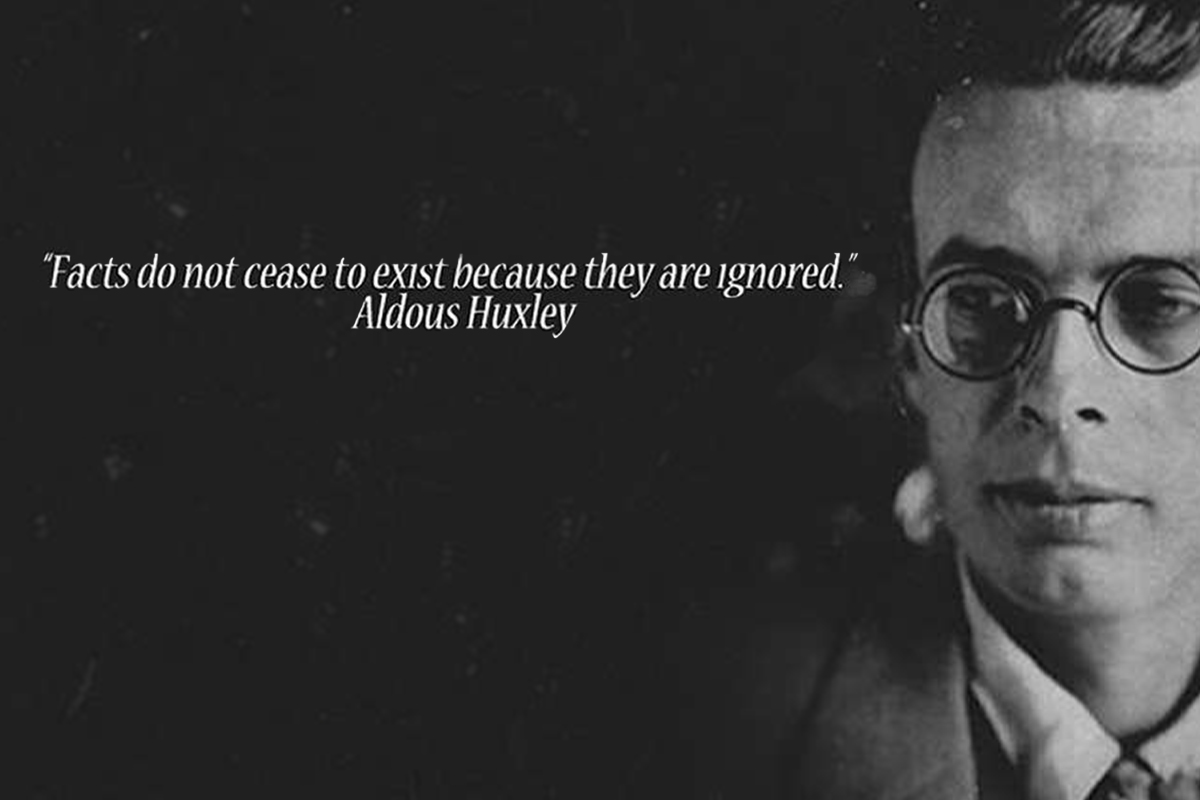
Guest: Aldous Huxley
5/18/58
WALLACE: This is Aldous Huxley, a man haunted by a vision of hell on earth. A searing social critic, Mr. Huxley 27 years ago, wrote Brave New World, a novel that predicted that some day the entire world would live under a frightful dictatorship. Today Mr. Huxley says that his fictional world of horror is probably just around the corner for all of us. We'll find out why, in a moment.
(OPENING CREDITS)
WALLACE: Good evening, I'm Mike Wallace. Tonight's guest, Aldous Huxley, is a man of letters, as disturbing as he is distinguished. Born in England, now a resident of California, Mr. Huxley has written some of the most electric novels and social criticism of this century.
He's just finished a series of essays called "Enemies of Freedom," in which he outlines and defines some of the threats to our freedom in the United States; and Mr. Huxley, right of the bat, let me ask you this: as you see it, who and what are the enemies of freedom here in the United States?
HUXLEY: Well, I don't think you can say who in the United States, I don't think there are any sinister persons deliberately trying to rob people of their freedom, but I do think, first of all, that there are a number of impersonal forces which are pushing in the direction of less and less freedom, and I also think that there are a number of technological devices which anybody who wishes to use can use to accelerate this process of going away from freedom, of imposing control.
WALLACE: Well, what are these forces and these devices, Mr. Huxley?
HUXLEY: I should say that there are two main impersonal forces, er...the first of them is not exceedingly important in the United States at the present time, though very important in other countries. This is the force which in general terms can be called overpopulation, the mounting pressure of population pressing upon existing resources.
WALLACE: Uh-huh.
HUXLEY: Uh...this, of course, is an extraordinary thing; something is happening which has never happened in the world's history before, I mean, let's just take a simple fact that between the time of birth of Christ and the landing of the May Flower, the population of the earth doubled. It rose from two hundred and fifty million to probably five hundred million. Today, the population of the earth is rising at such a rate that it will double in half a century.
WALLACE: Well, why should overpopulation work to diminish our freedoms?
HUXLEY: Well, in a number of ways. I mean, the...the experts in the field like Harrison Brown, for example, pointed out that in the underdeveloped countries actually the standard of living is at present falling. The people have less to eat and less goods per capita than they had fifty years ago;
and as the position of these countries, the economic position, becomes more and more precarious, obviously the central government has to take over more and more responsibility for keeping the ship-of-state on an even keel, and then of course you are likely to get social unrest under such conditions, with again an intervention of the central government.
So that, I think that one sees here a pattern which seems to be pushing very strongly towards a totalitarian regime. And unfortunately, as in all these underdeveloped countries the only highly organized political party is the Communist Party, it looks rather as though they will be the heirs to this unfortunate process, that they will step into the power...the position of power.
WALLACE: Well then, ironically enough one of the greatest forces against communism in the world, the Catholic Church, according to your thesis would seem to be pushing us directly into the hands of the communists because they are against birth control.
HUXLEY: Well, I think this strange paradox probably is true. There is, er..., it's an extraordinary situation actually. I mean, one has to look at it, of course, from a biological point of view: the whole essence of biological life on earth is a question of balance and what we've done is to practice death control in the most intensive manner without balancing this with birth control at the other end. Consequently, the birth rates remain as high as they were and death rates have fallen substantially. (COUGHS)
WALLACE: All right then, so much, for the time being anyway, for overpopulation. Another force that is diminishing our freedoms?
HUXLEY: Well another force which I think is very strongly operative in this country is the force of what may be called of overorganization. Er...As technology becomes more and more complicated, it becomes necessary to have more and more elaborate organizations, more hierarchical organizations, and incidentally the advance of technology is being accompanied by an advance in the science of organization.
It's now possible to make organizations on a larger scale than it was ever possible before, and so that you have more and more people living their lives out as subordinates in these hierarchical systems controlled by bureaucracy, either the bureaucracies of big businesses or the bureaucracies of big government.
WALLACE: Uh-huh. Uh-huh. Now the devices that you were talking about, are there specific devices or er...methods of communication which diminish our freedoms in addition to overpopulation and overorganization?
HUXLEY: Well, there are certainly devices which can be used in this way. I mean, let us er...take after all, a piece of very recent and very painful history is the propaganda used by Hitler, which was incredibly effective.
I mean, what were Hitler's methods? Hitler used terror on the one kind, brute force on the one hand, but he also used a very efficient form of propaganda, which er...he was using every modern device at that time. He didn't have TV., but he had the radio which he used to the fullest extent, and was able to impose his will on an immense mass of people. I mean, the Germans were a highly educated people.
WALLACE: Well, we're aware of all this, but how do we equate Hitler's use of propaganda with the way that propaganda, if you will, is used let us say here in the United States. Are you suggesting that there is a parallel?
HUXLEY: Needless to say it is not being used this way now, but, er...the point is, it seems to me, that there are methods at present available, methods superior in some respects to Hitler's method, which could be used in a bad situation. I mean, what I feel very strongly is that we mustn't be caught by surprise by our own advancing technology.
This has happened again and again in history with technology's advance and this changes social condition, and suddenly people have found themselves in a situation which they didn't foresee and doing all sorts of things they really didn't want to do.
WALLACE: And well, what...what do you mean? Do you mean that we develop our television but we don't know how to use it correctly, is that the point that you're making?
HUXLEY: Well, at the present the television, I think, is being used quite harmlessly; it's being used, I think, I would feel, it's being used too much to distract everybody all the time. But, I mean, imagine which must be the situation in all communist countries where the television, where it exists, is always saying the same things the whole time; it's always driving along.
It's not creating a wide front of distraction it's creating a one-pointed, er...drumming in of a single idea, all the time. It's obviously an immensely powerful instrument.
WALLACE: Uh-huh. So you're talking about the potential misuse of the instrument.
HUXLEY: Exactly. We have, of course...all technology is in itself moral and neutral. These are just powers which can either be used well or ill; it is the same thing with atomic energy, we can either use it to blow ourselves up or we can use it as a substitute for the coal and the oil which are running out.
WALLACE: You've even written about the use of drugs in this light.
HUXLEY: Well now, this is a very interesting subject. I mean, in this book that you mentioned, this book of mine, "Brave New World," er...I postulated it a substance called 'soma,' which was a very versatile drug. It would make people feel happy in small doses, it would make them see visions in medium doses, and it would send them to sleep in large doses.
Well, I don't think such a drug exists now, nor do I think it will ever exist. But we do have drugs which will do some of these things, and I think it's quite on the cards that we may have drugs which will profoundly change our mental states without doing us any harm.
I mean, this is the...the pharmacological revolution which is taking place, that we have now powerful mind-changing drugs which physiologically speaking are almost costless. I mean they are not like opium or like coca...cocaine, which do change the state of mind but leave terrible results physiologically and morally.
WALLACE: Mr. Huxley, in your new essays you state that these various "Enemies of Freedom" are pushing us to a real-life "Brave New World," and you say that it's awaiting us just around the corner. First of all, can you detail for us, what life in this Brave New World would you fear so much, or what life might be like?
HUXLEY: Well, to start with, I think this kind of dictatorship of the future, I think will be very unlike the dictatorships which we've been familiar with in the immediate past. I mean, take another book prophesying the future, which was a very remarkable book, George Orwell's "1984."
Well, this book was written at the height of the Stalinist regime, and just after the Hitler regime, and there he foresaw a dictatorship using entirely the methods of terror, the methods of physical violence. Now, I think what is going to happen in the future is that dictators will find, as the old saying goes, that you can do everything with bayonets except sit on them!
WALLACE: (LAUGHS)
HUXLEY: But, if you want to preserve your power indefinitely, you have to get the consent of the ruled, and this they will do partly by drugs as I foresaw in "Brave New World," partly by these new techniques of propaganda.
They will do it by bypassing the sort of rational side of man and appealing to his subconscious and his deeper emotions, and his physiology even, and so, making him actually love his slavery.
I mean, I think, this is the danger that actually people may be, in some ways, happy under the new regime, but that they will be happy in situations where they oughtn't to be happy.
WALLACE: Well, let me ask you this. You're talking about a world that could take place within the confines of a totalitarian state. Let's become more immediate, more urgent about it. We believe, anyway, that we live in democracy here in the United States. Do you believe that this Brave New World that you talk about, er...could, let's say in the next quarter century, the next century, could come here to our shores?
HUXLEY: I think it could. I mean, er...that's why I feel it so extremely important here and now, to start thinking about these problems. Not to let ourselves be taken by surprise by the...the new advances in technology. I mean the...for example, in the regard to the use of the...of the drugs.
We know, there is enough evidence now for us to be able, on the basis of this evidence and using certain amount of creative imagination, to foresee the kind of uses which could be made by people of bad will with these things and to attempt to forestall this, and in the same way,
I think with these other methods of propaganda we can foresee and we can do a good deal to forestall. I mean, after all, the price of freedom is eternal vigilance.
WALLACE: You write in Enemies of Freedom, you write specifically about the United States. You say this, writing about American political campaigns you say, "All that is needed is money and a candidate who can be coached to look sincere; political principles and plans for specific action have come to lose most of their importance. The personality of the candidate, the way he is projected by the advertising experts, are the things that really matter."
HUXLEY: Well, this is the...during the last campaign, there was a great deal of this kind of statement by the advertising managers of the campaign parties. This idea that the candidates had to be merchandised as though they were soap and toothpaste and that you had to depend entirely on the personality.
I mean, personality is important, but there are certainly people with an extremely amiable personality, particularly on TV, who might not necessarily be very good in political...positions of political trust.
WALLACE: Well, do you feel that men like Eisenhower, Stevenson, Nixon, with knowledge aforethought were trying to pull the wool over the eyes of the American public?
HUXLEY: No, but they were being advised by powerful advertising agencies who were making campaigns of a quite different kind from what had been made before. and I think we shall see probably, er...all kinds of new devices coming into the picture. I mean, for example, this thing which got a good deal of publicity last autumn, subliminal projection.
I mean, as it stands, this thing, I think is of no menace to us at the moment, but I was talking the other day to one of the people who has done most experimental work in the...psychological laboratory with this, was saying precisely this, that it is not at the moment a danger, but once you've established the principle that something works, you can be absolutely sure that the technology of it is going to improve steadily.
And I mean his view of the subject was that, well, maybe they will use it up to some extent in the 1960 campaign, but they will probably use it a good deal and much more effectively in the 1964 campaign because this is the kind of rate at which technology advances.
WALLACE: And we'll be persuaded to vote for a candidate that we do not know that we are being persuaded to vote for.
HUXLEY: Exactly, I mean this is the rather alarming picture that you’re being persuaded below the level of choice and reason.
WALLACE: In regard to advertising, which you mentioned just a little ago, in your writing, particularly in "Enemies of Freedom," you attack Madison Avenue, which controls most of our television and radio advertising, newspaper advertising and so forth. Why do you consistently attack the advertising agencies...
HUXLEY: Well, no I...I think that, er...advertisement plays a very necessary role, but the danger it seems to me in a democracy is this...I mean what does a democracy depend on? A democracy depends on the individual voter making an intelligent and rational choice for what he regards as his enlightened self-interest, in any given circumstance.
But what these people are doing, I mean what both, for their particular purposes, for selling goods and the dictatorial propagandists are for doing, is to try to bypass the rational side of man and to appeal directly to these unconscious forces below the surfaces so that you are, in a way, making nonsense of the whole democratic procedure, which is based on conscious choice on rational ground.
WALLACE: Of course, well, maybe...I...you have just answered this next question because in your essay you write about television commercials, not just political commercials, but television commercials as such and how, as you put it, "Today's children walk around singing beer commercials and toothpaste commercials." And then you link this phenomenon in some way with the dangers of a dictatorship. Now, could you spell out the connection or, have...or do you feel you've done so sufficiently?
HUXLEY: Well, I mean, here, this whole question of children, I think, is a terribly important one because children are quite clearly much more suggestible than the average grownup; and again, suppose that, er...that for one reason or another all the propaganda was in the hands of one or very few agencies, you would have an extraordinarily powerful force playing on these children, who after all are going to grow up and be adults quite soon. I do think that this is not an immediate threat, but it remains a possible threat, and...
WALLACE: You said something to the effect in your essay that the children of Europe used to be called 'cannon fodder' and here in the United States they are 'television and radio fodder.'
HUXLEY: Well, after all, you can read in the trade journals the most lyrical accounts of how necessary it is, to get hold of the children because then they will be loyal brand buyers later on. But I mean, again you just translate this into political terms, the dictator says they all will be ideology buyers when they are grownup.
WALLACE: We hear so much about brainwashing as used by the communists. Do you see any brainwashing other than that which we’ve just been talking about, that is used here in the United States, other forms of brainwashing?
HUXLEY: Not in the form that has been used in China and in Russia because this is, essentially, the application of propaganda methods, the most violent kind to individuals; it is not a shotgun method, like the...the advertising method. It's a way of getting hold of the person and playing both on his physiology and his psychology until he really breaks down and then you can implant a new idea in his head.
I mean the descriptions of the methods are really blood curdling when you read them, and not only methods applied to political prisoners but the methods applied, for example, to the training of the young communist administrators and missionaries. They receive an incredibly tough kind of training which may cause maybe twenty-five percent of them to break down or commit suicide, but produces seventy-five percent of completely one-pointed fanatics.
WALLACE: The question, of course, that keeps coming back to my mind is this: obviously politics in themselves are not evil, television is not in itself evil, atomic energy is not evil, and yet you seem to fear that it will be used in an evil way. Why is it that the right people will not, in your estimation, use them? Why is it that the wrong people will use these various devices and for the wrong motives?
HUXLEY: Well, I think one of the reasons is that these are all instruments for obtaining power, and obviously the passion for power is one of the most moving passions that exists in man; and after all, all democracies are based on the proposition that power is very dangerous and that it is extremely important not to let any one man or any one small group have too much power for too long a time.
After all what are the British and American Constitution except devices for limiting power, and all these new devices are extremely efficient instruments for the imposition of power by small groups over larger masses.
WALLACE: Well, you ask this question yourself in "Enemies of Freedom." I'll put your own question back to you. You ask this, "In an age of accelerating overpopulation, of accelerating overorganization, and ever more efficient means of mass communication, how can we preserve the integrity and reassert the value of the human individual?" You put the question, now here's your chance to answer it Mr. Huxley.
HUXLEY: Well, this is obviously...first of all, it is a question of education. Er...I think it's terribly important to insist on individual values, I mean, what is a...there is a tendency as a...you probably read a book by Whyte, "The Organization Man", a very interesting, valuable book I think, where he speaks about the new type of group morality, group ethic, which speaks about the group as though the group were somehow more important than the individual.
But this seems, as far as I'm concerned, to be in contradiction with what we know about the genetical makeup of human beings, that every human being is unique. And it is, of course, on this genetical basis that the whole idea of the value of freedom is based.
And I think it's extremely important for us to stress this in all our educational life, and I would say it's also very important to teach people to be on their guard against the sort of verbal booby traps into which they are always being led, to analyze the kind of things that are said to them.
Well, I think there is this whole educational side of...and I think there are many more things that one could do to strengthen people, and to make them more aware of what's being done.
WALLACE: You're a prophet of decentralization?
HUXLEY: Well, the...yes...if it...it's feasible. It's one of the tragedies, it seems to me. I mean, many people have been talking about the importance of decentralization in order to give back to the voter a sense of direct power. I mean...the voter in an enormous electorate field is quite impotent, and his vote seems to count for nothing.
This is not true where the electorate is small, and where he is dealing with a...with a group which he can manage and understand...and if one can, as Jefferson after all suggested, break up the units, er...into smaller and smaller units and so, get a real, self-governing democracy.
WALLACE: Well, that was all very well in Jefferson's day, but how can we revamp our economic system and decentralize, and at the same time meet militarily and economically the tough challenge of a country like Soviet Russia?
HUXLEY: Well, I think the answer to that is that there are...it seems to me that you...that production, industrial production is of two kinds. I mean, there are some kinds of industrial production which obviously need the most tremendously high centralization, like the making of automobiles for example.
But there are many other kinds where you could decentralize quite easily and probably quite economically, and that you would then have this kind of decentralized, like after all you begin to see it now, if you travel through the south, this decentralized textile industry which is springing up there.
WALLACE: Mr. Huxley, let me ask you this, quite seriously, is freedom necessary?
HUXLEY: As far as I am concerned it is.
WALLACE: Why? Is it necessary for a productive society?
HUXLEY: Yes, I should say it is. I mean, a genuinely productive society. I mean you could produce plenty of goods without much freedom, but I think the whole sort of creative life of man is ultimately impossible without a considerable measure of individual freedom, of initiative, creation, all these things which we value, and I think value properly, are impossible without a large measure of freedom.
WALLACE: Well, Mr. Huxley, take a look again at the country which is in the stance of our opponent anyway, it would seem, anyway it would seem to be there, Soviet Russia. It is strong, and getting stronger, economically, militarily, at the same time it's developing its art forms pretty well, er...it seems not unnecessarily to squelch the creative urge among its people. And yet it is not a free society.
HUXLEY: It's not a free society, but here is something very interesting that those members of the society, like the scientists, who are doing the creative work, are given far more freedom than anybody else. I mean, it is a privileged aristocratic society in which, provided they don't poke their noses into political affairs, these people are given a great deal of prestige, a considerable amount of freedom, and a lot money.
I mean, this is a very interesting fact about the new Soviet regime, and I think what we are going to see is er...a people on the whole with very little freedom but with an oligarchy on top enjoying a considerable measure of freedom and a very high standard of living.
WALLACE: And the people down below, the 'epsilons' down below...
HUXLEY: Enjoying very little.
WALLACE: And you think that that kind of situation can long endure?
HUXLEY: I think it can certainly endure much longer than the situation in which everybody is kept out; I mean, they can certainly get their technological and scientific results on such a basis.
WALLACE: Well, the next time that I talk to you then, perhaps we should investigate further the possibility of the establishment of that kind of a society, where the drones work for the queen bees up above.
HUXLEY: Well, but yes, but I must say, I still believe in democracy, if we can make the best of the creative activities of the people on top plus those of the people on the bottom, so much the better.
WALLACE: Mr. Huxley, I surely thank you for spending this half hour with us, and I wish you God speed sir.
HUXLEY: Thank you.
WALLACE: Aldous Huxley finds himself these days in a peculiar and disturbing position: a quarter of a century after prophesying an authoritarian state in which people were reduced to cyphers, he can point at Soviet Russia and say, "I told you so!" The crucial question, as he sees it now, is whether the so-called Free World is shortly going to give Mr. Huxley the further dubious satisfaction of saying the same thing about us.
Stay tuned for a preview of next weeks interview. Till then, Mike Wallace. Good night.
Closing credits
Digitization credits