
A Sense of Doubt blog post #3830 - 100 Greatest All-Time Baseball Players according to ESPN

This list by ESPN
published in 2022 of the 100 Greatest Baseball players of all time is in part
influenced by popular opinion and hype over actual reasonable measure of
performance. There are players included who do not belong in a top 100 and
players who do belong who are not listed. Throughout, the ranking is bizarre.
In 2003, Bill James published his Historical Baseball Abstract
(aren’t we due for a new one?), and he listed a top 100 as well. There is some
overlap and some glaring and bizarre differences.
Babe Ruth is indisputably the greatest Baseball player of all time. I
don’t have a problem with that assessment. Willie Mays must also be highly
ranked and both have them in the top five (James t three and ESPN at two).
ESPN places Henry “Hammerin’ Hank” Aaron at number three and James has
Honus Wagner at two. ESPN has Wagner at twelve.
Now granted, there are players who have played since 2003 when James made
his list. For the most part, James steered clear of players who were not yet
retired in making his list, though not completely.
Hero worship definitely play a HUGE role in the ESPN rankings.
James has Hank Aaron at 12, a basic flip with ESPN’s ranking of Wagner.
ESPN did not reveal its system for ranking the players but obviously Hank
Aaron ranks over Wagner for them because of his home runs.
By that logic, though, Barry Bonds should be in the number two. In 2003
when James PUBLISHED the Abstract (being written in the year or more prior),
Bonds had set the single season HR mark (73 in 2001), but he had not eclipsed
Aaron’s 755 home runs until 2007.
If home runs matter so much, not to mention walks and on-base percentage,
ESPN should have Bonds in the number two spot, and yet the
Performance-Enhancing Drugs scandal still haunts him, especially among sports
writers, and Bonds is not yet elected to Baseball’s Hall of Fame, which I think
is a travesty.
ESPN ranks Bonds at eight and James has him at sixteen, probably set in
the rankings prior to 2003.
ESPN and James both list Ty Cobb, Mickey Mantle, Ted Williams,
Walter Johnson, and Stan Musial in the top ten.
One big difference is that ESPN places Lou Gehrig at number six and James
has him at fourteen.
James uses a complex system to rank his players that includes runs created
and a system he created called WIN SHARES, similar to in some ways but not at
all identical to the “wins above replacement level” stat ESPN uses. Part of his
WIN SHARES assessment is a three best seasons measure and five best consecutive
seasons. He adjusts for time line and attempts to massage the ranks with
“subjective” elements like the mythical “clutch performance,” leadership, and
elements undefined by statistics.
With this system, James has the great Josh Gibson from the Negro Leagues
ranked ninth all time whereas ESPN places him thirty-fifth just below Pete Rose
that it ranks at thirty-fourth. Likewise, James has Oscar Charleston at fourth
whereas he does not appear in ESPN’s top 100, but it has a whole essay about
his “difficult case” linked to all the pages. Many consider Charleston the
greatest Baseball player of all time.
Something about shortstop affects the ranking of Honus Wagner at number
two all time in James’ list. It’s not a position known for power hitting, which
is a huge part of the measure. In the top ten all-time short stops only the top
six appear in James’ top 100 [top 100 rank/top shortstop rank]: Wagner [2/1],
Arky Vaughn [39/2], Cal Ripken [48/3], Robin Yount [55/4], Ernie Banks [77/5],
and Barry Larkin [93/6].
Even ESPN features Ozzie Smith, who is seventh in James’ shortstop list
and sixty-ninth in ESPN’s top 100. ESPN Barry Larkin at 100; it does not list
Arky Vaughn at all.
James ranks Alan Trammel ninth (after Joe Cronin) on the all-time
shortstop list, and Tram appears in neither James’ or ESPN’s top 100. I am
biased. I think he belongs in the top 100 list.
James ranks Derek Jeter [28th on ESPN] and Nomar Garciapara,
who were current players in 2003, around seventeen or eighteen on the
shortstops list but not at all in the top 100 all time list. Same with Alex
Rodriguez [26th on ESPN], who is on ESPN’s top 100 but not in James’
list and he is seventeenth on the shortstop list.
Nomar Garciapara had some good seasons but did not sustain his excellence
long enough to be in a top 100. Alex Rodriguez did, and though I feel he’s very
high on the ESPN list, he’s not in James’ top 100 at all. Nor is Jeter, whose
value has always been inflated by hero worship of his Yankee status. He was a
great player, granted, by two spots below Rodriguez? No. I mean, ESPN has Jeter
above PETE ROSE, which makes no sense. James has Rose at 33rd and
ESPn has him 34th. But Jeter does NOT deserve to be above him.
I could go on and on, so I am going to end on TWO final points.
I did add pictures for many of my childhood heroes, like Sandy Koufax,
Brooks Robinson, Johnny Bench, George Brett, Roberto Clemente, and of course Al
Kaline, among others. Some of the pictures come from the ESPN articles, except
Roger Clemens, whose picture I left out because sometimes I am spiteful.
https://www.espn.com/classic/s/moment010918-clemens-20k.html
CRAIG BIGGIO
James ranks Craig Biggio at 35th all time above Tom Seaver [38]
among others.
Warranted?
He spends a lot of time justifying this rank, starting with how Biggio is
the best player in the game at that time [2002-2003], and then James compares
Biggio and Griffey Jr. to show how Biggio is better. ESPN has Griffey Jr. at
thirteenth. It did not rank Biggio at all. Get James’ book, but he makes a
great case for Biggio being better than Griffey, even though Griffey was great!
RON SANTO
I admit that I am biased. I adore Ron Santo. James ranks him at 87th
all time. ESPN did not rank him at all. James ranked Santo over Al Kaline, who
ESPN did rank at 71st.
James has Santo at sixth all time in the third base list. Alex Rodriguez
had not yet moved to third for the Yankees when the book was published (though
it was the next year, 2004).
He played his entire career keeping his diabetes secret, a condition that
eventually killed him during his years as a fantastic broadcaster for Cubs
radio. That reason alone adds a boost for those factors that stats do not
capture. It is a travesty that Santo wasn’t elected to the Hall of Fame until
after his death.
The Hall of Fame is filled with players not as good as Santo, making ot
even more terrible how long it took the institution to induct him.
The ESPN list is flawed. I could point out more flaws, but this is enough.
Now go read up on Oscar Charleston!
Thanks for tuning in.
https://www.espn.com/mlb/story/_/id/33138638/top-100-mlb-players-all-nos-100-51
Top 100 MLB players of all time: Nos. 100-51
Feb 1, 2022, 07:00 AM ETWho are the best Major League Baseball stars ever to take the diamond? Dozens of ESPN writers and editors submitted more than 20,000 votes (see full methodology here) to rank the 100 greatest MLB players of all time.
Which active stars made the cut? Who ranks too high? Who's too low?
We present the first half of our top 100 list below. We revealed Nos. 50-26 on Wednesday and the Top 25 will be unveiled Thursday.
Let the debate begin!
The List: 100-51 | 50-26 | 25-1
Key links: Full rankings | Snubs | Debating our selections
Doolittle: The difficult case of Oscar Charleston
 Olney: Which current stars are destined to join the list?
100. Barry Larkin
Team(s): Cincinnati Reds (1986-2004)
Stats: .295/.371/.444, 198 HR, 960 RBI, 2,340 H, 70.5 bWAR
Primary position: Shortstop
What he's best known for: A product of Cincinnati's Moeller High School, the 12-time All-Star played his entire career with his hometown Reds, leading them to a World Series title in 1990 and winning MVP honors in 1995. The preeminent NL shortstop of the 1990s, Larkin could beat you with his bat (nine Silver Slugger awards), his defense (three Gold Gloves) and his speed (379 stolen bases, including 51 in his MVP season). -- David Schoenfield
99. Phil Niekro
Team(s): Milwaukee/Atlanta Braves (1965-83, 1987), New York Yankees (1984-85), Cleveland Indians (1986-87), Toronto Blue Jays (1987)
Stats: 318-274, 3.35 ERA, 3,342 SO, 5,404 IP, 95.9 bWAR
Primary position: Starting pitcher
What he's best known for: "Knucksie" will always be remembered for his namesake pitch, a fluttering knuckleball that kept him in the majors until he was 48. One of baseball's great ironies is that when Niekro won his 300th game while pitching for the Yankees in 1985, he didn't throw a single knuckleball until his last two pitches of the contest. -- Bradford Doolittle
98. Jim Thome
Team(s): Cleveland Indians (1991-2002, 2011), Philadelphia Phillies (2003-05, 2012), Chicago White Sox (2006-09), Los Angeles Dodgers (2009), Minnesota Twins (2010-11), Baltimore Orioles (2012)
Stats: .276/.402/.554, 612 HR, 1,699 RBI, 2,328 H, 73.1 bWAR
Primary position: First base/designated hitter
What he's best known for: The dominant Cleveland teams of the 1990s famously failed to win a championship, but that wasn't Thome's fault. He terrorized the Marlins during the 1997 World Series, then the Yankees during the 1998 American League Championship Series, then the Red Sox during the 1999 AL Division Series. But Cleveland lost each time, and so Thome's success went mostly unnoticed. -- Alden Gonzalez
97. Adrian Beltre
Team(s): Los Angeles Dodgers (1998-2004), Seattle Mariners (2005-09), Boston Red Sox (2010), Texas Rangers (2011-18)
Stats: .286/.339/.480, 477 HR, 1,707 RBI, 3,166 H, 93.5 bWAR
Primary position: Third base
What he's best known for: Well, he definitely didn't want anybody touching his head. Beltre's remarkable longevity -- he reached the majors at 19 and played 21 seasons -- and combination of offensive and defensive brilliance allowed him to accumulate the third-most WAR among third basemen (behind Mike Schmidt and Eddie Mathews) and become one of the game's most popular players later in his career. He ranks in the top 25 in RBIs (25th), hits (17th) and total bases (14th). -- David Schoenfield

96. Charlie Gehringer
Team(s): Detroit Tigers (1924-42)
Stats: .320/.404/.480, 184 HR, 1,427 RBI, 2,839 H, 84.7 bWAR
Primary position: Second base
What he's best known for: Nicknamed "The Mechanical Man," Gehringer's legacy is that of quiet, consistent excellence. His biography is the stuff of a Norman Rockwell painting: Born in rural Michigan, spent a year at the University of Michigan, discovered in a tryout by Tigers player-manager Ty Cobb, played 19 years in Detroit and eventually died in Michigan at the ripe old age of 89. -- Bradford Doolittle
95. Duke Snider
Team(s): Brooklyn/Los Angeles Dodgers (1947-62), New York Mets (1963), San Francisco Giants (1964)
Stats: .295/.380/.540, 407 HR, 1,333 RBI, 2,116 H, 65.9 bWAR
Primary position: Center field
What he's best known for: Snider took a lot of heat in the local press for the Dodgers' epic collapse in 1951, so much so that he requested a trade. Owner Walter O'Malley refused, and it wound up being one of the greatest things to ever happen to the Dodgers. Snider batted .310/.401/.598 over the next six seasons. In five of those years, he reached 40 home runs. In 1955, he led the Dodgers to a World Series title. -- Alden Gonzalez
94. Bryce Harper
Team(s): Washington Nationals (2012-18), Philadelphia Phillies (2019- )
Stats: .279/.392/.524, 267 HR, 752 RBI, 1,273 H, 40.1 bWAR
Primary position: Right field
What he's best known for: Arguably the most famous amateur player ever, Harper became the No. 1 overall pick in 2010 and reached the majors as a teenager. At his best, he's one of the top hitters in the game, winning MVP honors in 2015 with the best offensive season of the 2010s (.330/.460/.649) and then again in 2021. He needs to keep going to maintain top-100 status, but ranks 17th in career home runs through his age-28 season. -- David Schoenfield
93. John Smoltz
Team(s): Atlanta Braves (1988-2008), Boston Red Sox (2009), St. Louis Cardinals (2009)
Stats: 213-155, 154 saves, 3.33 ERA, 3,084 SO, 3,473 IP, 69.0 bWAR
Primary position: Starting pitcher/relief pitcher
What he's best known for: As great as Smoltz was in the regular season -- he not only was a Cy Young winner as a starter but was for a time an elite closer -- it was his ability to dial it up in October that defined his career. Smoltz went 15-4 with four saves and a 2.67 ERA over 41 postseason outings. -- Bradford Doolittle
92. Roy Halladay
Team(s): Toronto Blue Jays (1998-2009), Philadelphia Phillies (2010-13)
Stats: 203-105, 3.38 ERA, 2,117 SO, 2,749 1/3 IP, 65.4 bWAR
Primary position: Starting pitcher
What he's best known for: Halladay completed the second no-hitter in postseason history on Oct. 6, 2010, barely four months after twirling a perfect game. It was the height of Halladay's dominance, but also a fitting encapsulation. Halladay -- a late bloomer who was later burdened by injury -- seemed to reside on a different stratosphere at times. From 2003 to 2011, he accumulated 61 regular-season complete games. Nobody else had more than 31. Halladay, who died in a tragic plane crash in 2017, was posthumously inducted into the Baseball Hall of Fame in 2019. -- Alden Gonzalez

91. Ryne Sandberg
Team(s): Philadelphia Phillies (1981), Chicago Cubs (1982-97)
Stats: .285/.344/.452, 282 HR, 1,061 RBI, 2,386 H, 67.9 bWAR
Primary position: Second base
What he's best known for: His superlative MVP season in 1984, when he led the surprising Cubs to their first playoff appearance in 39 years and began a stretch of 10 consecutive All-Star appearances, nine of them starts. A power-speed combo who also won nine Gold Gloves as a second baseman, Sandberg stole as many as 52 bases and led the NL with 40 home runs in 1990. -- David Schoenfield
90. Ivan Rodriguez
Team(s): Texas Rangers (1991-2002, 2009), Florida Marlins (2003), Detroit Tigers (2004-08), New York Yankees (2008), Houston Astros (2009), Washington Nationals (2010-11)
Stats: .296/.334/.464, 311 HR, 1,332 RBI, 2,844 H, 68.7 bWAR
Primary position: Catcher
What he's best known for: Pudge could rake, but it is his defense behind the plate for which he is best remembered. Rodriguez racked up 13 Gold Gloves during his career, including 10 straight at one point. He led the AL in caught stealing percentage nine times. After the 12-year mark of his career, Rodriguez had erased more than half of opposing base stealers. -- Bradford Doolittle
89. Shoeless Joe Jackson
Team(s): Philadelphia Athletics (1908-09), Cleveland Naps (1910-15), Chicago White Sox (1915-20)
Stats: .356/.423/.517, 54 HR, 1,772 H, 202 SB, 62.2 bWAR
Primary position: Outfield
What he's best known for: Shoeless Joe was one of the best players of the early 20th century, batting .357/.424/.519 with 198 stolen bases from 1911 to 1920. But his legacy is forever tainted by his association with the 1919 White Sox team that famously threw the World Series. There has been incessant debate as to whether he actively took part in the scheme, apologists pointing mainly to his .375 batting average in that series. But he reportedly accepted a $5,000 bribe nonetheless and was ultimately banned from organized baseball, along with seven teammates. -- Alden Gonzalez
88. Willie Stargell
Team(s): Pittsburgh Pirates (1962-82)
Stats: .282/.360/.529, 475 HR, 1,540 RBI, 2,232 H, 57.5 bWAR
Primary position: Left field/first base
What he's best known for: "Pops" won MVP honors primarily due to his leadership, sharing the 1979 NL award with Keith Hernandez when he led the "We Are Family" Pirates to the World Series title at age 39. In his prime, he was a powerful slugger with a quick bat, known for his tape-measure home runs. Only six home runs have ever been hit out of Dodger Stadium -- two of them by Stargell. -- David Schoenfield
87. Carlton Fisk
Team(s): Boston Red Sox (1969-80), Chicago White Sox (1981-93)
Stats: .269/.341/.457, 376 HR, 1,330 RBI, 2,356 H, 68.4 bWAR
Primary position: Catcher
What he's best known for: Fisk donned the tools of ignorance in 24 big league seasons over four decades, yet he will always be remembered for one swing on an October night in 1975. Fisk ended one of the greatest World Series games with a 12th-inning homer in Game 6 of that season's Fall Classic, hammering a fly ball over the Green Monster that struck the netting attached to the left-field foul pole. The shot of Fisk hopping down the line, trying to wave the ball fair, remains one of baseball's enduring images. -- Bradford Doolittle
86. Roberto Alomar
Team(s): San Diego Padres (1988-90), Toronto Blue Jays (1991-95), Baltimore Orioles (1996-98), Cleveland Indians (1999-2001), New York Mets (2002-03), Chicago White Sox (2003-2004), Arizona Diamondbacks (2004)
Stats: .300/.371/.443, 210 HR, 2,724 H, 474 SB, 67 bWAR
Primary position: Second base
What he's best known for: Paul Molitor was the MVP of the 1993 World Series and Joe Carter became the hero with his walk-off home run in Game 6, but Alomar, then only 25, was everywhere. He batted .480, stole four bases and made an assortment of slick defensive plays at second base, most notably a full-extension catch on a flare off the bat of Lenny Dykstra. He was an all-around star throughout his career, though he is also notorious for spitting in an umpire's face, and the most recent memory is of him being placed on MLB's ineligible list after an investigation into a 2014 sexual misconduct allegation. -- Alden Gonzalez
85. Jim Palmer
Team(s): Baltimore Orioles (1965-84)
Stats: 268-152, 2.86 ERA, 2,212 SO, 3,948 IP, 68.5 bWAR
Primary position: Starting pitcher
What he's best known for: His Jockey underwear ads, his feuds with manager Earl Weaver, never allowing a grand slam -- oh, and winning 20 games eight seasons in the 1970s. The youngest pitcher to throw a shutout in the World Series when he blanked the Dodgers in 1966 at age 20, Palmer overcame a shoulder injury early in his career and relied on a blazing high fastball to pitch at least 296 innings in six different seasons. -- David Schoenfield
84. Paul Molitor
Team(s): Milwaukee Brewers (1978-92), Toronto Blue Jays (1993-95), Minnesota Twins (1996-98)
Stats: .306/.369/.448, 234 HR, 1,307 RBI, 3,319 H, 75.7 bWAR
Primary position: Infielder/designated hitter
What he's best known for: Perhaps baseball's best argument for the designated hitter, who knows where Molitor would have been without it? After an injury-plagued, yet dazzling, start to his career as an infielder, Molitor became more or less a full-time DH at 34. He rang out 1,449 of his 3,319 career hits after that point, led the AL in that category three times, and captured World Series MVP honors by hitting .458 for the champion Blue Jays in the 1993 Fall Classic. -- Bradford Doolittle
83. Roy Campanella
Team(s): Negro Leagues (1937-45, multiple teams), Brooklyn Dodgers (1948-57)
Stats (Major Leagues): .276/.360/.500, 242 HR, 856 RBI, 1,161 H, 35.6 bWAR
Primary position: Catcher
What he's best known for: A year after Jackie Robinson broke the color barrier in 1947, Campanella debuted. Twenty-one years after that, he became the second Black player -- after Robinson -- to be inducted into the Hall of Fame. In between, Campanella was a three-time MVP and an eight-time All-Star despite a career that began late because of segregation and ended tragically with a paralyzing automobile accident. -- Alden Gonzalez
82. Eddie Collins
Team(s): Philadelphia Athletics (1906-14, 1927-30), Chicago White Sox (1915-1926)
Stats: .333/.424/.429, 47 HR, 1,299 RBI, 3,315 H, 124.4 bWAR
Primary position: Second base
What he's best known for: The best player on Connie Mack's A's teams that won four pennants in five seasons from 1910 to 1914, Collins was one of the biggest stars of the dead ball era. An Ivy Leaguer, the second baseman was quickly nicknamed "Cocky" for his confidence and ability to outsmart opponents with his skill at the plate, bunting ability and thievery on the bases (he's still seventh of all time in stolen bases). He won the 1914 Chalmers Award as MVP and finished in the top three four other times, even though voting existed for only part of his career. -- David Schoenfield
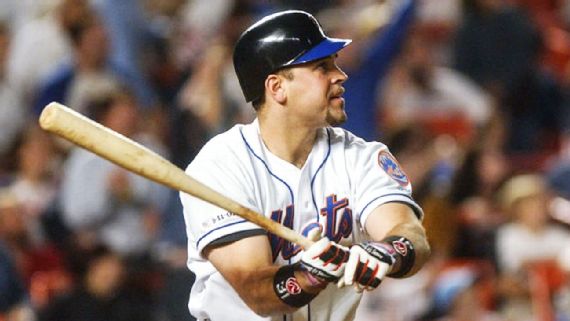
81. Mike Piazza
Team(s): Los Angeles Dodgers (1992-98), Florida Marlins (1998), New York Mets (1998-2005), San Diego Padres (2006), Oakland Athletics (2007)
Stats: .308/.377/.545, 427 HR, 1,335 RBI, 2,127 H, 59.5 bWAR
Primary position: Catcher
What he's best known for: Piazza's career highlight reel always culminates in his indelible, go-ahead homer for the Mets against the Braves in the eighth inning on Sept. 21, 2001 -- the first game played in New York after the 9/11 attacks. He's also known for where he began: Piazza was a 62nd-round draft pick by the Dodgers in 1988, and was picked there only after some cajoling by family friend Tommy Lasorda. -- Bradford Doolittle
80. Robin Yount
Team(s): Milwaukee Brewers (1974-93)
Stats: .285/.342/.430, 251 HR, 3,142 H, 271 SB, 77.3 bWAR
Primary position: Shortstop/center field
What he's best known for: Yount (along with Cal Ripken Jr.) helped revolutionize the shortstop position in the 1980s -- shifting the perception of shortstops as light-hitting defensive wizards into strapping sluggers. In 1982 -- his first MVP season -- he became the first shortstop in more than 20 years to combine a .300-plus batting average with 20 or more home runs and 100 or more RBIs in the same year, paving the way for Alex Rodriguez, Fernando Tatis Jr. and so many others in between. In 1989, Yount won a second MVP -- as a center fielder. -- Alden Gonzalez
79. Hank Greenberg
Team(s): Detroit Tigers (1930, 1933-41, 1945-46), Pittsburgh Pirates (1947)
Stats: .313/.412/.605, 331 HR, 1,274 RBI, 1,628 H, 55.5 bWAR
Primary position: First base
What he's best known for: The first Jewish superstar in the major leagues, Greenberg led the AL four times in home runs and RBIs, challenged Babe Ruth's then-record of 60 home runs when he belted 58 in 1938, won two MVP Awards and holds the AL single-season record with 184 RBIs in 1937. He missed nearly four full seasons due to World War II, cutting into his career totals, and was still an effective hitter when he retired to work in the Cleveland Indians' front office, becoming general manager in 1950. -- David Schoenfield
78. Chipper Jones
Team(s): Atlanta Braves (1993-2012)
Stats: .303/.401/.529, 468 HR, 1,623 RBI, 2,726 H, 85.3 bWAR
Primary position: Third base
What he's best known for: If Mickey Mantle is a no-brainer as the best switch-hitter ever (and he is), then Jones is the leading candidate for the designation among National League hitters. Mantle was the childhood hero of Jones' father, and, as it turned out, Jones, who was part of 12 playoff Atlanta clubs, is as synonymous with the Braves as Mantle was with the Yankees. -- Bradford Doolittle
77. Vladimir Guerrero
Team(s): Montreal Expos (1996-2003), Anaheim/Los Angeles Angels (2004-09), Texas Rangers (2010), Baltimore Orioles (2011)
Stats: .318/.379/.553, 449 HR, 1,496 RBI, 181 SB, 59.5 bWAR
Primary position: Right field
What he's best known for: Guerrero was a legitimate five-tool talent -- someone who could hit for average and power, run well, and change the game defensively. But two distinct characteristics defined him: an absurd throwing arm, capable of throwing out baserunners from warning tracks, and an innate ability to crush pitches way out of the strike zone. Guerrero was a natural, in the truest sense. -- Alden Gonzalez
76. Cap Anson
Team(s): Rockford Forest Citys (1871), Philadelphia Athletics (1872-75), Chicago White Stockings/Colts (1876-97)
Stats: .334/.394/.447, 96 HR, 2,075 RBI, 3,435 H, 94.3 bWAR
Primary position: First base
What he's best known for: The biggest star and dominant personality of 19th century baseball, Anson began his career in the National Association, the first professional league, and joined the Chicago franchise when the National League launched in 1876, also managing the team for 19 seasons. The first player to record 3,000 hits, Anson's lasting legacy, however, is that he refused to play against African American players, helping create the color barrier that existed until 1947. -- David Schoenfield
75. Rod Carew
Team(s): Minnesota Twins (1967-78), California Angels (1979-85)
Stats: .328/.393/.429, 92 HR, 1,015 RBI, 3,053 H, 81.2 bWAR
Primary position: First base/second base
What he's best known for: Carew's bat control was legendary, whether it came to bunting for a base hit or slapping a ball into the opposite field. He won seven AL batting crowns, including one stretch of six out of seven. His run at .400 in 1977 became a national story after he went on a 63-game tear in which he rolled up 110 hits and a .431 average. -- Bradford Doolittle
74. Juan Marichal
Team(s): San Francisco Giants (1960-73), Boston Red Sox (1974), Los Angeles Dodgers (1975)
Stats: 243-142, 2.89 ERA, 2,303 SO, 3,507 IP, 61.8 bWAR
Primary position: Starting pitcher
What he's best known for: His arms swung violently back and forth, propelling a delivery that culminated in a leg kick so high that Marichal's knee would often reach the level of his forehead. From there came an arm motion that was either over the top or three-quarters or sidearm, delivering any one of five different pitches. The quirky mechanics helped Marichal win more games than anybody in the 1960s -- even more than Bob Gibson and Sandy Koufax. -- Alden Gonzalez
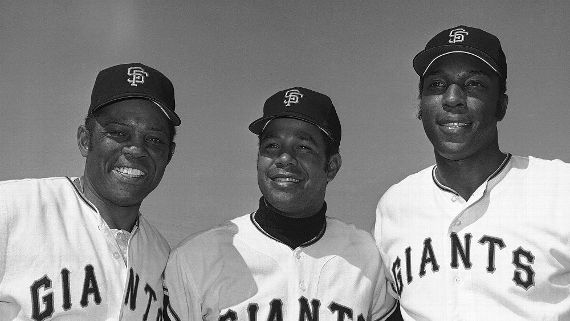
73. Willie McCovey
Team(s): San Francisco Giants (1959-74, 1977-80), San Diego Padres (1974-76), Oakland Athletics (1976)
Stats: .270/.374/.515, 521 HR, 1,555 RBI, 2,211 H, 64.5 bWAR
Primary position: First base
What he's best known for: Power. Big-time power. McCovey still hit 521 home runs despite being platooned early in his career and playing his best years in the windy environs of Candlestick Park in the pitching-dominated 1960s. When the mound was finally lowered in 1969, he hit .304/.448/.634 with 84 home runs over the next two seasons and won MVP honors in 1969. How much did pitchers fear him? Only Barry Bonds has ssurpassed his total of 45 intentional walks in a season. -- David Schoenfield

72. Justin Verlander
Team(s): Detroit Tigers (2005-17), Houston Astros (2017- )
Stats: 226-129, 3.33 ERA, 3,013 SO, 2,988 IP, 71.8 bWAR
Primary position: Starting pitcher
What he's best known for: Verlander's legacy remains a work in progress, but for now we can look at him as a mashup of the traditional notion of a tireless ace and an analytically fueled 21st century pitcher. Before his 2020 injury, Verlander was the perfect combination of durability and dominance, with a cerebral approach and the kind of high-spin, high-velocity stuff that contemporary teams covet. -- Bradford Doolittle

71. Al Kaline
Team(s): Detroit Tigers (1953-74)
Stats: .297/.376/.480, 399 HR, 1,582 RBI, 3,007 H, 92.8 bWAR
Primary position: Right field
What he's best known for: Decorated Tigers scout Ed Katalinas famously said this about Kaline: "To me he was the prospect that a scout creates in his mind and then prays that someone will come along to fit the pattern." Scouts drooled over Kaline as a high schooler. After signing with the Tigers, he bypassed the minor leagues entirely, then led the sport with a .340 batting average and 200 hits as a 20-year-old in 1955. It was just the start. -- Alden Gonzalez
70. Harmon Killebrew
Team(s): Washington Senators/Minnesota Twins (1954-74), Kansas City Royals (1975)
Stats: .256/.376/.509, 573 HR, 1,584 RBI, 2,086 H, 60.4 bWAR
Primary position: First base/third base/left field
What he's best known for: His nickname "Killer" suggests a slugger with a mean streak, but Killebrew was listed at just 6 feet, 195 pounds and was known as one of the nicest players in the game. He did kill baseballs, however, leading the AL six times in home runs, and only Babe Ruth has topped his eight 40-homer seasons. -- David Schoenfield
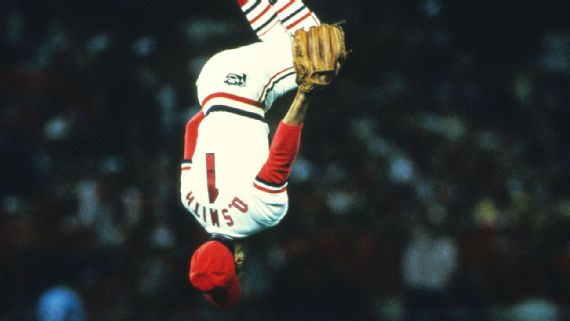
Ozzie Smith was a defensive, ahem, wizard, at shortstop. Ronald C. Modra/Sports Imagery/Getty Images
69. Ozzie Smith
Team(s): San Diego Padres (1978-81), St. Louis Cardinals (1982-96)
Stats: .262/.337/.328, 499 XBH, 2,460 H, 580 SB, 76.9 bWAR
Primary position: Shortstop
What he's best known for: The full-extension snags up the middle. The diving stops in the hole. The way he'd catch a flip, step on second base, leap and throw to first in one motion. And, of course, the backflips. Nobody dazzled in the field like "The Wizard." But his signature move might be lifting a fist to the sky after his home run won Game 5 of the 1985 NLCS. Smith didn't hit many homers, but few have ever been bigger -- or more improbable -- than that one. -- Alden Gonzalez
68. Manny Ramirez
Team(s): Cleveland Indians (1993-2000), Boston Red Sox (2001-08), Los Angeles Dodgers (2008-10), Chicago White Sox (2010), Tampa Bay Rays (2011)
Stats: .312/.411/.585, 555 HR, 1,831 RBI, 2,574 H, 69.3 bWAR
Primary position: Left field/right field
What he's best known for: Hitting baseballs. One of the all-time great right-handed hitters, Ramirez hit .300 11 times, slugged 40 home runs five times and drove in 100 runs 12 times. His 165 RBIs in 1999 are the most in modern baseball outside the 1920s or '30s. His quirky "Manny being Manny" personality was amusing -- until it wasn't, especially when he stained his legacy with two PED suspensions late in his career. -- David Schoenfield
 |
| after Orioles sweep Dodgers 1966 World Series |
67. Brooks Robinson
Team(s): Baltimore Orioles (1955-77)
Stats: .267/.322/.401, 268 HR, 1,357 RBI, 2,848 H, 78.4 bWAR
Primary position: Third base
What he's best known for: Robinson broke in with the Orioles at 18 and retired with the Orioles at 40, never having spent one second with another organization. Yet he is another player who can be summed up with a single highlight reel, one that features his string of miraculous defensive plays in the 1970 World Series. It was no fluke. Robinson might have been better at third base than any other player has ever been at any position. -- Bradford Doolittle

66. Cal Ripken Jr.
Team(s): Baltimore Orioles (1981-2001)
Stats: .276/.340/.447, 431 HR, 1,695 RBI, 3,184 H, 95.9 bWAR
Primary position: Shortstop
What he's best known for: Ripken's hallmark was consistency. And no moment captured that better than when the banners flipped to "2,131" in Camden Yards on Sept. 6, 1995, and Ripken broke Lou Gehrig's consecutive games streak, a record that might live on forever. Play stopped long enough for Ripken to encircle the ballpark and salute the fans, a moment that seemed to signal a resurgence in baseball interest coming off the cancellation of the 1994 World Series. Ripken was that beloved. -- Alden Gonzalez
65. Max Scherzer
Team(s): Arizona Diamondbacks (2008-09), Detroit Tigers (2010-14), Washington Nationals (2015-21), Los Angeles Dodgers (2021), New York Mets (2022-)
Stats: 190-97, 3.16 ERA, 3,020 SO, 2,536 IP, 67.1 bWAR
Primary position: Starting pitcher
What he's best known for: One of the most intense competitors the game has seen, the three-time Cy Young winner is still going strong at 37. His list of achievements speaks to his electrifying stuff: two no-hitters, a record-tying 20-strikeout game, a 300-strikeout season, and the only pitcher besides Nolan Ryan with two nine-inning Game Scores of 100 or better. -- David Schoenfield
64. Eddie Mathews
Team(s): Boston/Milwaukee/Atlanta Braves (1952-66), Houston Astros (1967), Detroit Tigers (1967-68)
Stats: .271/.376/.509, 521 HR, 1,453 RBI, 2,315 H, 96.1 bWAR
Primary position: Third base
What he's best known for: Owner of a left-handed swing that even Ty Cobb called "perfect" -- it was featured on the cover of the first issue of Sports Illustrated in 1954 -- Mathews is perhaps the most underrated great player of his time. He hit for power and drew a ton of walks and ranks behind only Mike Schmidt in career WAR among third basemen. He played in the shadow of Hank Aaron with the Braves, but from 1953 to 1963 he averaged 7.2 WAR per season and was twice an MVP runner-up. -- David Schoenfield
63. David Ortiz
Team(s): Minnesota Twins (1997-2002), Boston Red Sox (2003-2016)
Stats: .286/.380/.552, 541 HR, 1,768 RBI, 2,472 H, 55.3 bWAR
Primary position: Designated hitter
What he's best known for: How often he came through in the postseason. Like the back-to-back walk-off hits in the 2004 ALCS. Or the game-tying grand slam in the 2013 ALCS. Or the speech that inspired a rally in the ensuing World Series. But it was another speech that made Ortiz a legend in Boston -- on April 20, 2013, in the Red Sox's first home game after the Boston Marathon bombings, when he grabbed the mic and declared, "This is our f-ing city." -- Alden Gonzalez
62. Mel Ott
Team(s): New York Giants (1926-47)
Stats: .304/.414/.533, 511 HR, 1,860 RBI, 2,876 H, 110.9 bWAR
Primary position: Right field
What he's best known for: A beloved player, he beat out Babe Ruth, Lou Gehrig, Joe Louis and others in a 1944 vote of war-bond buyers as the most popular sports hero of all time. With a quirky, high-kick batting stance, Ott went straight from playing on a lumber-mill team in Louisiana to the majors at 17. He combined power (with help from the short right-field wall at the Polo Grounds), on-base skills and good defense in right to become the best NL player of the 1930s (only Gehrig had more WAR in the decade). Oddly, he never won an MVP Award, arguably making him the best position player never to win one. -- David Schoenfield
61. Carl Yastrzemski
Team(s): Boston Red Sox (1961-83)
Stats: .285/.379/.462, 452 HR, 1,844 RBI, 3,419 H, 96.5 bWAR
Primary position: Left field/first base
What he's best known for: Following Ted Williams as left fielder for the Red Sox is a tough task, but Yaz was the perfect player to pull it off. His 1967 Triple Crown season (.326, 44 HR, 121 RBIs at the height of a pitching-dominated era) was even greater in context: With Boston locked in a nail-biting, four-team chase for the AL pennant, Yastrzemski hit .523 with 16 RBIs over the last two weeks to drag the Red Sox to their first pennant in 21 years. -- Bradford Doolittle
60. Whitey Ford
Team(s): New York Yankees (1950-67)
Stats: 236-106, 2.75 ERA, 1,956 SO, 3,170 1/3 IP, 53.5 bWAR
Primary position: Starting pitcher
What he's best known for: Ford spent the modern-day equivalent of an entire season in the World Series, accumulating 10 wins, 146 innings and 94 strikeouts. On dominant Yankees teams of the 1950s and '60s, Ford was the clear-cut ace. He earned the nickname "Chairman of the Board" because of his remarkable calmness and helped lead the franchise to five championships. In back-to-back World Series in 1960 and '61 -- a loss to the Pirates, then a win over the Reds -- Ford pitched a combined 32 scoreless innings. -- Alden Gonzalez
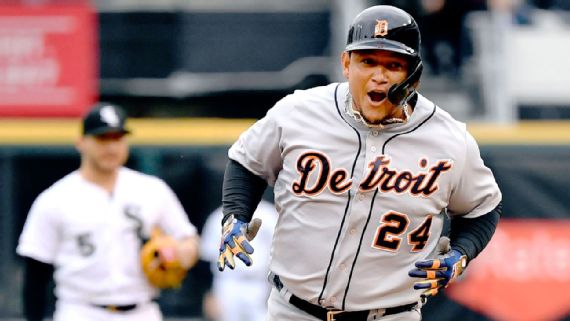
Miguel Cabrera will begin the 2022 season 13 hits shy of 3,000. Quinn Harris/USA TODAY Sports
59. Miguel Cabrera
Team(s): Florida Marlins (2003-2007), Detroit Tigers (2008-)
Stats: .310/.387/.532, 502 HR, 1,804 RBI, 2,987 H, 68.7 bWAR
Primary position: First base/third base
What he's best known for: Few players have ever hit the ball as consistently hard as Cabrera, the only Triple Crown winner of the past 50 years. Even as he has battled age and injuries in recent seasons, his career batting average remains above .300 thanks to four batting crowns and 11 .300 seasons. From 2006 to 2016, he hit .326 while averaging 33 home runs and 115 RBIs. Early in 2022, he'll become just the seventh member of the 500 HR/3,000 hit club -- and he'll have the highest career average of the group. -- David Schoenfield
58. Steve Carlton
Team(s): St. Louis Cardinals (1965-71), Philadelphia Phillies (1972-1986), San Francisco Giants (1986), Chicago White Sox (1986), Cleveland Indians (1987), Minnesota Twins (1987-88)
Stats: 329-244, 3.22 ERA, 4,136 SO, 5,217 2/3 IP, 90.2 bWAR
Primary position: Starting pitcher
What he's best known for: One of the game's greatest and most durable strikeout pitchers, Lefty featured one of history's best sliders. His 1972 season is the ultimate big-fish-in-a-small-pond campaign. Carlton won the NL pitching triple crown that year with a 27-10 record, 1.97 ERA and 310 strikeouts. His team, the Phillies, won just 59 games overall, going 32-87 in non-Carlton decisions. -- Bradford Doolittle
57. Pete Alexander
Team(s): Philadelphia Phillies (1911-17 & 1930), Chicago Cubs (1918-26), St. Louis Cardinals (1926-29)
Stats: 373-208, 2.56 ERA, 2,198 SO, 5,190 IP, 116 bWAR
Primary position: Starting pitcher
What he's best known for: Born as Grover Cleveland Alexander (the name on his Hall of Fame plaque), he was nearly as dominant as Walter Johnson during the tail end of the dead ball era. From 1911 to 1920, he led the National League in wins six times, in ERA five times, in innings seven times and in strikeouts six times. His numbers during that 10-year stretch were absurd: 235 wins, 3,116⅓ innings, 275 complete games and a 2.06 ERA. -- Alden Gonzalez
56. Dave Winfield
Team(s): San Diego Padres (1973-1980), New York Yankees (1981-90), California Angels (1990-91), Toronto Blue Jays (1992), Minnesota Twins (1993-94), Cleveland Indians (1995)
Stats: .283/.353/.475, 465 HR, 1,833 RBI, 3,110 H, 64.2 bWAR
Primary position: Right field
What he's best known for: Besides his battles with George Steinbrenner and getting arrested for killing a seagull, the towering 6-6 Winfield was drafted in three different pro sports -- baseball, basketball and football -- and four different leagues -- MLB, the NBA, the ABA and the NFL. His choice worked out: He was one of the biggest names in the game during his 22-season career, making 12 straight All-Star teams from 1977 to 1988. With his size and line-drive stroke he instilled fear in third basemen around the league, lashing more than 3,000 career hits. A two-way star at the University of Minnesota, he also had a powerful throwing arm that helped him win seven Gold Gloves. -- David Schoenfield

55. Reggie Jackson
Team(s): Oakland Athletics (1967-1975, 1987), Baltimore Orioles (1976), New York Yankees (1977-1981), California Angels (1982-86)
Stats: .262/.356/.490, 563 HR, 1,702 RBI, 2,584 H, 73.9 bWAR
Primary position: Right field
What he's best known for: Mr. October was among the iconic athletes of his time, whether it was for his light-tower home runs, his penchant for self-promotion ("the straw that stirs the drink"), the candy bar that bore his name or his presence on the Bronx Zoo New York Yankees. His performance backed up the hype, especially when it mattered most. His pinnacle came in Game 6 of the 1977 World Series when he homered three times to send broadcaster Howard Cosell into a tizzy and lift the Yankees to their first title in 15 years. -- Bradford Doolittle
54. Lefty Grove
Team(s): Philadelphia Athletics (1925-33), Boston Red Sox (1934-41)
Stats: 300-141, 3.06 ERA, 2,266 SO, 3,940 2/3 IP, 113.3 bWAR
Primary position: Starting pitcher
What he's best known for: Grove beat out Lou Gehrig for the AL MVP Award in 1931, at that time only the third different pitcher to win it. He won 16 consecutive games at one point, claimed his fourth of nine ERA titles, paced the AL in strikeouts for the seventh consecutive year and led the A's to their third straight World Series appearance. -- Alden Gonzalez
53. Oscar Charleston
Team(s): Negro Leagues (1915-41, Indianapolis ABCs, Harrisburg Giants, Homestead Grays, Pittsburgh Crawfords, others)
Stats: .364/.449/.615, 143 HR, 853 RBI, 1,207 H, 48.3 bWAR
Primary position: Center field/first base
What he's best known for: Buck O'Neil was among those who proclaimed Charleston the best player he ever saw, describing him as a combination of Babe Ruth, Tris Speaker and Ty Cobb. Yet what Charleston might be best remembered for is ... not being remembered, at least not to the extent that he should be. No player may have combined elite power and elite speed at Charleston's level, and on top of all that, his fierce competitiveness was the stuff of legend. -- Bradford Doolittle
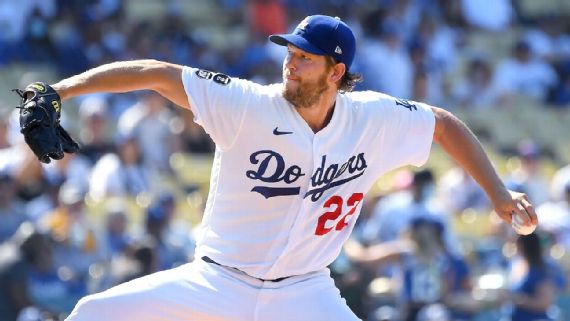
52. Clayton Kershaw
Team(s): Los Angeles Dodgers (2008- )
Stats: 185-84, 2.49 ERA, 2,670 SO, 2,454 IP, 71.9 bWAR
Primary position: Starting pitcher
What he's best known for: That herky-jerky windup, that fastball command, that wipeout slider, that big curveball, those heartbreaking defeats in the postseason -- and one of the greatest peaks any pitcher has enjoyed. From 2011 to 2017, Kershaw went 118-41 with a 2.10 ERA, winning three Cy Young Awards and five ERA titles. He's the Dodgers' all-time leader in WAR (including Brooklyn) and his adjusted ERA+ of 155 is the best for any pitcher with 2,000 career innings. Let's hope his Dodgers timeline extends beyond 2021. -- David Schoenfield

51. Ernie Banks
Stats: .274/.330/.500, 512 HR, 1,636 RBI, 2,583, 67.7 bWAR
Primary position: Shortstop/first base
What he's best known for: Banks' hitting redefined how we saw the shortstop position. The first Black player in Cubs history, Mr. Cub enjoyed a love affair with Chicago fans that lasted more than six decades, all the way to his death in 2015. For all Banks did on the field, his legacy might best be summed up as an attitude, exemplified by one legendary mantra: "What a great day for baseball. Let's play two." -- Bradford Doolittle
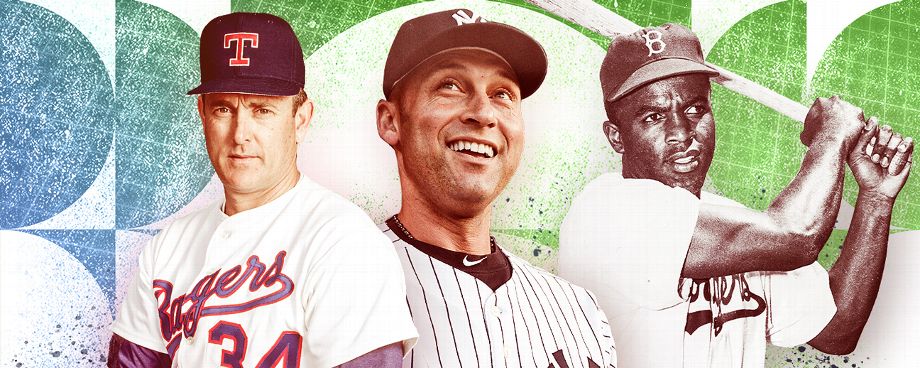
Top 100 MLB players of all time: Nos. 50-26
Legendary teammates -- and rivals -- highlight the next 25 stars unveiled on our all-time MLB Top 100 list.
Today we crack the top half of our ranking with Nos. 50-26. On Tuesday, we presented the first half of our list and we'll finish with the top 25 on Thursday (see full methodology here).
Are the leaders of the Big Red Machine in the right order? Would you take Derek Jeter or Alex Rodriguez? Who's too high or too low? Let the debate continue!
The List: 100-51 | 50-26 | 25-1
Key links: Full rankings | Snubs | Debating our selections
50. Bob Feller
Team(s): Cleveland Indians (1936 to 1941, 1945 to 1956)
Stats: 266-162, 3.25 ERA, 2,581 SO, 3,827 IP, 65.2 bWAR
Primary position: Starting pitcher
What he's best known for: Feller was probably the most dominant pitcher of his era, the speed of his fastball the stuff of legend -- and yet it's hard not to think about how much better he could have been had he not spent four years serving in World War II. Feller was a phenom who bypassed the minor leagues and debuted at 17. From 1939 to 1941, his ages 20 to 22 seasons, he won 76 games, accumulated 960 innings, posted a 2.88 ERA and finished within the top three in MVP voting all three years. In late 1941, he became one of the first American professional athletes to enlist, joining the U.S. Navy just two days after the bombing of Pearl Harbor. After serving in active combat, he returned to baseball in 1945 to continue his Hall of Fame career. -- Alden Gonzalez
49. Frank Thomas
Team(s): Chicago White Sox (1990-2005), Oakland Athletics (2006, 2008), Toronto Blue Jays (2007-08)
Stats: .301/.419/.555, 521 HR, 1,704 RBI, 2,468 H, 73.8 bWAR
Primary position: First base/designated hitter
What he's best known for: The Big Hurt combined the artistry of a singles hitter in the body of a tight end (a position he played at Auburn before switching to baseball full time) with the plate discipline of Ted Williams, making him one of the game's great all-around hitters. Thomas was a star the moment he reached the majors, leading the AL in OPS his first two full seasons and hitting over .300 his first eight seasons -- a remarkable .330/.452/.600 line from 1990 to 1997, with two MVP Awards along the way. He had more walks than strikeouts in his career, and his 1.217 OPS in 1994 is the third-highest since World War II from somebody not named Barry Bonds. The Big Hurt? Indeed. -- David Schoenfield
48. Nap Lajoie
Team(s): Philadelphia Phillies (1896-1900), Philadelphia Athletics (1901-02, 1915-16), Cleveland Naps (1902-1914)
Slash line: .338/.380/.466, 82 HR, 1,599 RBI, 3,243 H, 106.9 bWAR
Primary position: Second base
What he's best known for: The fiercely competitive Lajoie was the American League's first great hitter. An established star when he jumped from the Phillies to the Athletics for the junior circuit's inaugural season, Lajoie hit .426 that year (1901), still the highest-ever for any MLB hitter during the modern era. Lajoie went on to win multiple batting titles for Cleveland (the exact number of which remains a matter of historical debate), and was so respected that his team adopted the moniker of "Naps." Even opponents loved him: Legend has it the St. Louis Browns played so far back against Lajoie during a season-ending doubleheader in 1910 that Nap dropped down seven bunt hits, aiding his successful attempt to edge bitter rival Ty Cobb for the batting crown. -- Bradford Doolittle
47. Warren Spahn
Team(s): Boston/Milwaukee Braves (1942, 1946 to 1964), New York Mets (1965), San Francisco Giants (1965)
Stats: 363-245, 3.09 ERA, 2,583 SO, 5,243 2/3 IP, 92.4 bWAR
Primary position: Starting pitcher
What he's best known for: Only five pitchers have won more games than Spahn, and none of them threw a pitch after 1930. You can make the case that no pitcher was more productive or more durable during the live-ball era, and this one nugget would be enough: In 1963, his age-42 season, Spahn went 23-7 with a 2.60 ERA in 259 2/3 innings and led the league in complete games. It was his seventh consecutive time leading the league in complete games, and the end of a span of eight consecutive years in which he threw at least 250 innings and won at least 18 games. His ERA in that stretch, which should have marked the decline phase for what had already been an illustrious career: 2.96, sixth-lowest in the sport. -- Alden Gonzalez
46. Ichiro Suzuki
Team(s): Seattle Mariners (2001 to 2012, 2018-19), New York Yankees (2012 to 2014), Miami Marlins (2015 to 2017)
Stats: .311/.355/.402, 117 HR, 780 RBI, 3,089 H, 60.0 bWAR
Primary position: Right field
What he's best known for: The iconic Ichiro -- first name only required -- was the first position player from Japan to play in the majors and his unique style of hitting seemed straight out of the dead-ball era instead of the steroids era. Remarkably durable (he averaged 159 games his first 12 seasons), he lined, blooped, slapped and outraced more than 200 hits in each of his first 10 seasons, including an all-time record 262 in 2004. Despite not coming to the Mariners until he was 27, he still reached 3,000 hits -- 4,367 when you include his Japanese career. In an era of power hitters, he was one of a kind: Who else has a YouTube video showing nothing but his infield hits? -- David Schoenfield
45. Wade Boggs
Team(s): Boston Red Sox (1982 to 1992), New York Yankees (1993 to 1997), Tampa Bay Devil Rays (1998-99)
Slash line: .328/.415/.443, 118 HR, 1,014 RBI, 3,010 H, 91.4 bWAR
What he's best known for: The easiest way to sum up Boggs' legacy is "batting average" -- and all the things that go into having a lofty one. He was disciplined (.415 career OBP), rarely struck out, almost never popped up, took almost every first pitch. After Boggs' age-30 season, he had a career average of .356 and had won five batting titles over his first seven big league seasons. He was obsessive about routine which manifested in both work habits and superstitions. On the latter, Boggs may be best remembered for eating chicken before every game. When "Chicken Man" won a World Series title with the Yankees in 1996, he famously rode a police horse around Yankee Stadium. Ironically, despite Boggs' career-long mania for base hits and batting average, in 1999 he became the first player to reach the 3,000-hit milestone by hitting a home run. -- Bradford Doolittle
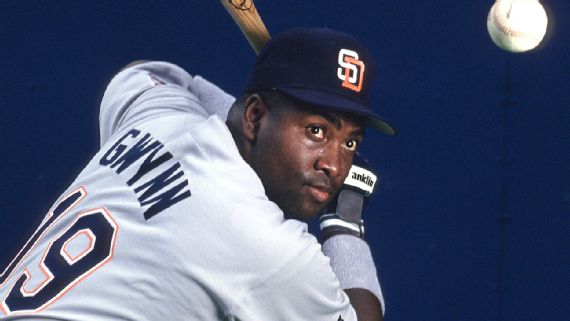
44. Tony Gwynn
Team(s): San Diego Padres (1982 to 2001)
Stats: .338/.388/.459, 763 XBH, 3,141 H, 319 SB, 69.2 bWAR
Primary position: Right field
What he's best known for: Gwynn was a magician with the bat. He could seemingly place the ball wherever he pleased, most notably in the "5.5 hole" between the opposing third baseman and shortstop. Watching Gwynn hit -- with his crouched stance and his light bat -- was among the greatest baseball experiences of the 1980s and '90s. Three numbers that most stick out: Gwynn played in 2,440 games and struck out three times only once. He compiled 541 plate appearances against 18 Hall of Fame pitchers and batted .331/.371/.426. Against Greg Maddux, the man he faced more than any other, he hit .415. -- Alden Gonzalez

43. George Brett
Team(s): Kansas City Royals (1973 to 1993)
Stats: .305/.369/.487, 317 HR, 1,596 RBI, 3,154 H, 88.6 bWAR
Primary position: Third base
What he's best known for: Brett's run at a .400 batting average in 1980 captivated the sports world and established him as one of his generation's iconic ballplayers and ultimate big-game performers. Brett's frenetic, hair-on-fire playing style merged that year with a picture-perfect swing that was largely attributed to his early career collaboration with famed hitting coach Charlie Lau. The result was perhaps the most amazing prolonged hot streak a hitter has ever had. From his return from injury on July 10 through the end of the 1980 season, Brett hit .424, finishing at .390 overall, and was at .400 as late as Sept. 19. That campaign resulted in one of his three career batting crowns, each in a different decade, and his only MVP trophy. Three years later, Brett's furious charge from the dugout in the infamous Pine Tar Game would become iconic. -- Bradford Doolittle

42. Nolan Ryan
Team(s): New York Mets (1966 to 1971), California Angels (1972 to 1979), Houston Astros (1980 to 1988), Texas Rangers (1989 to 1993)
Stats: 324-292, 3.19 ERA, 5,714 SO, 5,386 IP, 81.3 bWAR
What he's best known for: Ryan was to pitchers what his home state -- Texas -- is to America: Everything seems a little bit bigger than life. Ryan was long recognized by the Guinness Book of World Records as baseball's fastest pitcher, but that's just the tip of his iceberg. He did throw as hard as anybody, but he did it from 1966 to 1993. He is the all-time leader in strikeouts, but also walks. He has the lowest rate of hits allowed per nine innings in history, but also ranks second in wild pitches. He won 324 games, but lost 292. He threw a record seven no-hitters, the last nearly 18 years after the first. Simply put, there has never been anyone else quite like the Ryan Express. -- Bradford Doolittle
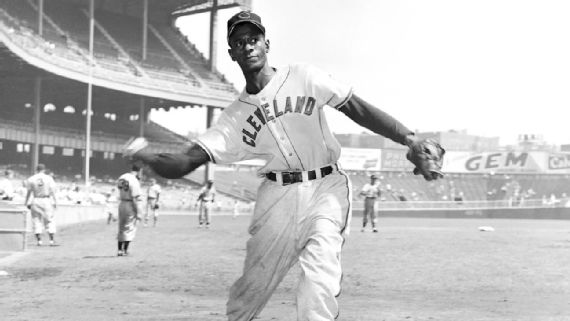
41. Satchel Paige
Team(s): Negro Leagues (1927 to 1947, Birmingham Black Barons, Cleveland Cubs, Pittsburgh Crawfords, Kansas City Monarchs, others), Cleveland Indians (1948-49), St. Louis Browns (1951-53), Kansas City Athletics (1965)
Stats (Negro Leagues and Major Leagues combined): 118-80, 2.70 ERA, 1,438 SO, 1,695 IP, 46.6 bWAR
Primary position: Starting pitcher
What he's best known for: Paige's major league debut came two days after his 42nd birthday. Before that, he spent more than 20 years dazzling in the Negro Leagues. And through that, he established himself as something of a baseball mercenary, leveraging his talent while barnstorming in Cuba, the Dominican Republic, Mexico, Puerto Rico and throughout the continental United States, from Birmingham to Cleveland to Pittsburgh to Kansas City. He established himself with a blistering fastball but later expanded his repertoire to throw practically everything -- from a variety of angles and in a variety of tempos. He was also a showman, famously commanding his infielders to sit down before striking out hitters. -- Alden Gonzalez
40. Jimmie Foxx
Team(s): Philadelphia Athletics (1925 to 1935), Red Sox (1936 to 1942), Cubs (1942 to 1944), Phillies (1945)
Stats: .325/.428/.609, 534 HR, 1,922 RBI, 2646 H, 93.1 bWAR
Primary position: First base
What he's best known for: One of the most menacing hitters in the game's history, Foxx's nickname was, simply, "Beast." And well-earned. He twice hit 50 home runs, including 58 in 1932, but he was no mere slugger, winning two batting titles and the Triple Crown in 1938 (one of his three MVP seasons). At 6 foot, 195 pounds, Foxx wasn't a giant, but he wore his jersey sleeves short to show off the biceps, made strong growing up on a farm in Maryland. As Yankees pitcher Lefty Gomez once said, "Even his hair had muscles." -- David Schoenfield
39. Yogi Berra
Team(s): New York Yankees (1946 to 1965)
Stats: .285/.348/.482, 358 HR, 1,430 RBI, 2,150 H, 59.6 bWAR
Primary position: Catcher
What he's best known for: Quotes, perhaps more than anyone in history. Quotes like, "Baseball is 90% mental. The other half is physical" and "If people don't want to come out to the ballpark, how are you going to stop them?" The persona sometimes overshadowed the player. Make no mistake, Berra is on the short list of greatest backstops, a superstar who was at the center of 10 championship clubs for the Yankees. If not for all those colorful Yogisms, the bad-ball-hitting Berra would be most remembered for a preternatural ability to get good wood on pitches no matter where they were thrown. Six times Berra's home run total equaled or surpassed his strikeout total. Only Joe DiMaggio (seven) had more such seasons. -- Bradford Doolittle
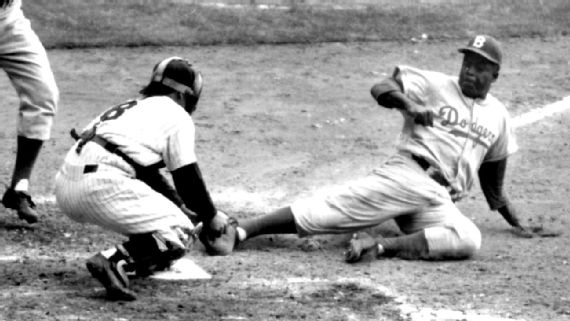
38. Jackie Robinson
Stats (Major Leagues): .311/.409/.474, 464 XBH, 1,518 H, 197 SB, 61.8 bWAR
Primary position: Second base
What he's best known for: Robinson's No. 42 is retired throughout Major League Baseball, his legacy inspiring the sport's most cherished holiday. Seventy-five years ago, Robinson became the first Black man to play in the major leagues, changing the course of baseball -- and America -- forever. Robinson faced intolerance and hatred while breaking baseball's color barrier but handled it with grace. He also performed spectacularly, making six consecutive All-Star teams, winning an MVP Award and bringing a palpable electricity to every field he stepped upon. -- Alden Gonzalez
37. Joe Morgan
Team(s): Houston Colt .45s/Astros (1963 to 1971, 1980), Cincinnati Reds (1972 to 1979), San Francisco Giants (1981-82), Philadelphia Phillies (1983), Oakland Athletics (1984)
Stats: .271/.392/.427, 268 HR, 1,133 RBI, 2517 H, 100.4 bWAR
Primary
position: Second base
What he's best known for: A younger generation may only remember Morgan as the longtime analyst on ESPN's "Sunday Night Baseball" and not even realize he is arguably the greatest second baseman of all time. When the Big Red Machine finally won back-to-back World Series in 1975 and 1976, Morgan was their best player (he was NL MVP both years), not Johnny Bench or Pete Rose. From 1972 through 1976, after coming over from the Astros in the heist of the decade, "Little Joe" (he was 5-foot-7) was about as perfect a ballplayer as you could find: He hit .303/.431/.508 while averaging 60 steals (at a high success rate) and winning five Gold Gloves. He probably should have won the MVP Award all five seasons. -- David Schoenfield
36. Tris Speaker
Team(s): Boston Americans/Red Sox (1907 to 1915), Cleveland Indians (191626), Washington Senators (1927), Philadelphia Athletics (1928)
Stats: .345/.428/.500, 117 HR, 1,531 RBI, 3,514 H, 134.7 bWAR
Primary position: Center field
What he's best known for: The Grey Eagle's prowess in center field marks him as an all-timer with the glove. Only Willie Mays recorded more putouts in center, and Speaker's penchant for playing shallow helped him to a record 448 assists, 173 more than any other center fielder. He's also far and away the leader in double plays at the position, occasionally recording unassisted twin kills at second base because of how close he played to the infield. He was pretty good at the plate, too. Speaker led the AL in doubles seven times and is the all-time leader with 792 two-baggers. -- Bradford Doolittle
35. Josh Gibson
Team(s): Negro Leagues (1930 to 1946, Memphis Red Sox, Pittsburgh Crawfords, Homestead Grays)
Stats (Negro Leagues): .374/.458/.719, 165 HR, 806 H, 725 RBI, 38.6 bWAR
Primary position: Catcher
What he's best known for: They called him "The Black Babe Ruth." Or maybe Ruth was "The White Josh Gibson." Gibson's Hall of Fame plaque states he "hit almost 800 home runs in league and independent baseball during his 17-year career." But the Negro Leagues didn't schedule many league games, allowing players to barnstorm against semi-professional competition in order to earn a little extra money. From 1933 to 1939, Gibson played in just 339 official games, as tabulated by Baseball-Reference. He led his league in home runs in every season of that seven-year stretch and RBIs six times, totaling 105 and 429, respectively. The 162-game average amounts to 50 home runs and 205 RBIs (to go along with a .375/.454/.746 slash line). Ruth's best seven-year stretch, from 1926 to 1932, produced a 162-game average of 55 home runs and 171 RBIs. -- Alden Gonzalez
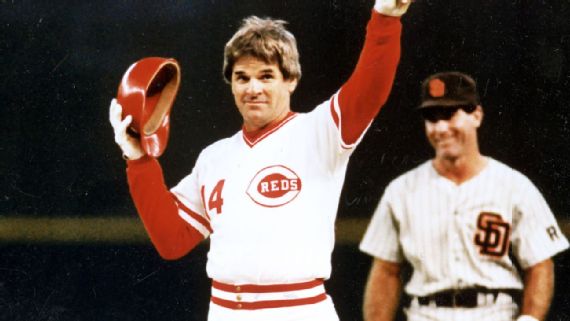
34. Pete Rose
Team(s): Cincinnati Reds (1963 to 1978, 1984 to 1986), Philadelphia Phillies (1979 to 1983), Montreal Expos (1984)
Stats: .303/.375/.409, 160 HR, 1,314 RBI, 4,256 H, 79.6 bWAR
Primary position: He was a regular at five of them! (First base, second base, third base, left field, right field)
What he's best known for: He's the Hit King, he's Charlie Hustle, he's the player who had a 44-game hitting streak and made 17 All-Star teams. He's also the guy who bet on baseball, received a lifetime ban, wrote a book titled "My Prison Without Bars," only to finally come clean. Fans idolized Rose, sportswriters admired him and he was a great player, averaging 5.6 WAR from 1965 to 1976. He played wherever the Reds needed him and played every day (10 seasons with 162 games). He also selfishly hung on way too long to break Ty Cobb's record (playing first base, he hit six home runs in 3,229 at-bats over his final seven seasons). He's overrated, he's underrated, he's beloved, he's despised. -- David Schoenfield
33. Bob Gibson
Team(s): St. Louis Cardinals (1959 to 1975)
Stats: 251-174, 2.91 ERA, 3,117 SO, 3,884 1/3 IP, 89.1 bWAR
Primary position: Starting pitcher
What he's best known for: There may be no athlete more synonymous with fierce competitiveness than Gibson, who once faced three batters after suffering a broken leg. But Gibson was much more than just an intense pitcher. At his best, Gibson was the prototype for what we still think of as a rotation ace. It all came together in 1968, when Gibson posted a 1.12 ERA during the "Year of the Pitcher." That season, Gibson threw 13 shutouts and enjoyed one unfathomable stretch: From June 6 to Sept. 2, Gibson started 18 games, completed 17 of them and went 16-1 with a 0.60 ERA. Yet his greatness was most on display in the World Series. In nine Fall Classic starts, Gibson went 7-2 with eight complete games. -- Bradford Doolittle

32. Sandy Koufax
Team(s): Brooklyn/Los Angeles Dodgers (1955 to 1966)
Stats: 165-87, 2.76 ERA, 2,396 SO, 2,324 1/3 IP, 53.1 bWAR
Primary position: Starting pitcher
What he's best known for: Six years. That's all it took for Koufax to establish himself as one of the greatest pitchers in history. From 1961 to 1966, Koufax won three Cy Young Awards unanimously -- back when there was only one award for the entire sport -- and an MVP, while accumulating 129 wins, a 2.19 ERA and 1,713 strikeouts in 1,632 2/3 innings. Hall of Famer Willie Stargell once compared hitting against Koufax to "drinking coffee with a fork." He boasted a big fastball and a devastating curveball and retired with more strikeouts than innings pitched. But that retirement came abruptly, after a brilliant season in 1966, when Koufax was still just 30 years old and chronic arthritis in his left elbow finally became too much to bear. -- Alden Gonzalez
31. Mariano Rivera
Team(s): New York Yankees (1995 to 2013)
Stats: 82-60, 2.21 ERA, 652 saves, 1,173 SO, 1283 IP, 56.3 bWAR
Primary position: Closer
What he's best known for: The greatest reliever of all time -- and, unlike every other position, there isn't even a debate. Throwing his famous cut fastball over and over and over, a pitch that suddenly appeared one day in 1997 when Rivera was playing catch, Rivera single-handedly kept Louisville Slugger in business with all the broken bats he induced. "The Lord gave it to me," Rivera once said. He didn't even change his grip. The ball just started moving. He had 11 seasons with a sub-2.00 ERA and a this-can't-be-real 0.70 ERA in 141 postseason innings. The most respected player of his generation, in 2019 he became the first player elected unanimously to the Hall of Fame. -- David Schoenfield
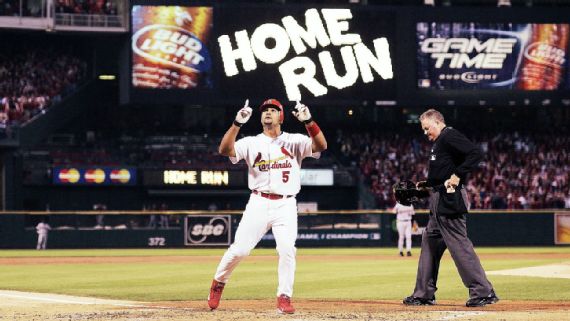
30. Albert Pujols
Team(s): St. Louis Cardinals (2001 to 2011), Los Angeles Angels (2012 to 2021), Los Angeles Dodgers (2021)
Stats: .297/.375/.544, 679 HR, 2,150 RBI, 3,301 H, 99.6 bWAR
Primary position: First base
What he's best known for: The first half of Pujols' career was defined by almost metronomic greatness. In each of his first 11 seasons, Pujols hit at least .299 with 30 homers, 99 RBIs and 99 runs scored and won three NL MVP Awards. He also provided one of the signature moments of the 2000s when he hit a moonshot off Houston's Brad Lidge with the Cardinals down by two runs with two outs and two runners on in a 2005 NLCS elimination game. A 13th-round draft pick out of a Kansas City-area junior college, Pujols was so consistently dominant that he became known simply as "The Machine." -- Bradford Doolittle

29. Johnny Bench
Team(s): Cincinnati Reds (1967 to 1983)
Stats: .267/.342/.476, 389 HR, 1,376 RBI, 2,048 H, 75.1 bWAR
Primary position: Catcher
What he's best known for: A lot has been left up for debate, but not this: Johnny Bench is the greatest catcher in MLB history. He brought uncommon offensive prowess and unquestioned defensive excellence to the sport's most rigorous position, accumulating 10 Gold Glove Awards and twice leading the majors in home runs. "The Big Red Machine" dominated the 1970s, winning two World Series titles and four National League pennants. And Bench was their leader. He made 13 consecutive All-Star teams from 1968 to 1980, and in that stretch he played in more than 140 games nine times. -- Alden Gonzalez
28. Derek Jeter
Team(s): New York Yankees (1995-2014)
Stats: .310/.377/.440, 260 HR, 1,311 RBI, 3,465 H, 71.3 bWAR
Primary position: Shortstop
What he's best known for: The Yankees won the World Series in Jeter's rookie season of 1996 -- the first time they'd been there since 1981 -- and nearly every October for almost two decades after that, we invited Jeter into our living rooms and watched him deliver clutch hits and iconic moments and pump his fist from the top step of the dugout. Yankees fans loved him; non-Yankees fans grew to resent not only his success, but the idolatry directed his way. Jeter seemed only concerned with winning. Overrated or not, you can't deny the five World Series rings. -- David Schoenfield

27. Roberto Clemente
Team(s): Pittsburgh Pirates (1955 to 1972)
Stats: .317/.359/.475, 240 HR, 1,305 RBI, 1,416 R, 94.8 bWAR
Primary position: Right field
What he's best known for: The annual award named after Clemente signifies his legacy, honoring the player who "best exemplifies the game of baseball, sportsmanship, community involvement and the individual's contribution to his team." Clemente will always be remembered for the way his career ended (getting his 3,000th hit on the last day of the 1972 season) and the way he died, in a plane crash on a humanitarian mission to aid victims of an earthquake in Nicaragua. But he will also be remembered simply as a great baseball player, one who won 12 Gold Gloves as perhaps the best defensive right fielder in history. Clemente reached his pinnacle in 1971, when he starred with the glove and at the plate while carrying the Pirates to a World Series win over the Orioles. -- Bradford Doolittle

26. Alex Rodriguez
Team(s): Seattle Mariners (1994 to 2000), Texas Rangers (2001 to 2003), New York Yankees (2004 to 2016)
Stats: .295/.380/.550, 696 HR, 2,086 RBI, 3,115 H, 117.5 bWAR
Primary position: Shortstop/third base
What he's best known for: A-Rod, a No. 1 overall pick at 17, was an incredibly skilled hitter with power who played shortstop gracefully and boasted a cannon for an arm. The numbers and the hardware -- three MVPs, two Gold Gloves, 10 Silver Sluggers -- make his case as one of the greats. When he joined the Yankees in 2004, he moved to third base to accommodate Derek Jeter, going on to win his lone World Series title in 2009. But Rodriguez's career is defined as much for his missteps as it is for his triumphs, most notably a PED-related, season-long suspension in 2014 -- five years after admitting to using steroids early in his career and claiming he never did so again. -- Alden Gonzalez
Top 100 MLB players of all time: Nos. 25-1
Inner-circle Hall of Famers. The best player in the game today. A couple of PED-tainted superstars. Our ranking of the 100 greatest MLB players of all time comes down to the top 25.
Dozens of ESPN writers and editors submitted more than 20,000 votes (see full methodology here) to determine the final order. So who's too high? Too low? Just right?
Let the debate continue!
The List: 100-51 | 50-26 | 25-1
Key links: Full rankings | Snubs | Debating our selections
Doolittle: The difficult case of Oscar Charleston
Olney: Which current stars are destined to join the list?
25. Christy Mathewson
Team(s): New York Giants (1900-16), Cincinnati Reds (1916)
Stats: 373-188, 2.13 ERA, 2,507 SO, 4,788 IP, 106.5 bWAR
Primary position: Starting pitcher
What he's best known for: The most admired star of the first two decades of 20th century baseball, Mathewson's three shutouts in a five-day span in 1905 remains one of the most heroic feats in World Series history. He won 30 games four times, led the NL five times in ERA and strikeouts, and was one of the five original inductees into the Hall of Fame in 1936. Mathewson relied on impeccable control and a pitch he called a "fadeaway," which some say was a screwball while others suggest might have been more like a modern-day circle change. "Matty was master of them all," reads his Hall of Fame plaque. -- David Schoenfield
24. Randy Johnson
Team(s): Montreal Expos (1988-89), Seattle Mariners (1989-1998), Houston Astros (1998), Arizona Diamondbacks (1999-2004, 2007-08), New York Yankees (2005-06), San Francisco Giants (2009)
Stats: 303-166, 3.29 ERA, 4,875 SO, 4,135 1/3 IP, 101.1 bWAR
Primary position: Starting pitcher
What he's best known for: The "Big Unit" was to lefties what Nolan Ryan was to righties. After a slow start to his career, the 6-foot-10 Johnson harnessed his command and was lights out for the next two decades. Of his 303 wins, 293 came after his age-25 season. Johnson won his league strikeout crown nine times, including two different stretches of four straight. During the latter stretch, he won four straight Cy Young Awards, giving him five overall.
Perhaps the best expressions of Johnson's dominance came during a pair of All-Star Game matchups with left-handed stars. In 1993, his wild pitch over the head of John Kruk had Kruk faking heart palpitations as the dugout erupted in laughter; after that, Kruk wouldn't go near the plate, striking out. In 1997, Larry Walker flipped his batting helmet around and switched to the right side of the plate after getting a look at a Johnson pitch. It was all in good fun, but also an indication of how fearsome Johnson looked to anyone who stepped into the batter's box against him. -- Bradford Doolittle
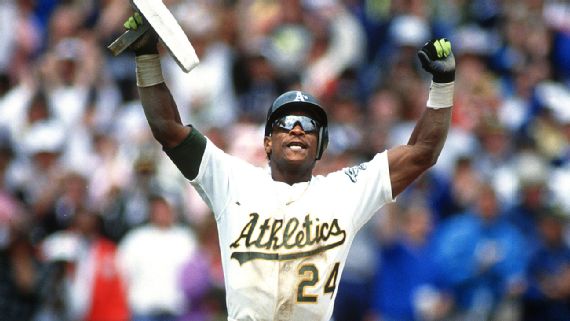
23. Rickey Henderson
Team(s): Oakland Athletics (1979-84, 1989-93, 1994-95, 1998), New York Yankees (1985-89), Toronto Blue Jays (1993), San Diego Padres (1996-97, 2001), Anaheim Angels (1997), New York Mets (1999-2000), Seattle Mariners (2000), Boston Red Sox (2002), Los Angeles Dodgers (2003)
Stats: .279/.401/.419, 297 HR, 3,055 H, 1,406 SB, 111.2 bWAR
Primary position: Left field
What he's best known for: He was loud, brash, defiant, cocky and electric. He was the greatest base stealer in history, the greatest leadoff hitter in history and one of the greatest trash-talkers in history. Henderson stole 50% more bases than the all-time runner-up, Lou Brock. Henderson hit 81 leadoff home runs, and nobody else has hit more than 54. After being traded to the Yankees, he was asked about wearing the same uniform Joe DiMaggio and Mickey Mantle once donned. "I don't care about them," he said. "I never saw DiMaggio and Mantle play. It's Rickey time." It always was. -- Alden Gonzalez
22. Tom Seaver

Team(s): New York Mets (1967-77, 1983), Cincinnati Reds (1977-1982), Chicago White Sox (1984-86), Boston Red Sox (1986)
Stats: 311-205, 2.86 ERA, 3,640 SO, 4,783 IP, 109.9 bWAR
Primary position: Starting pitcher
What he's best known for: The Cy Young-winning ace of the '69 Miracle Mets, Seaver was one of the most beloved athletes in New York sports history. To this day, Mets fans of a certain age still cry in disbelief that the club traded him away. Known for his power pitching -- his drop-and-drive delivery that stained his right knee with dirt was the iconic motion for a generation of pitchers -- Seaver topped 230 innings pitched in 15 seasons. He would add two more Cy Young Awards after 1969, and when elected to the Hall of Fame in 1992, he received 98.8% of the vote -- the highest ever at the time. -- David Schoenfield
21. Cy Young
Team(s): Cleveland Spiders (1890-98), St. Louis Perfectos/Cardinals (1899-1900), Boston Americans/Red Sox (1901-08), Cleveland Naps (1909-11), Boston Rustlers (1911)
Stats: 511-315, 2.63 ERA, 2,803 SO, 7,356 IP, 163.6 bWAR
Primary position: Starting pitcher
What he's best known for: Sixty-six years after Young died, his name has remained omnipresent in big league baseball because of the annual award given in his name to the best pitcher in each league. Denton True Young dominated the last decade of the 19th century and the first decade of the 20th century, putting up numbers that to the modern eye just don't look real. You could fill a book with a list of them, but here's one: Young had 19 seasons in which he completed at least 30 games. The active career leader in that category is Adam Wainwright -- with 27. Yes, the game has transformed since Young's time, but that's exactly why his career record is something that will never be replicated. -- Bradford Doolittle
20. Rogers Hornsby
Team(s): St. Louis Cardinals (1915-26, 1933), New York Giants (1927), Boston Braves (1928), Chicago Cubs (1929-32), St. Louis Browns (1933-37)
Stats: .358/.434/.577, 301 HR, 2,930 H, 1,584 RBI, 127.3 bWAR
Primary position: Second base
What he's best known for: Any conversation around the greatest hitter in baseball history needs to include Hornsby, whose combination of hitting for average and power is legendary. Hornsby boasts the third-highest career batting average, behind only Ty Cobb and Oscar Charleston. He hit over .400 three times, including .424 in 1924. Two years earlier, he combined a .401 batting average with 42 home runs, an accomplishment no player has ever matched. And it took 50 years for someone (Joe Morgan) to break his record for home runs by a second baseman. -- Alden Gonzalez
19. Frank Robinson
Team(s): Cincinnati Reds (1956-1965), Baltimore Orioles (1966-1971), Los Angeles Dodgers (1972), California Angels (1973-74), Cleveland Indians (1974-76)
Stats: .294/.389/.537, 586 HR, 1,812 RBI, 2,943 H, 107.2 bWAR
Primary position: Right field
What he's best known for: A pioneer as the first African American manager in MLB, Robinson was also a two-time MVP, a Triple Crown winner and one of the toughest and fiercest competitors the game has known. "He plays the game the way the great ones played it -- out of pure hate," famed writer Jim Murray wrote. He stood close to the plate, his head hanging over it, daring pitchers to come inside. In his six seasons as leader of the Orioles, they won four pennants and two World Series. What was his impact? Cincinnati, Baltimore and Cleveland all erected Robinson statues outside their stadiums. -- David Schoenfield
18. Mike Schmidt
Team(s): Philadelphia Phillies (1972-1989)
Stats: .267/.380/.527, 548 HR, 1,595 RBI, 2,234 H, 106.9 bWAR
Primary position: Third base
What he's best known for: Schmidt was an ideal third baseman. Power bat, elite reflexes in the field and a strong throwing arm. No one combined these traits better or longer at the hot corner than Schmidt did during a career of near uniform excellence. Schmidt wasn't quite a three-true-outcomes player, as he did have seasons with solid batting averages, but he did put up prodigious numbers in homers (seven times leading the NL), walks (four times in the lead) and strikeouts (also four times in the lead). Tack on 10 Gold Glove awards and you have what Schmidt became: the greatest Phillie of them all. -- Bradford Doolittle
17. Roger Clemens
Team(s): Boston Red Sox (1984-96), Toronto Blue Jays (1997-98), New York Yankees (1999-2003, 2007), Houston Astros (2004-06)
Stats: 354-184, 3.12 ERA, 4,672 SO, 4,916 2/3 IP, 138.7 bWAR
Primary position: Starting pitcher
What he's best known for: Rocket was on a Hall of Fame track in Boston even before signing with Toronto and winning back-to-back Cy Young Awards. He then helped lead the Yankees to four World Series appearances in five years and won another Cy Young -- his record seventh -- as a 41-year-old anchoring the Astros' rotation in 2004. However, Clemens' inclusion in the Mitchell report, which alleged steroid use in the late stages of his career, kept him from Hall of Fame election by the BBWAA. -- Alden Gonzalez
16. Joe DiMaggio
Team(s): New York Yankees (1936-51)
Stats: .325/.398/.579, 361 HR, 1,537 RBI, 2,214 H, 79.2 bWAR
Primary position: Center field
What he's best known for: After Babe Ruth retired, DiMaggio became the icon of the Yankees. Since they won more often than they did even with Ruth, it meant he became an American icon in an era when baseball ruled the sports pages. He hit in 56 straight games, arguably baseball's most famous record. He played in 10 World Series in his 13 seasons -- and the Yankees won nine of them. Hemingway mentioned him ("I would like to take the great DiMaggio fishing," the old man said. "They say his father was a fisherman."). Songs were written in his tribute. He married Marilyn Monroe. "Baseball isn't statistics; it's Joe DiMaggio rounding second base," one scribe supposedly said. -- David Schoenfield
15. Mike Trout
Team(s): Los Angeles Angels (2011- )
Stats: .305/.419/.583, 310 HR, 816 RBI, 1,419 H, 76.1 bWAR
Primary position: Center field
What he's best known for: Trout turned 30 during the 2021 season, so the text on his eventual Hall of Fame plaque is yet to be composed. Few players have ever burst onto the big league scene with more splendor. Twenty-four players were selected before Trout in the 2009 draft, but three years later, the product of Millville, New Jersey, recorded perhaps the best rookie season of all time. His 10.5 bWAR that year (2012) is the record for a position player. He already has won three MVP trophies and finished in the top five of MVP balloting for nine straight years, a streak that ended last season because of injury. Injuries and being on a franchise that has kept him out of the October limelight seem to be the only things standing in the way of Trout entering the greatest-of-all-time discussion. -- Bradford Doolittle
14. Greg Maddux
Team(s): Chicago Cubs (1986-92, 2004-06), Atlanta Braves (1993-2003), Los Angeles Dodgers (2006, 2008), San Diego Padres (2007-08)
Stats: 355-227, 3.16 ERA, 3,371 SO, 5,008 1/3 IP
Primary position: Starting pitcher
What he's best known for: Few things in baseball are more hypnotizing than a GIF of Maddux's two-seamer. Maddux dominated the 1990s with pinpoint control, unrivaled savvy and a devastating arsenal of pitches, all of which traveled slowly but moved forcefully. Maddux won four consecutive Cy Young Awards from 1992 to 1995, while joining John Smoltz and Tom Glavine to form a devastating rotation on dominant Braves teams. He accumulated an NL-best 37 complete games during that stretch. In five of those, he allowed zero runs and threw fewer than 100 pitches. There's a term for that -- it's called a "Maddux." All told, he is the only pitcher to combine 300-plus wins, 3,000-plus strikeouts and fewer than 1,000 walks. -- Alden Gonzalez
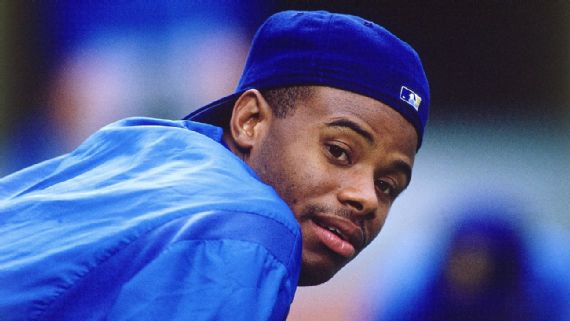
13. Ken Griffey Jr.
Team(s): Seattle Mariners (1989-99, 2009-10), Cincinnati Reds (2000-08), Chicago White Sox (2008)
Stats: .284/.370/.538, 630 HR, 1,836 RBI, 2,781 H, 83.8 bWAR
Primary position: Center field
What he's best known for: He was the face of a generation, the most popular player of the past 30 years. Junior reached the majors at 19, played alongside his dad in the Mariners outfield, wore his cap backward and made imagination-defying leaping grabs at the wall. Mostly, however, he hit home runs with the most beautiful swing you'll ever see. He led his league four times, including back-to-back seasons of 56. We can only imagine that final home run number if he had stayed healthy after leaving Seattle. Some will argue he's too high on this list; don't tell that to kids of the '90s. -- David Schoenfield
12. Honus Wagner
Team(s): Louisville Colonels (1897-99), Pirates (1900-1917)
Stats: .328/.391/.467, 101 HR, 1,732 RBI, 3,420 H, 130.8 bWAR
Primary position: Shortstop
What he's best known for: "The Flying Dutchman" is generally considered to be the best shortstop who ever lived, though his contemporaries usually said he would have been the best in the game at any position except pitcher. If Wagner were a young player today, he would be an odd sight. He was stockily built, with wide shoulders, a barreled chest, bowed legs and huge hands. Yet he did everything well: superb defense, elite average (eight batting titles), elite power (six slugging percentage titles) and was one of the best baserunners ever (723 steals, 252 triples). All that said, Wagner might be best known today for his rare baseball card that recently sold for more than $6 million. -- Bradford Doolittle
11. Pedro Martinez
Team(s): Los Angeles Dodgers (1992-93), Montreal Expos (1994-97), Boston Red Sox (1998-2004), New York Mets (2005-08), Philadelphia Phillies (2009)
Stats: 219-100, 2.93 ERA, 3,154 SO, 2,827 1/3 IP, 86.1 bWAR
Primary position: Starting pitcher
What he's best known for: Martinez was listed, generously, at 5-11, 170 pounds, but he used a big fastball and a hellacious changeup to lead the league in strikeouts three times and in ERA five times. His two best years, 1999 and 2000, came at the height of one of the highest-scoring eras in history. Martinez won the AL Cy Young Award after both those seasons, combining for a 1.90 ERA in 430 1/3 innings. The major league average in that stretch: 4.62. In 2000, he registered a 291 ERA plus -- an adjusted stat accounting for ballparks and era, with the average being 100 -- that stands as the best since at least 1893. -- Alden Gonzalez
10. Stan Musial
Team(s): St. Louis Cardinals (1941-63)
Stats: .331/.417/.559, 475 HR, 1,951 RBI, 3,630 H, 128.7 bWAR
Primary position: Left field/right field/first base
What he's best known for: "He could have hit .300 with a fountain pen," cracked Joe Garagiola. And hitting .300 is what Musial did year after year. He topped the mark in each of his first 17 seasons in the big leagues, winning seven batting titles. His 1948 MVP season (his third MVP award) is one of the best ever: .376/.450/.702, 39 home runs, 18 triples, 46 doubles (that's 103 extra-base hits). He's second all-time in total bases, third in runs created (behind Barry Bonds and Babe Ruth) and in the top 10 in numerous other categories. He hit from an awkward-looking, hunched-over stance, but it worked: He was The Man. -- David Schoenfield
9. Walter Johnson
Team(s): Washington Senators (1907-27)
Stats: 417-279, 2.17 ERA, 3,509 SO, 5,914 1/3 innings, 164.8 bWAR
Primary position: Starting pitcher
What he's best known for: Johnson contemporary Ping Bodie said of Johnson's stuff, "You can't hit what you can't see." It's hard to say there is a consensus about who should own the title of "best pitcher ever." However, it would be impossible to have that discussion without the "Big Train" at the center of it. Estimates of how hard Johnson threw are all over the place, but we can safely say that at the very least, for his time he was off the charts. To the velocity, you can add a side-whipping, almost underhand arm slot, and hitters of his time had no chance. Today's hitters might not fare much better against peak Johnson. The numbers he compiled are staggering. Of them, perhaps the most illustrative of Johnson's dominance is his 110 shutouts -- 20 more than any other pitcher. -- Bradford Doolittle

8. Barry Bonds
Team(s): Pittsburgh Pirates (1986-92), San Francisco Giants (1993-2007)
Stats: .298/.444/.607, 762 HR, 2,935 H, 2,558 BB, 162.7 bWAR
Primary position: Left field
What he's best known for: There might not be a more polarizing figure in baseball's modern era than Barry Lamar Bonds. He was a five-tool, Hall of Fame-caliber outfielder even before his neck widened and his numbers inflated, posting a .981 OPS while averaging 33 home runs and 34 stolen bases on the way to three MVPs from 1987 to 1998. Then Bonds became superhuman after allegedly starting to use PEDs. He broke the single-season home run record, passed Hank Aaron to become baseball's new home run king and put up these numbers from 2001 through 2004, his ages 36 to 39 seasons: 1.368 OPS (292 points higher than the runner-up), 209 home runs (17 more than the runner-up), 755 walks (307 more than the runner-up). -- Alden Gonzalez
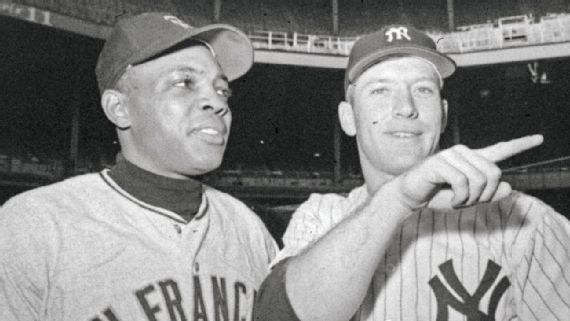
7. Mickey Mantle
Team(s): New York Yankees (1951-68)
Stats: .298/.421/.557, 536 HR, 1,509 RBI, 2415 H, 110.2 bWAR
Primary position: Center field
What he's best known for: He was the center of the baseball universe, back when New York ruled the baseball world and the Yankees ruled baseball. He combined breathtaking raw power from both sides of the plate -- did he really hit a 565-foot home run? -- with blazing speed, at least until his knees went bad. He won a Triple Crown in 1956 and won three MVP awards -- and frankly could have won a few more (he led the AL nine times in offensive WAR). He hit 18 home runs in the World Series. Let's see somebody break that record. Asked if he went up to the plate trying to hit home runs, Mantle said, "Sure, every time." -- David Schoenfield
6. Lou Gehrig
Stats: .340/.447/.632, 493 HR, 1,995 RBI, 2,721 H, 113.7 bWAR
Primary position: First base
What he's best known for: Society remembers Gehrig for the disease that took his life and bears his name, and for the courage he displayed when facing it. From a strictly baseball standpoint, the "Iron Horse" is remembered as a constant, a player who showed up every day and produced at a level few have. His legendary consecutive-games streak of 2,130 is his most-cited statistic and is the number responsible for turning the name of poor Wally Pipp, Gehrig's predecessor with the Yankees, into a verb. The yin to Babe Ruth's yang, Gehrig was perhaps baseball's best RBI man. His 1,995 ribbies rank seventh all-time despite the abrupt end to his career. -- Bradford Doolittle
5. Ted Williams
Team(s): Boston Red Sox (1939-42, 1946-60)
Stats: .344/.482/.634, 521 HR, 1,839 RBI, 2,654 H, 122.1 bWAR
Primary position: Left field
What he's best known for: Williams was probably the greatest hitter who ever lived, largely because of the astronomical numbers he put up but also because of how he revolutionized the approach to hitting. His book, "The Science of Hitting," came out in 1970 and is still referenced frequently today, preaching modern-day concepts such as swinging with a slight uppercut, letting the hips lead and focusing on the parts of the strike zone where hitters can do the most damage. Williams boasts the highest on-base percentage in baseball history and is the last hitter to reach a .400 batting average. At ages 39 and 40, in 1957 and '58, he won the AL batting title. And his career totals could have been even higher had he not missed three prime seasons to serve in World War II. -- Alden Gonzalez
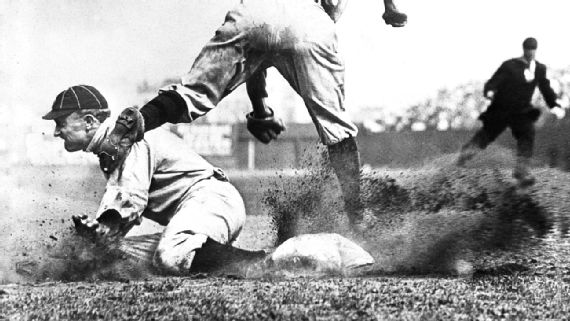
4. Ty Cobb
Team(s): Detroit Tigers (1905-26), Philadelphia Athletics (1927-28)
Stats: .366/.433/.512, 117 HR, 1,944 RBI, 4,189 H, 151.5 bWAR
Primary position: Center field
What he's best known for: In an era when batting average reigned supreme, Cobb was the greatest of 'em all: He won a record 12 batting titles, hit .400 three times and finished with the highest lifetime average in MLB history. He played a game where you had to outthink the opponent, not outslug. Nearly 100 years since he played his final game, the image of Cobb remains vivid: the sharpened spikes, the aggression, the fiery temperament. Through the years, it became difficult to separate fact from fiction. "They were all against me," Cobb wrote in his autobiography. "But I beat the bastards down and left them in the ditch." Babe Ruth put it this way: "Cobb is a p---k. But he sure can hit. God Almighty, that man can hit." -- David Schoenfield
3. Hank Aaron

Team(s): Negro Leagues (1951, Indianapolis Clowns), Milwaukee/Atlanta Braves (1954-74), Milwaukee Brewers (1975-76)
Stats: .305/.374/.555, 755 HR, 2,297 RBI, 3,771 H, 143.1 bWAR
Primary position: Right field
What he's best known for: 7-5-5. Even today, if you ask a lifelong baseball fan how many homers Aaron hit, they'll probably be able to tell you. You ask how many Barry Bonds hit, and they might have to whip out their smartphone. When Aaron's pursuit of Babe Ruth's career homer record culminated in No. 715 on April 8, 1974, it was an iconic event in American history. And yet, Aaron was not really a home run hitter. He was a great hitter, period, as evidenced by his .305 lifetime average and 3,771 hits. Aaron's 2,297 RBIs remain the career record, one that is probably safe for a long time to come. When Aaron died just over a year ago, he was even more lauded for his presence off the field. And few did more on the field than Henry Aaron. -- Bradford Doolittle

2. Willie Mays
Team(s): Negro Leagues (1948, Birmingham Black Barons), New York/San Francisco Giants (1951-52, 1954-72), New York Mets (1972-73)
Stats: .301/.384/.557, 660 HR, 1,909 RBI, 3,293 H, 156.1 bWAR
Primary position: Center field
What he's best known for: For playing a shallow center field at a cavernous Polo Grounds, sprinting toward the center-field fence and making an improbable over-the-shoulder basket catch at the warning track with the score tied late in Game 1 of the 1954 World Series. It's a play known simply as "The Catch," and it epitomized Mays -- the athleticism, the grace, the ingenuity. Mays went on to win 12 Gold Gloves, but he was also an elite hitter, averaging 40 home runs per season from 1954 through 1966. And he ran with the best of them, leading the majors in stolen bases for four straight years from 1956 to 1959. His unmatched collection of skills made him the greatest center fielder who ever lived. -- Alden Gonzalez

1. Babe Ruth
Team(s): Boston Red Sox (1914-19), New York Yankees (1920-34), Boston Braves (1935)
Stats:
As a hitter: .342/.474/.690, 714 HR, 2,214 RBI, 2873 H, 162.7 bWAR
As a pitcher: 94-46, 2.28 ERA, 488 SO, 1,221 IP, 20.4 bWAR
Primary position: Right field/left field
What he's best known for: Home runs. The baseball we watch today is Babe Ruth's game. Many players make an impact, a few become folk heroes, but nobody changed a sport like Ruth did when he joined the Yankees and transformed baseball into a game of power. No player dominated his era like Ruth. He led his league in home runs 12 times, often out-homering entire teams, and 13 times in slugging and OPS. He slugged .690 ... for his career. He slugged .744 in 41 World Series games. He won all three of his World Series starts as a pitcher, one of them 14 innings. He called his shot. Or maybe he didn't. Does it matter? -- David Schoenfield
+++++++++++++++++++++++++++++++++++++++++++++++++++++++++++++++++++++++
+++++++++++++++++++++++++++++++++++++++++++++++++++++++++++++++++++++++
+++++++++++++++++++++++++++++++++++++++++++++++++++++++++++++++++++++++


No comments:
Post a Comment