
Sometimes to get a quick post that's already set up, it's important to pull from the draft archive that currently contains 640 posts in various states of completion.
Pulling from the archive also helps to cycle the draft posts.
I am not sure if I set up this one in 2016 when it was published or discovered it later, but it's likely that it has been sitting in draft form for nine years.
That's all today because lots of homework, work-work, going to the SUPERMAN movie tomorrow, and have to do a hard thing on Friday.
Thanks for tuning in.
How predicting Shakespeare’s writing could improve our understanding of natural language
March 1, 2016

Google used the writings of 1,000 authors to train a deep neural network to predict writing patterns (credit: Martin Droeshout/Wikimedia Commons)
A Google natural language understanding research group led by Ray Kurzweil is building software systems that can understand natural language at a human level. The goal is to understand and interpret meanings of spoken or written language.
One key to achieving that understanding is establishing context, suggest researchers Chris Tar; Marc Pickett, PhD.; and Brian Strope, PhD., on the Google Research Blog.
For example, take the phrase, “Great, ice cream for dinner!” If a six-year-old says it, it means something very different than if a parent says it, they point out.
That is, knowing the characteristics of the speaker (or writer) can narrow down the set of possible meanings of a phrase.
Similarly, the researchers suggested, a deep neural network (DNN) that takes into account the specific author’s style and “personality” should be able to predict (with higher accuracy than with a random guess) the next sentence an author would be likely to write in a book.
To test that idea, the researchers imported the text of 1,000 different authors from the Project Gutenberg website.
“The information our system derived is presumably representative of the author’s word choice, thinking, and style,” say the researchers. “We call these “Author vectors.’”
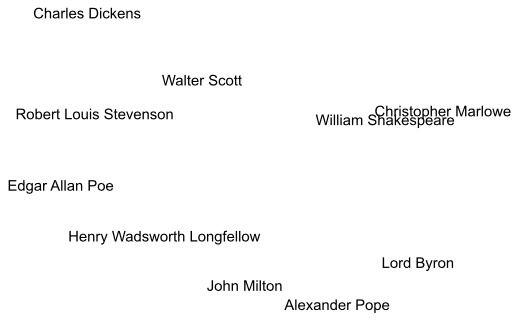
A section of a representation of “Author vectors” for some of the authors in the study. Note that contemporaries and influencers tend to be near each other (e.g., Marlowe and Shakespeare vs. Milton and Pope). It uses the t-SNE algorithm. (credit: Google/Christopher Olah)
Essentially, the system is saying, “I’ve been told that this is Shakespeare, who tends to write like this, so I’ll take that into account when weighing which sentence is more likely to follow.” In effect, one can chat with a statistical representation of text written by Shakespeare, the researchers note.
(Or in the future, suggest completions to the unfinished works of Philip K. Dick?)
The system could enrich Google products through personalization, the researchers suggest. “For example, it could help provide more personalized response options for the recently introduced Smart Reply feature in Inbox by Gmail” (a system that could automatically determine if an email was answerable with a short reply, and compose a few suitable responses that a user could edit or send with just a tap).
PREDICTING SHAKESPEARE
Reflect and connect.
Have someone give you a kiss, and tell you that I love you.
Talk to you tomorrow, Mom.
+++++++++++++++++++++++++++++++++++++++++++++++++++++++++++++++++++++++
+++++++++++++++++++++++++++++++++++++++++++++++++++++++++++++++++++++++
+++++++++++++++++++++++++++++++++++++++++++++++++++++++++++++++++++++++
- Bloggery committed by chris tower - 2507.12 - 10:10
- Days ago: MOM = 3667 days ago & DAD = 321 days ago
- New note - On 1807.06, I ceased daily transmission of my Hey Mom feature after three years of daily conversations. I post Hey Mom blog entries on special occasions. I post the days since ("Days Ago") count on my blog each day, and now I have a second count for Days since my Dad died on August 28, 2024. I am now in the same time zone as Google! So, when I post at 10:10 a.m. PDT to coincide with the time of Mom's death, I am now actually posting late, so it's really 1:10 p.m. EDT. But I will continue to use the time stamp of 10:10 a.m. to remember the time of her death and sometimes 13:40 EDT for the time of Dad's death. The blog entry numbering in the title has changed to reflect total Sense of Doubt posts since I began the blog on 0705.04, which include Hey Mom posts, Daily Bowie posts, and Sense of Doubt posts. Hey Mom posts will still be numbered sequentially. New Hey Mom posts will use the same format as all the other Hey Mom posts; all other posts will feature this format seen here.


No comments:
Post a Comment