Hey, Mom! The Explanation.

Here's the permanent dedicated link to my first Hey, Mom! post and the explanation of the feature it contains.

Also,

Friday, June 9, 2023

A Sense of Doubt blog post #3034 - MLA and Sources - Citation and References - Instructional Tip of the Day


A Sense of Doubt blog post #3034 - MLA and Sources - Citation and References - Instructional Tip of the Day

Here's the next one in my tips of the day sequence.

It's worth noting and kinda funny that my recent "anger" series resulted from a major disappointment at work. During that week, I booted a post I was going to publish about rhetoric and pedagogy because I didn't give a fuck.

Now I have done a week on instructional tips for research projects. In part, I published these because they are easy posts as they are already written; however, publishing them also shows how deeply I care about my work.

Maybe my follow-up series to the "anger" posts should be deep sadness and verge of tears posts...

I will share this same text tomorrow.

Thanks for tuning in.


GREETINGS WRITERS!


Welcome to instructional tip of the day #3 on citing sources in the text of the essay and the references that correspond to those cites (the WORKS CITED) that appears at the end. Also, related is the annotated bibliography, which has its own page explaining: ANNOTATION?? What is it?.

Your instructor (hi, that's me, chris tower), I like BIG cites, and I like redundancy with cites. I also like (require) "locators," IE. where does the material you're sharing appear in the source.


SIP FORMAT AND IN-TEXT CITES

As described in part in yesterday's tip #2, follow SIP FORMAT: SIGNAL, INFORMATION, PARENTHESES.

Today, I want to focus on the P part, parentheses, where the in-text cite goes: Click here for more on parentheses.

This page, by my colleague Amber Lemiere, mentions that you MAY (not must) eliminate redundancy, IE. if you name the author in the signal phrase, you do not have to repeat that author's name in the citation. This is true, and the MLA Handbook repeats that advice.

However, in other classes outside of English, some instructors care about your in-text cites more than anything else and make it a major element of their grade of your assignment. So, making the cite large so these teachers can spot them helps avoid annoying point losses for missed cites.

Some teachers may tell you not to repeat the author in the cite, and then, do not.

However, this teacher (me again) requires it.

(Author pg#) - (Morrison 7)

(Author para#) - (Cracknell, para 17) or (Cracknell, par. 17) 

Actually, (Cracknell, par. 17) is MLA format, but I like the APA abbreviation "para" better because I am fussy.

Locators are important, especially with paraphrases. The reader wants to find the material you're citing. The locator also allows YOU, the writer, to easily find it again. And, it's just good documentation form, even though MLA lists it as an "option" not a requirement.

I get it. No one likes counting paragraphs, and so THE PDF WORK AROUND.

PDF ORIGINAL PAGES: Often, from the library database, you download the article as a PDF, and since it had appeared in print on paper, the PDF is like a photocopy of the original with the original pages. Use those. Problem solved.

PDF FILE PAGES: More and more lately, the article comes in just a PDF without pages on the document, in these cases you can use the PDF file page numbers that appear in the PDF reader.

PARAGRAPHS: If you do not have a PDF and the articles lives on the Internet, then you should count paragraphs to give the reader the location of your material.

WHEN IN DOUBT, CITE IT OUT

Everything that is not common knowledge must be cited whether it's a word-for-word quotation surrounded in quotation marks (that's obvious) or a paraphrase/summary (less obvious).

If you know a lot about your subject because you came to the project with lots of knowledge OR you have learned a lot as you have worked on the project, you may inadvertently share factual material that should be cited because it seems general enough, and you're not actively quoting or paraphrasing.

However, sharing material from sources without citing or sharing material that is not common knowledge without citing is plagiarism.

95% of all plagiarism is unintentional and accidental for this reason.

When in doubt, CITE, even if you have to go get a source to corroborate what you already know.

What is "COMMON KNOWLEDGE"? If you walked around town and asked ten people a question and the answer is the information you are thinking might need to be cited, if 8 of 10 of them get the answer right, then no need to cite it. If not, then cite it. (No one expects you to LITERALLY go ask people; this explanation is a concept not an instruction.)


REFERENCES

We use MLA in this class not APA.

Make sure all your references are "correct" in MLA format before the final draft is submitted.

In-person classes will enjoy an MLA workshop review to help with this task.

Tutors and librarians are skilled with helping get your references in MLA format with all the required parts.

Relying on citation generators, Word's reference system, and/or even the library database cites may lead to errors. In some future classes, all these errors will get dinged in point loss and lower your grade substantially. Less so in this class, but the correctness is important and being wildly incorrect or using APA will see your work suffer a significant penalty.

Our MLA document created at LCC will help:

MLA 8 Works Cited Worksheet.pdf


LEARN MORE BY REVIEWING THE FOLLOWING:


Citing Sources - Writing Center at UNC Chapel Hill


How to Cite Sources - (OER text - Choosing and Using Sources - OSU)

Thanks for tuning to the learning that happens with these tips of the day!!


Tomorrow's will be on logical order and arrangement of paragraphs (organization).


peace, chris tower, your friend in learning!
https://sensedoubt.blogspot.com/

"The vacuum created by the arrival of freedom
And the possibilities it seems to offer,
It’s got nothing to do with you, if one can grasp it."
~ "Up the Hill Backwards" - David Bowie

#DisciplineIsAVehicleForJoy

“Always look on the bright side” - from THE LIFE OF BRIAN
#WritingIsRewriting
"An open mind is a curious mind ready to learn!"


+++++++++++++++++++++++++++++++++++++++++++++++++++++++++++++++++++++++
+++++++++++++++++++++++++++++++++++++++++++++++++++++++++++++++++++++++
+++++++++++++++++++++++++++++++++++++++++++++++++++++++++++++++++++++++

- Bloggery committed by chris tower - 2306.09 - 10:10

- Days ago = 2898 days ago

- New note - On 1807.06, I ceased daily transmission of my Hey Mom feature after three years of daily conversations. I plan to continue Hey Mom posts at least twice per week but will continue to post the days since ("Days Ago") count on my blog each day. The blog entry numbering in the title has changed to reflect total Sense of Doubt posts since I began the blog on 0705.04, which include Hey Mom posts, Daily Bowie posts, and Sense of Doubt posts. Hey Mom posts will still be numbered sequentially. New Hey Mom posts will use the same format as all the other Hey Mom posts; all other posts will feature this format seen here.

Thursday, June 8, 2023

A Sense of Doubt blog post #3033 - Sources: Set-Up, Follow-Up, Unpacking, and Piggybacking: Instructional Tip of the Day for Research Projects


A Sense of Doubt blog post #3033 - Sources: Set-Up, Follow-Up, Unpacking, and Piggybacking: Instructional Tip of the Day for Research Projects

So, I have been doing a series of "instructional tips" for my students, different than the two big catch-all posts published the last two days:


I probably will not post all of the tips of the day as some are specific to my class and my class' assignments.

However, this is a good one from which the general public can benefit.

Thanks for tuning in!


Welcome to Instructional Tip of the Day #2!! I am a day late in posting this one, so there will be two today, one later on.

To excel in research project writing, you must do more than just work directly on your project.

You must study the aspects of good writing and work to improve your own project in an informed way.

Don't stop with the four tips I give in today's lesson. Click through the resource links at the end and spend some time reading web pages and OER texts.

This time investigating and reading is a process some call "learning." :-)

SET UP SOURCE MATERIAL

Signal all (most) source material when you share it whether you are quoting or paraphrasing. Some fun high school instructors refer to "quote bombs" as dropping sources into the text, often quotes, with no set-up and no follow-up, nothing for the reader to understand why that material is there in the paragraph or in the project (sometimes the quotes are BIG).

Honestly, you can write your entire project with NO block quotes, despite some teachers who require them. Use them if required. I am saying that they are not needed (and see upcoming "unpacking" section for one reason why).

At a basic level, you need to signal the introduction of source material with "signal phrases."

You are giving credit for source material and signaling the reader that the material to come is not yours. It's obviously not yours if quoted and surrounded with quotation marks. But even paraphrases need these signal phrases because it alerts the reader to the start of the paraphrase and the cite shows the reader where the paraphrase ends.

Hence, SIP format = Signal, Information, Parentheses (in-text cite).

In English 102, often though not always, you want very ROBUST signal phrases that give the author, title, and publication of the source, credentials of the author and/or publication, and/or comments on credibility. ALSO, and most importantly, for some key sources, usually scholarly, that you will use a few times, it's best to describe the source briefly: what's in it? what's it all about? why is it important? is it a key study/article in the greater conversation happening with your subject? Is the author an authority on the subject? All of these elements give CONTEXT to your evidence and show its importance to the world beyond your project-essay. It's one of the reasons you write summaries of your sources in your annotated bib.

Now, it would be tedious if you shared a TON of information each time you introduce a source, and surely, you would not repeat this information each time you cite the same source again (though you always signal in some fashion if just a brief "according to" statement). Fully robust introductions of sources should appear a few times in your project. A writer must use their own judgement to decide what is enough and not too much.

HOT RELATED TIP:  Do not jump straight to signaling  sources immediately following a single-sentence claim/transition. Like sources that need "unpacking" for understanding context and reasoning related to arguments, the arguments themselves, your claim, needs some explanation. The single sentence may not be enough to understand your point. I like to call this content "connective tissue" but it's also part of what Toulmin calls the warrant. Explain your claim somewhat before you launch into source material. Connect it all. Guide the reader carefully and wisely. Readers will be happier when you do.

FOLLOW UP SOURCE MATERIAL

We have two rules that are "all the time" rules in research writing, at least at our current level: 

Do not start paragraphs with source material and do not end paragraphs with sources.

If we think about how our paragraphs are constructed, we want to follow PIE format

P = point = topic sentence and transition = claim

I = information = evidence (Toulmin's grounds)

E = explanation and analysis (Toulmin's warrant)

In this structure, obviously, since a paragraph starts with a claim (or at least a claim-like sentence that justifies the purpose of conveying the information) as well as a transition from the previous paragraph, all written by you, the project writer, one does not start a paragraph with a signal phrase describing and introducing a source or with a quotation or paraphrase, even if that material is a "claim" written by someone else.

Likewise, a paragraph would not end on source use (and with a cite) because then you are not following evidence with YOUR explanation/analysis.

In English 102, more often than English 101, paragraphs are not simple PIE structures, but PIE-IE-IE-IE structures, in which you, the writer, are unpacking lots of source material and describing how it serves as evidence for your arguments at the paragraph and entire essay levels.

More on "unpacking" source material next....

UNPACK SOURCE MATERIAL (ESPECIALLY QUOTATIONS)

A colleague of mine said the thing I have always done and had never said: "I am a lazy reader. If you, the writer of the project, do not give me a reason to read the quote, then I am going to skip it."

You, the project writer, give readers reasons to read quotations from sources because you explain, extend, and analyze the text of that quotation.

I call this "unpacking."

The reason you quoted the material rather than paraphrasing it is that the words are complicated and need a great deal of additional explanation and/or analysis. You "unpack" the words of the quotation explaining how the quote adds to a point you are trying to make, a claim, the overall argument.

Toulmin calls this part of the process "the warrant," the explanation (reasoning) that connects the grounds (evidence) to the claim (argument).

Also, unpacking quotes shows that you have a great deal to share about the quote, and you quoted the material to be able to share those ideas and not because you do not understand what's in the quote and could not paraphrase it or just are being lazy and using lots more quotes than you need as copy and pasting them into your project is easier than paraphrasing them.

NO PIGGYBACKING SOURCES WITHOUT CONNECTING EXPLANATIONS

Piggybacking is stringing together two or more quotes or paraphrases with only, at most, a signal phrase in between.

This technique creates terrible results.

Guide the reader from one source to the next as you the writer describe how the content connects comparatively or contrastingly.

Many of the samples I have shared show this technique.


Click here for Project samples


For more on working with sources, see the following:

Working with Sources - Lemiere


Ethical Use and Citing Sources (OER text - Composition 2: Research and Writing ed. Brittany Seay)

and

Annoying Ways People Use Sources


Writing Tips on Source Use (OER text - Choosing and Using Sources - OSU)

When to Quote, Paraphrase, or Summarize

Helping Others Follow

Synthesis of Your Own Ideas

~ peace, chris tower, your friend in learning!
https://sensedoubt.blogspot.com/

#DisciplineIsAVehicleForJoy
“Always look on the bright side” - from THE LIFE OF BRIAN

"Didn't know what time it was, the lights were low
I leaned back on my radio
Some cat was layin' down some rock 'n' roll
"Lotta soul," he said" 
~ David Bowie, "Starman"


+++++++++++++++++++++++++++++++++++++++++++++++++++++++++++++++++++++++
+++++++++++++++++++++++++++++++++++++++++++++++++++++++++++++++++++++++
+++++++++++++++++++++++++++++++++++++++++++++++++++++++++++++++++++++++

- Bloggery committed by chris tower - 2306.08 - 10:10

- Days ago = 2897 days ago

- New note - On 1807.06, I ceased daily transmission of my Hey Mom feature after three years of daily conversations. I plan to continue Hey Mom posts at least twice per week but will continue to post the days since ("Days Ago") count on my blog each day. The blog entry numbering in the title has changed to reflect total Sense of Doubt posts since I began the blog on 0705.04, which include Hey Mom posts, Daily Bowie posts, and Sense of Doubt posts. Hey Mom posts will still be numbered sequentially. New Hey Mom posts will use the same format as all the other Hey Mom posts; all other posts will feature this format seen here.

Wednesday, June 7, 2023

A Sense of Doubt blog post #3032 - Things to Keep in Mind When Drafting a Research Project part two


A Sense of Doubt blog post #3032 - Things to Keep in Mind When Drafting a Research Project part two

As I wrote yesterday, for now, I am out of my anger phase, purged by yesterday's "Breather" by Afterlife, which seems appropriate.

This post, like yesterday's, are posts I created a couple of years ago and have revised several times in my online Canvas shell. The first versions were pre-pandemic. I feel the content may need some re-organizing. Or perhaps, I should just make separate posts for key lessons that expand on the content here and are linked here as this page (like tomorrow's) are good guides to research project writing with a wealth of resources and some solid advice.

Thanks for tuning in.

I think it's funny to have two images to start about mental distress or nervous breakdowns.

Not to make light of serious mental health issues, but to make light of how anxiety about school work is often over-blown: this too shall pass.


image.png

SUBJECT: ENG102: THINGS TO KEEP IN MIND WHEN DRAFTING: PART TWO


AN IMPORTANT MOTTO: Quote rarely, summarize, sometimes, paraphrase often.

Right now, you may feel like Spider-Man as seen here in an early issue of The Amazing Spider-Man drawn by Steve Ditko and written by Stan Lee.

The project may feel overwhelming, like a crushing weight you can barely hold up, but there is hope, there is process, there is time, and there is help. Engage, think, learn, practice, work, draft, brainstorm, research, get help, think more, work more, succeed.

Spider-Man is not still under this immense weight. He got out of it. The issue ended. He moved on.

image.png

PREVIOUSLY IN EPISODES OF ENGLISH 102:

Things to Keep in Mind When Drafting

image.png

A Sense of Doubt blog post #2530 - Various Research Project Preparation Yummy Goodnesses

HOT TIPS from the Reading Period

For now these are just listed in the order in which they became apparent, I will try to organize them later.

- LAZY READER: I am a lazy reader. I am going to skip over your quoted research unless you give me a reason to read the quotes. Take me through it like a toddler. Set it up. Follow it up. Explain it slowly. Make me see how it fits your overall plan and argument, the narrative you are building and the purpose you have.

- COMMON KNOWLEDGE varies by person. Though all "non-common knowledge" information must be cited, we do cut you a little slack for things you obviously know and some general information you learn as you work with your subject matter. When in doubt, cite information.

- THIRD PERSON ONLY - "we" and "us" are not third person. Remove all. Remove "you." Limited first person for personal experience or observations.

- DO NOT PIGGY BACK SOURCES - you, the author of the rhetoric, should write connective tissue between all source material. Even if weaving multiple sources together in the same paragraph, which we want to see you do many times in your projects, follow up source material and set up the next. Quotes or paraphrases. Doesn't matter. Connect, unpack, set up, follow up, explain, slowly, as if to a toddler.

- UNPACK TOPICS before launching into source material. After setting up your point in the first sentence of a paragraph (that will likely also contain a transition), unpack the idea. Explain it. Add to it. Expand it. Once sufficiently unpacked then set up a source and deliver information. Source use should neither lead or end paragraphs nor should it immediately follow topic sentences or other source material.

- STRONG, EXPLICIT TRANSITIONS. All ideas are linked together by you the writer. The best place for these links is part of a topic sentence that leads a paragraph. Sections with labels are not substitutes for transitions. Good writing still leads the reader from one idea to the other from paragraph to paragraph, from section to section, from sentence to sentence, from idea to idea.

- BASIC DETAILS - 6 Ws. Think critically about your subject. What are all the basics? What information does the reader need to understand your content, your sources, your ideas, your purpose, your argument. Have you missed anything obvious? Get help with this as you may not be able to see it yourself.

- STATEMENTS NOT QUESTIONS. Questions are weak sauce. Readers want statements. You could have a very good project that contains zero questions. If you choose to write rhetorical questions, answer them immediately. And don't over use the question thing. However, regardless, questions ARE NOT good ways to introduce ideas.

- CITE EVERYTHING. Missing cites are considered plagiarism. See other comment on "common knowledge." When in doubt, cite it out. That's supposed to rhyme.

- BE REAL: Readers want real people and real things. Avoid abstraction. Give real examples full of specifics and details. Examples full of vivid detail make your writing come alive and get the reader to care about your content. SHOW ME. This SHOWING OF REAL PEOPLE AND THINGS is in large part the true meaning of PATHOS.

- OVERVIEW: An introduction fully overviews your entire project in good detail.

- FOLLOW UP: always follow up source use. Never end a paragraph on a cited source. This guidance deserved being repeated.

- DID YOU OPEN THAT? If you open a can, you have to deal with what's in the can. Do not open cans of ideas that you do not expand upon and explain and connect to your purpose. ALL OF YOUR content serves a purpose and how it serves the purpose must be made clear by you in a way that is not narrating: "I am writing about this because..." is ugly and unnecessary. 

- SPELL CHECK. Even the first draft. Running that takes like five minutes.

- IT or THIS what? See below.

A Sense of Doubt blog post #1789 - The IT Phenomenon and good sentence rules

- JUSTIFY ALL PARTS. Worth repeating. All parts of your project serve your purpose. Show me how.

- FULL CITES are required. Signal phrases are not enough. (author pg#) (Price 6) or para # = (Price, para 6). Look up what to do when you do not have an author, though try to have very few of those sources as they do not count toward your required minimum.

- DO NOT lead or end paragraphs on sources. Worth repeating.

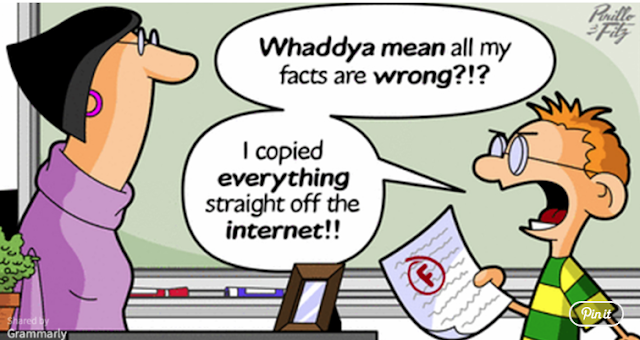
- GRAPHICS are not content - explain and analyze all graphics. Why are using it? What does it show us? If it's data, unpack and analyze, explain, the data.

- Sentences should not start with "that" and never with "which."

- SOURCES DO NOT "talk."

- General reference sources do not count toward the minimum required sources EVEN if they have human authors.

- BETTER DEFINITIONS - the dictionary is the worst way to define something in a research paper. There are ALWAYS better sources for that definition than a dictionary. NO DICTIONARIES!

- NO INFO DUMPS! If you find yourself dumping information, find your topic, figure out your purpose and rework it. No page long paraphrases. Break those up WITH YOUR WRITING. Always Info-exp and info-exp.

- LIST OF ILLUSTRATIONS - cite each visual (you may also want to number them fig. 1 etc.)


THE NEW STUFF FOR PART TWO


As you write and revise and finish

A Sense of Doubt blog post #2445 - GROWTH MINDSET - part one


OVERVIEW


In the conference process in previous quarters, I found myself telling many student writers that early in their drafts that they needed to overview the subject for the reader. What’s the focus? What’s the key research?


Most projects need all the basics of context early on in the paper. The content then sets up the declaration of the project’s purpose.


For instance, in a project about AI, I would need some sense of the basic definition of AI, weak and strong AI, current AI, the Turing test, key individuals in the research and development of AI, and the work going into the future. All of which sets up the student’s argument, which may be that conscious AI is inevitable (or it isn’t).


PERSONAL STATEMENT OF BELIEF


Some essays need a personal statement of belief in the early going, possibly before the overview. For example, if the writer ultimately will be arguing for rights for LBGTQ people that cys-hetero people enjoy, but does not establish the argument right away, then a statement of belief along with a personal connection to the subject matter and relevant experiences will help orient the reader to the rest of the material that follows.


INITIAL purpose or thesis declaration


Regardless of the structure, as explained in the next section, the student writer must establish either the purpose of the project (“this project investigates”) or the thesis (“all people should enjoy the same rights of marital union equally”) at the end of the introductory section. Not the use of the word “section” here and not paragraph.


STRUCTURE

- the whole project is an argument

- delayed thesis-structure - later section is the argument


DEEP AND COMPLEX

How does one achieve this?

https://lemiere102.weebly.com/ethos.html

​Expand with sources by... ​

  • CORROBORATING: You can use multiple sources to say the same thing; as in, they said this thing, and they ALSO said the same thing, so isn't that more convincing?
  • ​COMPLICATING: You can also use multiple, DIVERSE sources (and you should) to look at a thing from various angles before you move along. This means that you deepen what is already on the page. 

Check EACH point to see if you corroborated/complicated and make note if you think a paragraph could use more of one or the other. 


ALSO, GLOBAL PERSPECTIVES can function as a LENSE.


STASIS THEORY


https://prezi.com/2oae7iimd4sq/stasis-theory/


Stasis Theory in Critical Thinking


Argumentful


OPENING

- Do you have the best opening you can have?


- A strong hook in an extended introduction


- appropriate context (overview)


- personal statement of belief if needed


- declaration of purpose or thesis


- STRONG ENDING

https://writingcenter.unc.edu/tips-and-tools/conclusions/

https://writingcenter.fas.harvard.edu/pages/ending-essay-conclusions

https://www.umgc.edu/current-students/learning-resources/writing-center/writing-resources/parts-of-an-essay/conclusions.cfm

TOULMIN ARGUMENT

PROPOSED ARGUMENT: attempting to prove that violent media kindles violent action in the consumer in some cases.


- CLAIM - Your claim (thesis) must appear at the beginning of your argument; if the whole project is an argument, then thesis appears early in the draft; if the project builds to the thesis, make clear where the argument begins.


- WARRANT - The warrant is common ground with your intended audience. Though often Toulmin descriptions suggest that the warrant is implicit, it’s best for our work that you establish the common ground explicitly. See pages 194-195 as well as additional research into “common ground persuasive essays.” 


- REBUTTAL - Have you devoted a section to the opposition’s arguments and have refuted these effectively?


A Sense of Doubt blog post #2366 - ARGUMENTS - Toulmin Model


Toulmin Model for Creating an Argument - Dr. Hanlon


106. The Toulmin Method of Argumentation | THUNK


Toulmin Method - tamuwritingcenter


SIMPSONS LOGICAL FALLACIES

- Colburn Classroom

- 22 video playlist (don't freak 0 they are all short)Links to an external site.

SOME MORE STUFF HERE

A Sense of Doubt blog post #2825 - Counter Argument and Logical Fallacies video via the SIMPSONS (and more)

image.png

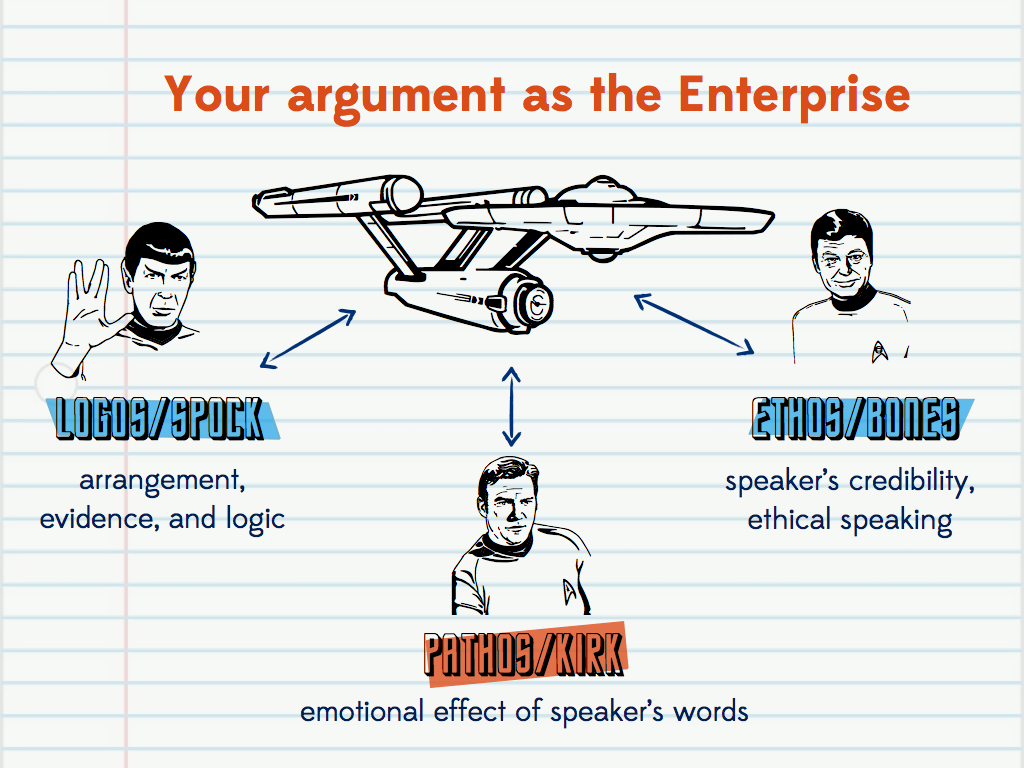
A Sense of Doubt blog post #2823 - Ethos, Pathos, and Logos - The Nature of Writing

A Sense of Doubt blog post #2241 - What's a Rhetorical Decision?

image.png

ON WRITING AN ELEGANCE OF WRITING...

A Sense of Doubt blog post #2221 - 10 Ways to spot bad writing


image.png

BONUS VIDEO - just for fun

A Sense of Doubt blog post #2438 - Your Essay Shows Promise But Suffers from Demonic Possession


peace and love, chris tower

"The vacuum created by the arrival of freedom
And the possibilities it seems to offer,
It’s got nothing to do with you, if one can grasp it."
~ "Up the Hill Backwards" - David Bowie

#DisciplineIsAVehicleForJoy

“Always look on the bright side” - from THE LIFE OF BRIAN
#WritingIsRewriting
"An open mind is a curious mind ready to learn!"


Just for fun, from 2021: (some images from here)

Thursday, February 25, 2021


+++++++++++++++++++++++++++++++++++++++++++++++++++++++++++++++++++++++
+++++++++++++++++++++++++++++++++++++++++++++++++++++++++++++++++++++++
+++++++++++++++++++++++++++++++++++++++++++++++++++++++++++++++++++++++

- Bloggery committed by chris tower - 2306.07 - 10:10

- Days ago = 2896 days ago

- New note - On 1807.06, I ceased daily transmission of my Hey Mom feature after three years of daily conversations. I plan to continue Hey Mom posts at least twice per week but will continue to post the days since ("Days Ago") count on my blog each day. The blog entry numbering in the title has changed to reflect total Sense of Doubt posts since I began the blog on 0705.04, which include Hey Mom posts, Daily Bowie posts, and Sense of Doubt posts. Hey Mom posts will still be numbered sequentially. New Hey Mom posts will use the same format as all the other Hey Mom posts; all other posts will feature this format seen here.

Tuesday, June 6, 2023

A Sense of Doubt blog post #3031 - Things to Keep in Mind when Drafting a Research Project part one

A Sense of Doubt blog post #3031 - Things to Keep in Mind when Drafting a Research Project part one

For now, I am out of my anger phase, purged by yesterday's "Breather" by Afterlife, which seems appropriate.

So, it's time for a series of posts related to my teaching. This one and tomorrow's are posts I created a couple of years ago and have revised several times in my online Canvas shell. The first versions were pre-pandemic. I feel the content may need some re-organizing. Or perhaps, I should just make separate posts for key lessons that expand on the content here and are linked here as this page (like tomorrow's) are good guides to research project writing with a wealth of resources and some solid advice.

Thanks for tuning in.

SUBJECT: ENG102: THINGS TO KEEP IN MIND WHEN DRAFTING

AN IMPORTANT MOTTO: Quote rarely, summarize, sometimes, paraphrase often.


If you have not started already, then it’s time to start writing your research paper, first draft.

The first draft should be as complete as you can make it, though it may be missing a conclusion and an introduction and all your sources may not be annotated.

RESEARCH

It all starts with research. By the time you finish this project, you may not be an expert on your subject, but you will likely know more about it than anyone else in the room.


WORKING BIBLIOGRAPHY - This accumulation of sources begins with the working bibliography. If yours is not now filled with over 36 sources and many notes, then you are far behind the work curve.


FOCUS, TOPICS, AND THESIS


As you research your subject, you are not just accumulating materials to explore information, you are obtaining materials to focus your ideas, organize your subject by topics, and ultimately construct a complex, multi-part thesis that argues your ideas in a rich, deep, and substantial way.


SORT - CATEGORIES


We discussed sorting the working bibliography by lenses, categories, perspectives, types of sources, especially scholarly versus non-scholarly sources and credible sources apart from extra materials that may not be credible but may be needed for your project.


Keywords will be your guide. Examining keywords in results via library search lead to more sources. Dissect source titles, mine key words and abstracts, refine searches, and search again, and again, and again. Group results by category. Make notes. Keep searching.


Examine this (which we will look at again under credibility):


https://lemierecomp.weebly.com/research-new.html


WHAT IS SCHOLARLY?


Searching in the library with the “peer-reviewed. Scholarly” filter checked produces articles from academic journals that qualify. Nothing else qualifies as scholarly.


These may be found via Google Scholar, also, but you may hit a pay wall and in the library you will not.


BALANCE


Though the minimum number of scholarly sources is set at seven, you must still maintain balance. If you have the minimum sources (15) for the project and seven are scholarly, then you have perfect balance, but you may not meet expectations despite meeting the minimum if you project’s subject and your content need more sources to do the job.


If you have twenty-five sources and only seven are scholarly, then you DO NOT have balance. Not that your ratio must be 50-50, but it should be better than 20-80.


Also, issues of credibility. If you have twenty-five sources listed in your works cited, and fifteen are of dubious credibility or lack credibility, then you have the same problem in different clothes.


VARIETY


You should strive to have a variety of sources.


When we ask you to research and find materials both scholarly and popular, we mean mostly published ARTICLES WRITTEN by people with names. It’s even better to have primary sources than secondary. Many journalistic accounts are secondary. The book Radical Evolution is a journalistic account and thus a secondary source, whereas a scholarly publication by Radical Evolution author Joe Bietlizki on his research and studies would be considered primary.

Still, you are encouraged to have other types of sources as well, such as news accounts, books, blogs, interviews, podcasts, videos, Facebook posts, TV cable news reports, and so on. HOWEVER, you must vet your sources carefully. Though there are times to use a Facebook post as it is essential to your subject or use a TV cable news report with a dubious perspective for a specific reason, if you have twenty, non-authored, non-written, non-publication materials, you have missed the boat on credibility, variety, and scholarly requirements.

Likewise, if you list fifteen books and that’s all, you do not have variety, you do not have qualifying scholarly articles, and you may not have credible sources as books are not automatically credible.

CREDIBILITY

Examine this page by Amber Lemiere:


https://lemierecomp.weebly.com/evaluating-credibility.html


You must EVALUATE your sources both in the search process AND in the end as you complete annotated bibliography. Despite the leeway to use the occasional source of dubious credibility for a specific reason (Facebook, Twitter, Fox News), your sources must be credible.


But what do we mean by credible?


Examine the Evaluating Sources section at the link.


PREPPING to DRAFT:


Gathering materials and creating focus is a first step. But do not put all your time into research forsaking writing as the deadline for the rough draft looms. You should have at least eight hours of time into researching and reading sources, but eventually, you may wish to begin writing sections that begin to emerge that you know will probably find their way into your project. At a certain stage in the process the ideal student will start drafting the project while concurrently continuing to research, especially as information needs arise in the writing process. (Page 115 - The Curious Researcher - “Writing in the Middle”)


Let your research guide these early writings. For example, in a paper on queer representation, one might start with the stereotypes, such as the sissy. In fact, in such a project, ultimately all queer representation (LBGTQI) may be too broad and the writer may need to limit scope focusing the majority of content to gay male representation with some tacit nods lesbian, intersex, bisexual, and other queer representations in minor sections that discuss the limits of the project.


Lenses may make good early section: history, sociology, psychology, etc..


In this paper, I know I want to analyze stereotypes (sissy), the closet (repression), heteronormative messages (Will and Grace v. Dawson’s Creek), homophobia, the AIDS crisis, and so on. I can start to write these sections as I research.


I am writing from the MIDDLE OUT. I am not writing the introduction and conclusion yet. I may leave those for last. I am not writing the argument yet, though I am starting to see all the parts of my argument emerge as I write toward a call to action for change and consider the counter arguments of MY INTENDED AUDIENCE.


INDEPENDENT CORROBORATION & WEAVING AND LAYERING


As you write, you need to think about several complex issues, which we have already discussed, such as paragraph structure (PIE), section structure (lenses), flow (transitions), Toulmin or other argument structure (parts - counter arguments especially), and overall project structure: where is the thesis? How is the purpose communicated? Does all the content advance a thesis and end with a call to action? Not all essays need to end with a strong call to immediate action, but they should all end with some forward-looking argument for change: changing how the audience views a thing (argument of clarification), changing how audience understands a thing (argument of interpretation), changing whether an audience will use a thing (argument of evaluation), and so on. Not all arguments are problem-solution and call to action for the solution in nature.


You also need complexity and depth. Start with a core idea, like my example of the stereotype of the sissy. Work with one source as your core and build the content around a single PIE format. Then weave and layer in more materials to corroborate the core source.


It is an outcome expectation for this course that by and large your ideas are supported from multiple, diverse, credible authorities.


Take another example that may work better for my point. I start by arguing that fewer crimes are committed by people with permits to carry concealed weapons than those without such permits. I have a statistic in my core source that only 5% of gun-related crimes in the country were committed by such people since 2015. Can I corroborate this “fact”? Can I find multiple perspectives on that fact? Are there contrasting views? Can I find the truth?

Or back to my sissy stereotype. What have others written about the stereotype? How many examples can I find? What analytical criticisms exist? Are there articles in defense of the stereotype or of movies in which it was used?


I weave in these ideas. I layer and layer more IE-IE-IE repetitions to my base PIE structure. Ultimately, I may have multiple paragraphs. Ultimately, I link these paragraphs together with transitions that advance my thesis. As I write, I begin to see a section develop. I may have multiple paragraphs on various facets of a complex idea. I am using my research. I am using multiple perspectives. I am adding depth to my idea not breadth. And I can see focus emerge. Maybe I need to JUST focus on concealed weapon laws? Or JUST write about the persistence of stereotypes?


If you cannot do this work with your subject, then you have not chosen a good subject as I feared in many cases, though I have approved you all to proceed.

Graphic organizer drawn on white paper. On the left, several bubbles are collectively labeled "The Commons" and include land, water, health care, free speech, knowledge/education, air, and genetic heritage. In the middle, emphasized in red, are bubbles labeled Capitalism. To the right, are empty bubbles collectively labeled Society. Arrows and lines indicate movement between bubbles in all sections.


WHEN THE EXPERTS DISAGREE

https://muse.jhu.edu/article/209433/pdf

https://www.albany.edu/cpr/stewart/Papers/MumpowerStewartExpert-1996cap.pdf


A Sense of Doubt blog post #1955 - Peer-Reviewed Scientific Journals Don't Really Do Their Job


WRITING WITH SOURCES (Blending)

https://courses.lumenlearning.com/waymaker-level1-english/chapter/text-blending-source-material-with-your-own-work/

https://nps.edu/web/gwc/source-blending-paraphrasing-quoting-and-summarizing

https://www.e-education.psu.edu/styleforstudents/c5_p7.html

http://content.nroc.org/DevelopmentalEnglish/unit09/Foundations/blending-source-material-into-an-essay.html


Let’s look at more of these links and think about how we use information.


WORKING WITH INFORMATION


https://lemierecomp.weebly.com/information.html


SIPs AND CITING


https://lemierecomp.weebly.com/sip-format-workshop.html


https://lemierecomp.weebly.com/signal-phrases.html


https://lemierecomp.weebly.com/parentheses.html


RHETORIC - JOURNALISTS


https://lemiere102.weebly.com/week-seven.html


OUR OER TEXTS

These are our required TEXT BOOKS

SAMPLES

Project samples


These directives and notes are a first glance at process and concerns and are incomplete as we may both think of additional items.


Let me know if you have questions as you work through your process.


peace and love,

Chris Tower

your friend in learning

https://sensedoubt.blogspot.com/

It's the same thing here - 

https://sensedoubt.blogspot.com/2020/02/a-sense-of-doubt-blog-post-1828-things.html


+++++++++++++++++++++++++++++++++++++++++++++++++++++++++++++++++++++++
+++++++++++++++++++++++++++++++++++++++++++++++++++++++++++++++++++++++
+++++++++++++++++++++++++++++++++++++++++++++++++++++++++++++++++++++++

- Bloggery committed by chris tower - 2306.06 - 10:10

- Days ago = 2895 days ago

- New note - On 1807.06, I ceased daily transmission of my Hey Mom feature after three years of daily conversations. I plan to continue Hey Mom posts at least twice per week but will continue to post the days since ("Days Ago") count on my blog each day. The blog entry numbering in the title has changed to reflect total Sense of Doubt posts since I began the blog on 0705.04, which include Hey Mom posts, Daily Bowie posts, and Sense of Doubt posts. Hey Mom posts will still be numbered sequentially. New Hey Mom posts will use the same format as all the other Hey Mom posts; all other posts will feature this format seen here.

Monday, June 5, 2023

A Sense of Doubt blog post #3030 - Afterlife - "Breather" - Music Monday for June 5th, 2023


A Sense of Doubt blog post #3030 - Afterlife - "Breather" - Music Monday for June 5th, 2023

Welcome to Music Monday for June 05, 2023 also written as 2306.05.

Music featured today comes from British electronic music producer Stephen Miller, aka Afterlife. Today's song "Breather" appeared on the album Simplicity Two Thousand, released in the year 2000 (duh).

This Afterlife is not to be confused with a metal band called Afterlife or a record label of the same name.

I came across this song the other day listening to a compilation by Phobos while randomly perusing my iTunes catalog.

It's the mood, it's the vibe, it's today's Music Monday song.

Thanks for tuning in.


Subatomic UK


Lyrics
Now I took what I want
But you find it
Everything has gone
Follows to my shadow
You wont follow in my plateau
I look into the sky
You try to catch me
I follow into the sky
You where once there
Now your not there
I went peace
Please
Do you feel me
When you swallow
Catch me down and i am
Breathing...
Breathing...
Scatting
As I swallow
Catch my eye
Seeing places far behind
In your city it fills me up
Clouds are falling to
Yeah I couldnt stop
I couldnt stop
I couldnt stop
Falling...
But i couldnt stop
I couldn't...
I follow shadows
Fill me up
Fill me up
Oh no no
Fill me up
Fill me up
Breathing...
Breathing...

Source: Musixmatch
Songwriters: Erik Wolkoff / Marius Hansen / Rachel Ann Lloyd / Steven Gordon Miller


+++++++++++++++++++++++++++++++++++++++++++++++++++++++++++++++++++++++
+++++++++++++++++++++++++++++++++++++++++++++++++++++++++++++++++++++++
+++++++++++++++++++++++++++++++++++++++++++++++++++++++++++++++++++++++

- Bloggery committed by chris tower - 2306.05 - 10:10

- Days ago = 2894 days ago

- New note - On 1807.06, I ceased daily transmission of my Hey Mom feature after three years of daily conversations. I plan to continue Hey Mom posts at least twice per week but will continue to post the days since ("Days Ago") count on my blog each day. The blog entry numbering in the title has changed to reflect total Sense of Doubt posts since I began the blog on 0705.04, which include Hey Mom posts, Daily Bowie posts, and Sense of Doubt posts. Hey Mom posts will still be numbered sequentially. New Hey Mom posts will use the same format as all the other Hey Mom posts; all other posts will feature this format seen here.

Sunday, June 4, 2023

A Sense of Doubt blog post #3029 - Cover Gallery for Comic Book Sunday June 4th, 2023

BatGirl 66 Elsa Charretier
A Sense of Doubt blog post #3029 - Cover Gallery for Comic Book Sunday June 4th, 2023

Another cover gallery for Comic Book Sunday with a few images that are not covers, like the above, which is a Batgirl image for issue #66 by Love Everlasting artist Elsa Charretier.

I had wanted to write about Supergirl: Being Super, which is an incredible graphic novel, a four-issue series, but that review and send-up will have to wait for another day. I need to get a post up and try to keep close to my established schedule.

Here's a bunch of images that are loitering in my downloads folder (which is not called downloads).


New Captain America that will be written by JMS


+++++++++++++++++++++++++++++++++++++++++++++++++++++++++++++++++++++++
+++++++++++++++++++++++++++++++++++++++++++++++++++++++++++++++++++++++
+++++++++++++++++++++++++++++++++++++++++++++++++++++++++++++++++++++++

- Bloggery committed by chris tower - 2306.04 - 10:10

- Days ago = 2893 days ago

- New note - On 1807.06, I ceased daily transmission of my Hey Mom feature after three years of daily conversations. I plan to continue Hey Mom posts at least twice per week but will continue to post the days since ("Days Ago") count on my blog each day. The blog entry numbering in the title has changed to reflect total Sense of Doubt posts since I began the blog on 0705.04, which include Hey Mom posts, Daily Bowie posts, and Sense of Doubt posts. Hey Mom posts will still be numbered sequentially. New Hey Mom posts will use the same format as all the other Hey Mom posts; all other posts will feature this format seen here.

Saturday, June 3, 2023

A Sense of Doubt blog post #3028 - English Composition Instructional Tip: Organization, Arrangement, Logical Order, Flow, and Transitions


A Sense of Doubt blog post #3028 - English Composition Instructional Tip: Organization, Arrangement, Logical Order, Flow, and Transitions

I have been doing tips of the day for my students while we do conferences and do not have class, and they are revising their projects for the final draft.

I will probably publish all of the tips of the day here eventually, but here's one I am fairly proud of even though I am sure I can think of ways (or receive suggestions) to make it better.

Thanks for tuning in.

Greetings Writers!

Welcome to the fourth consecutive instructional tip of the day. I am aiming to do this for at least a week. I have a week planned so far.

Also, this is a longer one, but tip three was shorter; I am trying to alternate between longer and shorter instruction.

Today's subject concerns Arrangement, Logical Order, and FLOW. 

One achieves FLOW for the most part with transitions.

OUR STRUCTURE

In our English 102 course, we have two basic structures: whole project argument or project with argument section.

WHOLE PROJECT ARGUMENT

This structure may make the most sense to you and be the easiest to achieve because it will seem most familiar: just a longer English 101 essay.

In this structure the thesis appears early in the project. Unlike an English 101 the thesis need not be a single sentence or at the end of the introduction, but it needs to be delivered in the introduction.

Since most if not all arguments boil down to a call to action (solution) and reasons for the change (problems), it makes sense to write a problem-solution style thesis, and then structure based on that thesis, moving from description and details of the problems (reasons for change) and then arguing for the change (call to action/solution[s]).

Unlike English 101, writers of 102 projects rarely confine a single problem (reason for change) to one paragraph backed by a single piece of evidence. In English 102 projects, writers should think of SECTIONS of content that concern a single unit in the outline with multiple paragraphs and multiple sources shared as evidence. In this way, literally dividing the project into sections and labeling these sections can be very helpful to the reader. However, section labels do not serve as transitions by themselves.

PROJECT WITH ARGUMENT SECTION

This structure in which the argument appears later in the essay may be more difficult to compose successfully as the writer will have to justify all the content prior to the argument section in how it serves the argument to come as well as preview in some way the thesis, even if the official thesis appears later in the essay.

The same problems-solutions structure makes sense here, though if this argumentative stance fills the argument section, then previous parts of contextual information have to be clearly tied to the argument and justified for the reader.

COUNTER ARGUMENTS

In both descriptions of argument structures, the counter arguments were not explicitly mentioned as they are best delivered within each topic or argument part.

Thinking back to Toulmin structure of argument: if each section of the project follows a Toulmin pattern, then oppositional arguments and refutation of them will appear in these sections.

PLEASE NOTE

Though explaining the structure of the essay to the reader early on is appreciated for a long research project, beware of narrating your essay as if you are giving a tour. Description of all the parts makes sense in the first couple of pages, transitions linking one idea section to the next are needed, but all must be done describing and linking IDEAS not like driving instructions: "In the next paragraph, we will see..." is not a good form.

ARRANGE LOGICALLY

In most argument essays, writers choose to position the reasons before the call to action because readers will be more likely to accept the argument for change after being convinced of WHY the change must happen.

However, within these sections, one idea must be linked to the next with transitions and one follows the next logically.

Readers such as peers, tutors, instructors, and others may be very helpful in spotting when ideas do not follow one another, especially if asked to read for assessing the order of ideas.

MODES OF ORGANIZATION (from our textbooks)

There are modes of organization as shown in the image below that make obvious sense.

Examine the link for more on moving from thesis to outline to topics and their order:

12.2: Writing for Success- Outlining - LUMEN

Likewise, ancient Greek rhetoric has a system for constructing arguments built from the famous triangle.

Check out the following:

WITH VIDEOS - 12.1: Classical Essay Structure - LUMEN

CHECK YOUR WORK

Finally, in thinking about order and sections of paragraphs, check your work with these handy questions:

Revisiting Body Paragraphs - Write Here, Right Now

AND THE REST OF IT...

Lots of resources follow.

I placed the best and often simplest resources at the top of each list.

Writing well and improving one's writing requires study of writing constructions and how to improve one's writing one feature at a time, such as arrangement and logical order, then flow (transitions).

Have fun!!

ARRANGEMENT AND LOGICAL ORDER


ORDERING INFORMATION IN THE BODY OF THE ESSAY - SUNY Empire State Univ - Saratoga Springs


Organizing an Essay - LUMEN


Organizing an Essay _ English Composition I_ Rhetorical Methods–Based_LUMEN-PDF Version


Organizing_logical-flow-in-writing_ppt_Cuyamaca_edu


Organizing_Ordering your Ideas-Advanced Writing Resource for ESL Students


Organizing_Writing Paragraghs - Academic Writing - Library at Bethlehem College & Seminary


ACHIEVING FLOW

Five Ways to Create FLOW in your writing
Walden University Writing Center
Beth Oyler - 2013

Flow in Scholarly Writing - PURDUE OWL

FLOW - UNC AT CHAPEL HILL

FLOW - UNC at Chapel Hill - PDF version

FLOW - UMASS.edu

FLOW - UMASS.edu - PDF VERSION

The Four Levels of Flow in Writing: What it Means When Writing Flows - Grammar Flip
Julia Lowe - April 2, 2018


Making Your Writing Flow: How to add clarity to your sentences and paragraphs
The University of Arizona Global Campus

What Does “Flow” Mean & How to Achieve It in Your Writing: How to achieve flow in writing by learning to omit unnecessary elements
William Samayoa - The Writing Cooperative - Dec 18, 2020

PDF VERSION: What Does “Flow” Mean & How to Achieve It in Your Writing: How to achieve flow in writing by learning to omit unnecessary elements


TRANSITIONS

Writing Effective Transitions Between Paragraphs pt1 - Monmouth University

Writing Effective Transitions Between Paragraphs pt2 - Monmouth University


+++++++++++++++++++++++++++++++++++++++++++++++++++++++++++++++++++++++
+++++++++++++++++++++++++++++++++++++++++++++++++++++++++++++++++++++++
+++++++++++++++++++++++++++++++++++++++++++++++++++++++++++++++++++++++

- Bloggery committed by chris tower - 2306.03 - 10:10

- Days ago = 2892 days ago

- New note - On 1807.06, I ceased daily transmission of my Hey Mom feature after three years of daily conversations. I plan to continue Hey Mom posts at least twice per week but will continue to post the days since ("Days Ago") count on my blog each day. The blog entry numbering in the title has changed to reflect total Sense of Doubt posts since I began the blog on 0705.04, which include Hey Mom posts, Daily Bowie posts, and Sense of Doubt posts. Hey Mom posts will still be numbered sequentially. New Hey Mom posts will use the same format as all the other Hey Mom posts; all other posts will feature this format seen here.