
I love Annie Dillard.
So, this is sad.
She will be missed.
Thanks for tuning in.
Annie Dillard brought poetry into prose, pioneering a mystical form of creative nonfiction that critics both admired and misunderstood
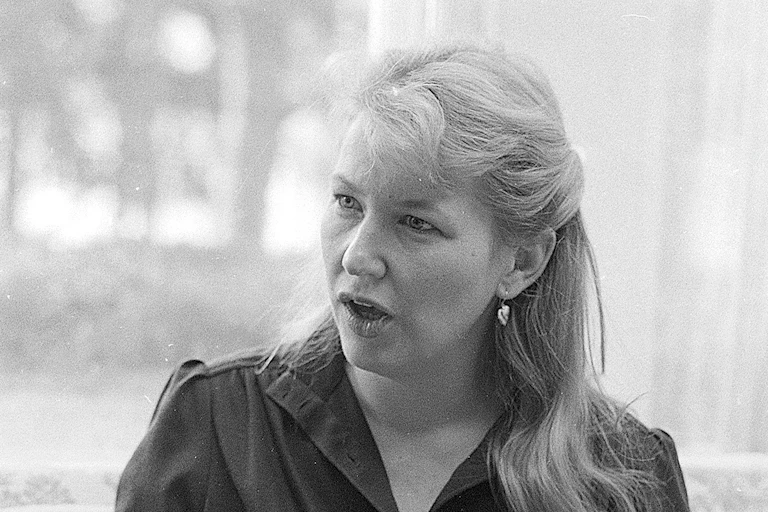
Annie Dillard is rightly celebrated as a pioneer in creative nonfiction after her death on Sep. 15, 2026, at age 81. But the dazzling, disorienting feel of Dillard’s work might be best understood as the often overlooked influence of poetry on her prose.
Dillard published her first full-length work of creative nonfiction, “Pilgrim at Tinker Creek,” when she was only 28. Winning her the 1975 Pulitzer Prize, this early book set the tone for her later work in creative nonfiction: the essay collection “Teaching a Stone to Talk,” and full-length works “Holy the Firm” and “For the Time Being.” They all attend closely to the natural world, with a theologian’s eye and a poet’s idiom.
Dillard’s creative nonfiction about nature owes a debt to the lyrical prose of transcendentalists like Henry David Thoreau, whom Dillard cited as a major influence in her work. She was also overt about the central role that fiction played in her thinking in her book of literary criticism, “Living by Fiction.”
But Dillard’s nonfiction, though undeniably prose, can have “the shape and intensity of a poem,” as her New York Times obituary puts it.
As a writer and writing professor, I think often about how blurred the boundary between poetry and prose really is. Annie Dillard’s work embodies this permeability.
Prose and poetry, in combination
Not all writing is the same. Prose typically features continuous sentences arranged in paragraphs. Poetry tends to be differentiated from prose by a deliberate organization of language that’s not determined by the page itself.
Prose poetry, the lyric essay and other hybrid forms of literature play at the intersection of genre, which usually defines these separate categories of writing. Creative nonfiction likewise aims to accurately convey reality while emphasizing literary style. The literary features of creative nonfiction are often drawn from fiction, with devices such as dialogue, scene and flashback.
But one of the distinctions of Annie Dillard’s nonfiction is how much her prose owes to poetry.

Poetry can be defined in many ways, but it tends to be characterized by honed, heightened language. Poems are often noted for their memorable images, rich sounds and foregrounding of emotion. Dillard’s nonfiction is shot through with images that arrest readers with their beauty or confront readers with their terror – as in her Harper’s essay “The Death of a Moth,” where the insect is drawn to a candle flame, becomes stuck in the wax and is transformed into a burning wick. In Dillard’s words:
“She burned for two hours without changing, without swaying or kneeling – only glowing within, like a building fire glimpsed through silhouetted walls, like a hollow saint, like a flame-faced virgin gone to God, while I read by her light, kindled, while Rimbaud in Paris burnt out his brain in a thousand poems, while night pooled wetly at my feet.”
It’s no accident that Dillard describes herself as reading the work of French poet Arthur Rimbaud by the light of the moth. She previously wrote that she loved how language sounds in French symbolist poetry, and Rimbaud was known to combine prose with his poetry in a way Dillard herself does.
Writing prose as a poet
In “The Writing Life,” Dillard describes the process of writing “a favorite, difficult book” – likely “Holy the Firm” – as akin to writing poetry. She notes that the writing was “so intense and accented, and the world it described was so charged with meaning,” that the idea of going further exhausted her.
To help her write, she read Conrad Aiken’s poetry aloud, describing it as “pure sound unencumbered by sense.” She would read a poetry anthology’s index of first lines because “the parallels sounded strong and suggestive.”
She also describes repeating a single line of Wallace Stevens’ poetry “for hours, like a song” while writing.
Dillard purposefully channeled poetry’s sonic density in her writing process; it comes as no surprise that the heightened register of these poems made its way into her prose.
Inspired by ineffable nature
Dillard’s virtuosic, visionary style isn’t for everyone. Writer Eudora Welty praised Dillard in her review of “Tinker Creek,” but Welty also admitted “not (knowing) what she’s talking about” at times and that her writing “leaves something to be desired.” That something was what Welty called “straight narrative,” the clarity of “point, direction, and shape” more often demanded of prose than poetry. The solitude of the narrator in Dillard’s nonfiction and her apparent disengagement with society also was a source of criticism. As critic William Deresiewicz put it, “There is no economy and no society” in “Tinker Creek.” “We don’t know how Dillard lives, or how she makes a living, or much of anything about her circumstances.” Her mix of cultural disengagement and theological concern smacked to Deresiewicz of “hypocrisy and spiritual snobbery.”
In the contained world of lyric poetry, especially nature poetry, this hermetic perspective would be less of a fault. Her mystical encounters with the divine through the natural world are reminiscent of poets like Gerard Manley Hopkins, Wendell Berry and Mary Oliver. The narrow lens of her attention can be viewed as a poetic feature played out at length over her nonfiction essays and books.
Like an expressionist painting, poetry draws attention to how something is being depicted, not just what is being portrayed. Prose can do this, too – creative nonfiction, especially, and Annie Dillard’s writing most of all.
Annie Dillard, Meditative Author of ‘Pilgrim at Tinker Creek,’ Dies at 81
Her Thoreau-like account of journeys in the woods, published when she was 28, was the first of many ruminations on life and nature, good and evil.
https://www.nytimes.com/2026/09/16/books/annie-dillard-dead.html
Annie Dillard, who as a young American writer walked into
the woods and came out with a Pulitzer Prize-winning book on the wonders and
horrors of creation, the modern classic “Pilgrim at Tinker Creek,” died on
Tuesday at her home in South Wellfleet, Mass. She was 81.
Her death was confirmed by her literary executor, Maggie
Nelson. No further details were given.
With the publication of “Pilgrim at Tinker Creek” in 1974,
Ms. Dillard, just 28, was recognized as a major new voice in American letters.
It was only the beginning of her career: In the years to come, she would
publish essays, meditations on religion, poems, a theory of literature, two
novels, journalism, a best-selling autobiography and another best seller, “The
Writing Life,” about what it takes to put words into a world that has more than
enough of them.
Reviewers of “Tinker Creek” were quick to understand it as a
20th-century analogue to Henry David Thoreau’s “Walden.” This was no
coincidence: Ms. Dillard had chosen Thoreau as the subject of her master’s
thesis at Hollins College (now University), the women’s liberal arts school in
Roanoke, Va.
Like Thoreau, she found an unremarkable body of water to be
as good a place as any for deep thoughts — particularly about how to reconcile
the idea of a benevolent God with nature’s cruelty.
Unlike Thoreau, Ms. Dillard didn’t build a cabin in the
woods and live there through the seasons of a year. Though her writing could
convey the sense of a solitary life in the wilderness, she was mostly a
day-tripper. After her forays into the Roanoke Valley of the Blue Ridge
Mountains — which was, after all, her neighborhood — she would return home to
the suburban house she shared with Richard Dillard, a creative writing
instructor she had married at the end of her sophomore year at Hollins.

That she was a photogenic young woman coming to grips with
raw nature — a business that had been almost exclusively the province of men
with beards — was undeniably part of the Dillard mystique. So was her
insistence that, in spite of her patient, unflinching observations on flora and
fauna, she wasn’t a nature writer, but rather a theologian looking high and low
for God.
Among the many things she saw at Tinker Creek was a little
green frog, half out of the water, “deflating like a football” before her eyes.
It was in the clutches of a giant water bug whose bite had liquefied the frog’s
innards. Such encounters could cause “nightmares that plunder rest and force me
face down all night long in some muddy ditch seething with hatching insects and
crustaceans,” she wrote.
“But if I can bear the nights, the days are a pleasure,” she
added. “I walk out; I see something, some event that otherwise would have been
utterly missed and lost; or something sees me, some enormous power brushes me
with its clean wing, and I resound like a beaten bell.”
“Tinker Creek” won the Pulitzer for general nonfiction in 1975, and Ms. Dillard was overwhelmed by requests for speeches, interviews and television appearances. Her looks were thought by many media outlets to be as newsworthy as her writing — so much so that she was ridiculed in some circles as “Cheesecake at Tinker Creek.”
Repelled by the consequences of her success, she moved to Washington State and began dividing her time between the city of Bellingham and the islands Waldron and Lummi. Her marriage to Mr. Dillard had ended in amicable divorce, and in the Pacific Northwest, she found privacy enough to regain the concentration essential to her work.
“The Cascade Range, in these high latitudes, backs almost into the water,” she wrote. “There is only a narrow strip, an afterthought of foothills and farms sixty miles wide, between the snowy mountains and the sea.”
She added: “If the Greeks had looked at Mt. Baker all day, their large and honest art would have broken, and they would have gone fishing, as these people do.”
The Problem of Evil
Those lines are from the first fruit of her relocation, “Holy the Firm,” published in 1977, a three-part metaphysical tour de force in 76 pages honed almost to the shape and intensity of a poem. It took 14 months of full-time work, by her account, in a one-room house as “plain as a skull,” her only companions a cat and a spider.
“Nothing is going to happen in this book,” she writes.
“There is only a little violence here and there in the language, at the corner
where eternity clips time.”
But by that point, she has already told an excruciating
account of a moth that gets stuck in the molten wax of a candle and itself
becomes a wick that burns for two hours. Just ahead is the story of a
7-year-old girl she calls Julie Norwich, who gets safely to ground after her
father’s light plane clips a line of fir trees on takeoff, only to have her
face burned off by a splurt of hot fuel.
Which brings Ms. Dillard once more head-to-head with a
question known to religious thinkers as the problem of evil: Could it possibly
be that a loving, all-powerful God allows bad things to happen just to make
goodness stand out in sharper relief?
Ms. Dillard’s years in Washington inspired some of the
essays in her celebrated collection “Teaching a Stone to Talk” (1982).
Its jewel was “Total Eclipse,” which in 2000 was included in “The Best American Essays of the Century,” not long after “Pilgrim at Tinker Creek” appeared on the Modern Library’s list of the 100 best nonfiction books.
On the morning of Feb. 26, 1979, Ms. Dillard and her second
husband, the anthropologist Gary Clevidence, sat atop a 500-foot-tall hill in
the orchard country of the Yakima Valley to view an eclipse. They put on
welder’s goggles. When the show began, Ms. Dillard experienced something like a
psychedelic trip, minus the acid. The light was all wrong. The grass was
platinum. Her hands were silver.
“The hillside,” she wrote, “was a nineteenth-century tinted
photograph from which the tints had faded.”
The first of Ms. Dillard’s two novels grew out of her
Washington sojourn as well: Published in 1992, “The Living,” a 19th-century
pioneer saga, centered on what became Whatcom County.
All the while, she had been teaching classes at Western
Washington State College (now Western Washington University). In an account
written by Paul Lindholdt, a former student working on a critical biography of
Ms. Dillard, she came across as a chain-smoking force of nature: “She
was by turns disorganized and inspiring, prickly and brilliant. She required
her students to foot-stomp aloud the meter of favorite poems, including ‘God’s
Grandeur’ by Gerard Manley Hopkins.”
Though she had once said that she might remain in the
Northwest, she and Mr. Clevidence moved east in 1979, and from then until 2001
she taught at Wesleyan University in Middletown, Conn.
Pittsburgh-Born
Annie Dillard was born Meta Ann Doak on April 30, 1945, in
Pittsburgh. Her father, Frank Doak, was an executive with the American Standard
corporation and a great-grandson of the founder; her mother, Pam Lambert Doak,
was known as a platinum-haired wit with a taste for modernist furniture and a
passion for liberal causes.
In “An American Childhood” (1987), an autobiography, Ms.
Dillard recalls her young self as a serious reader, an explorer who was allowed
to roam freely as soon as she could recite her phone number, and a roughneck
who played football with the boys.
As a teenager, she later wrote, “I would give my heart to
one oddball boy after another — to older boys, to prep-school boys no one knew,
to him who refused to go to college, to him who was a hood, and all of them
wonderfully skinny.”
She was suspended from school for smoking. She unfairly
blamed her parents for everything that was wrong with North America. And when
it came time for college, she went to Hollins on the recommendation of her high
school principal, who thought the place might smooth her “rough edges.” She
went on to earn bachelor’s and master’s degrees there, in 1967 and ’68.
Ms. Dillard and Mr. Clevidence divorced in 1988, and Ms.
Dillard married Robert D. Richardson Jr., whom she met after sending him a fan
letter about his book “Henry Thoreau: A Life of the Mind.”
Mr. Richardson died
in 2020. Ms. Dillard’s survivors include a child from her second marriage,
Cody-Rose Clevidence; four stepdaughters, Carin Clevidence, Shelly Clevidence,
Anne Richardson and Lissa Richardson; and two sisters, Amy Fields and Molly
Simonds.
Ms. Dillard’s first book was a collection of poems, “Tickets
for a Prayer Wheel,” published a few months before “Tinker Creek.” Her later
books included the journalistic “Encounters with Chinese Writers” (1984); “The
Writing Life” (1989), which offered, instead of tips, reflections that amounted
to “a spiritual Funk and Wagnalls,” in the words of one reviewer; “For the Time
Being” (1999), which included a series of essays exploring what it means to be
human; and her second novel, “The Maytrees” (2007), an uncharacteristically
warm story of love set in postwar Provincetown, Mass., at the tip of Cape Cod.
It was the last book she wrote.
Ms. Dillard’s papers are held at the Beinecke Library at
Yale University, where Diana Saverin, a researcher and Dillard fan, went
through them and reported on her findings for The Atlantic in 2015. Of
particular interest were the journals in which Ms. Dillard talked herself
through the fear that no one would read a book like “Tinker Creek” because it
was written by a woman.
“It’s impossible to imagine another situation where you
can’t write a book ’cause you weren’t born with a penis,” Ms. Dillard wrote.
“Except maybe ‘My Life With My Penis.’”
And Then Silence
Ms. Dillard was not immune to criticism. She took heat for
fictionalizing part of “Tinker Creek,” which was billed as nonfiction —
specifically the opening scene, about a fighting tomcat that smeared blood on
her. It turned out to be a story she had borrowed with permission from a
graduate student.
More generally, some readers who admired her bravery and
virtuosity faulted her for leaving out what Thoreau had included: a sense of
connection to the world most people live in. No news of the Vietnam War,
Watergate or the energy crisis ever reached Tinker Creek. Writing about the
book in The New York Times, Eudora Welty — herself a Pulitzer winner for her
novel “The Optimist’s Daughter” — observed
that Ms. Dillard was “the only person in her book, substantially the only one
in her world.”
Ms. Welty added, “Speaking of the universe very often, she
is yet self-surrounded, and, beyond that, book-surrounded.”
Forty-two years later, in a sweeping appraisal of her work,
the author and critic William Deresiewicz noted in The Atlantic that “Dillard,
like Thoreau, is never shy about pronouncing wholesale condemnation on the way
her fellows live.” He thought that the alternative she represented smacked of
spiritual snobbery and hypocrisy — a mystical way of life for the few who could
afford it; like, for instance, the daughter of a wealthy family who became a
success before she turned 30.
Mr. Deresiewicz’s article was occasioned by publication of
“The Abundance: Narrative Essays Old and New” (2016), in which the only “new”
thing was 11 years old. Ms. Dillard had, by then, been silent for nine years,
since “The Maytrees.”
She was last photographed in public in 2014, when she went
to the White House to receive the National Humanities Medal from President
Barack Obama for her “profound reflections on human life and nature.”

Her website told readers, “I can no longer travel, can’t meet with strangers, can’t sign books.” It stated her religion as “none” — she had been a Protestant and then a Roman Catholic and then neither — but acknowledged her connection to Christianity and Hasidism. She spent recent years at her Cape Cod home, painting.
She had written with all her might, and had tried to light the same fire in others. Amid the pyrotechnics of “Holy the Firm,” she told the following story of a day in her classroom.
“How many of you, I asked the people in my class, which of you want to give your lives and be writers?” she wrote. “I was trembling from coffee, or cigarettes, or the closeness of faces all around me … All hands rose to the question. (You, Nick? Will you? You, Margaret? Randy? Why do I want them to mean it?)”
She added: “And then I tried to tell them what the choice must mean: You can’t be anything else. You must go at your life with a broadax.”
+++++++++++++++++++++++++++++++++++++++++++++++++++++++++++++++++++++++
+++++++++++++++++++++++++++++++++++++++++++++++++++++++++++++++++++++++
+++++++++++++++++++++++++++++++++++++++++++++++++++++++++++++++++++++++
- New note - On 1807.06, I ceased daily transmission of my Hey Mom feature after three years of daily conversations. I post Hey Mom blog entries on special occasions. I post the days since ("Days Ago") count on my blog each day, and now I have a second count for Days since my Dad died on August 28, 2024. I am now in the same time zone as Google! So, when I post at 10:10 a.m. PDT to coincide with the time of Mom's death, I am now actually posting late, so it's really 1:10 p.m. EDT. But I will continue to use the time stamp of 10:10 a.m. to remember the time of her death and sometimes 13:40 EDT for the time of Dad's death. The blog entry numbering in the title has changed to reflect total Sense of Doubt posts since I began the blog on 0705.04, which include Hey Mom posts, Daily Bowie posts, and Sense of Doubt posts. Hey Mom posts will still be numbered sequentially. New Hey Mom posts will use the same format as all the other Hey Mom posts; all other posts will feature this format seen here.


No comments:
Post a Comment